April 2026 New Vehicle Sales

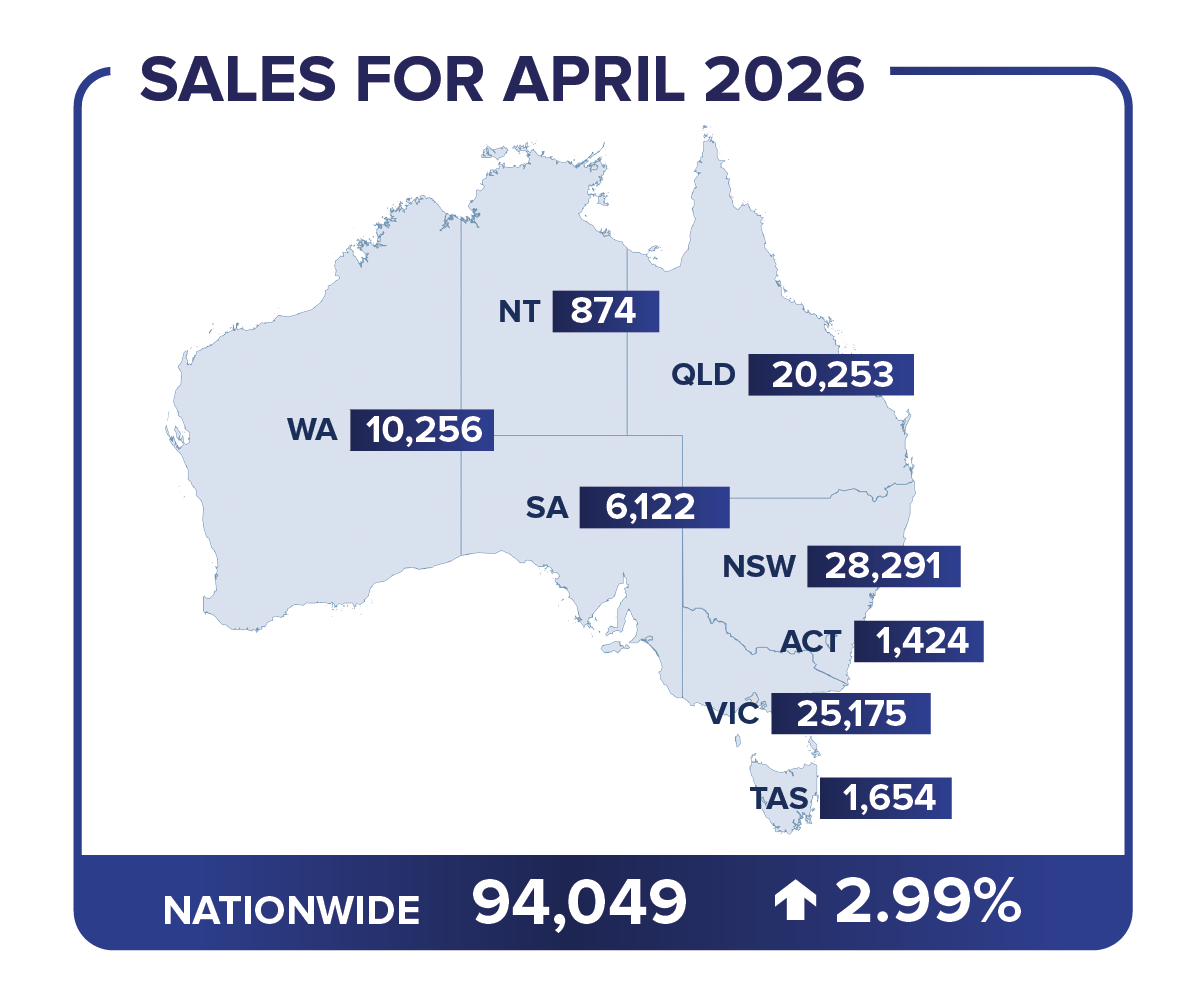
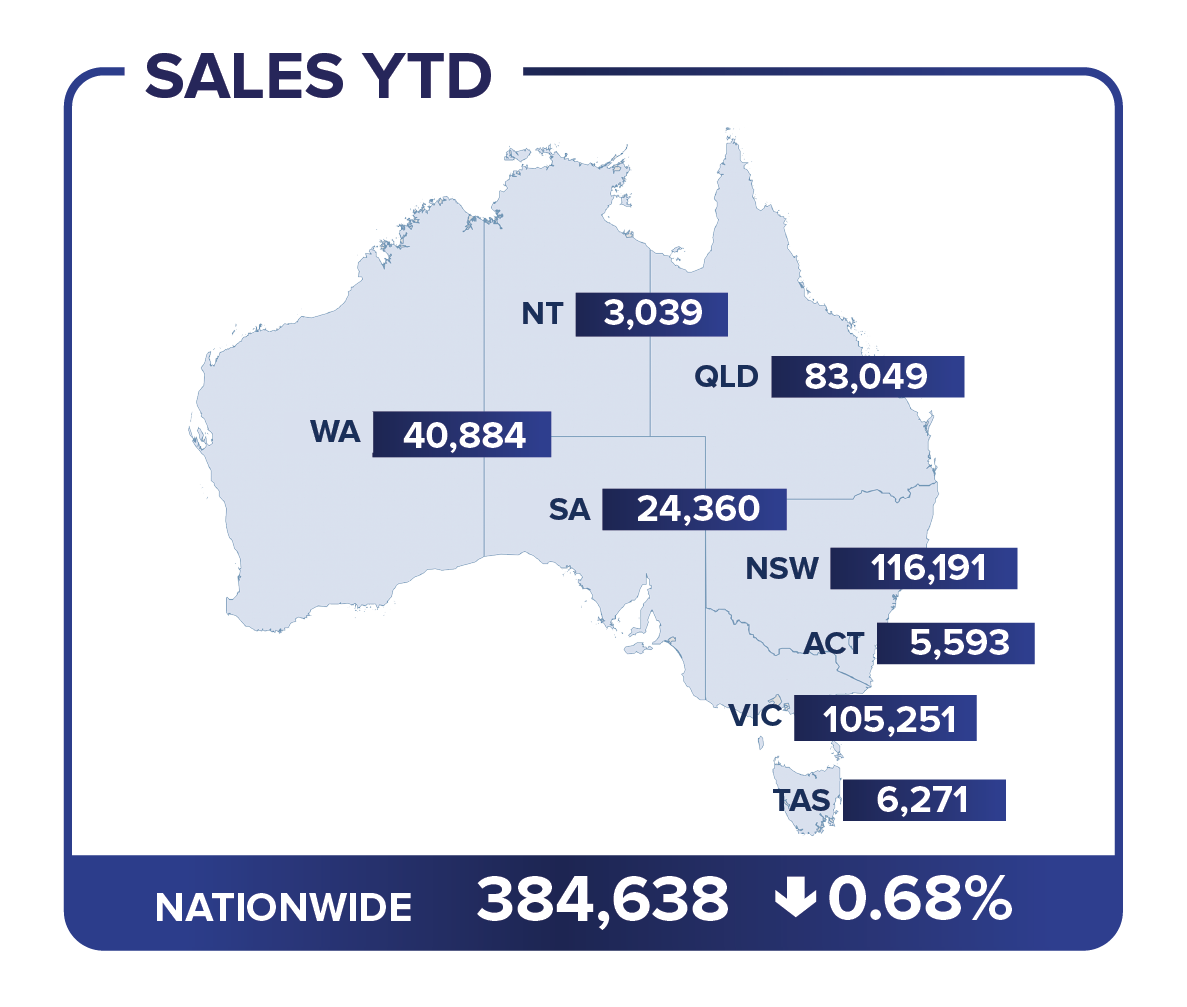
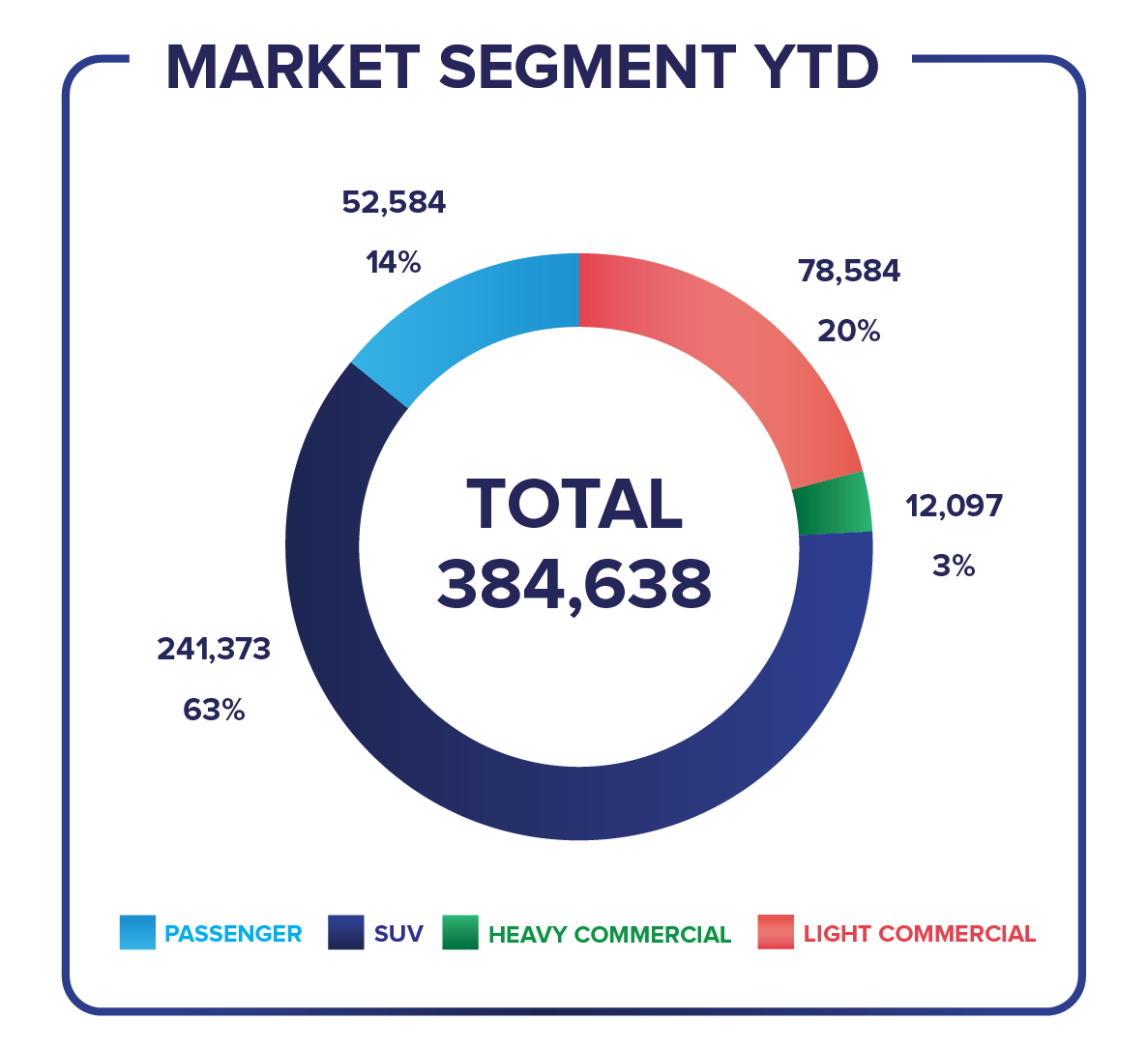
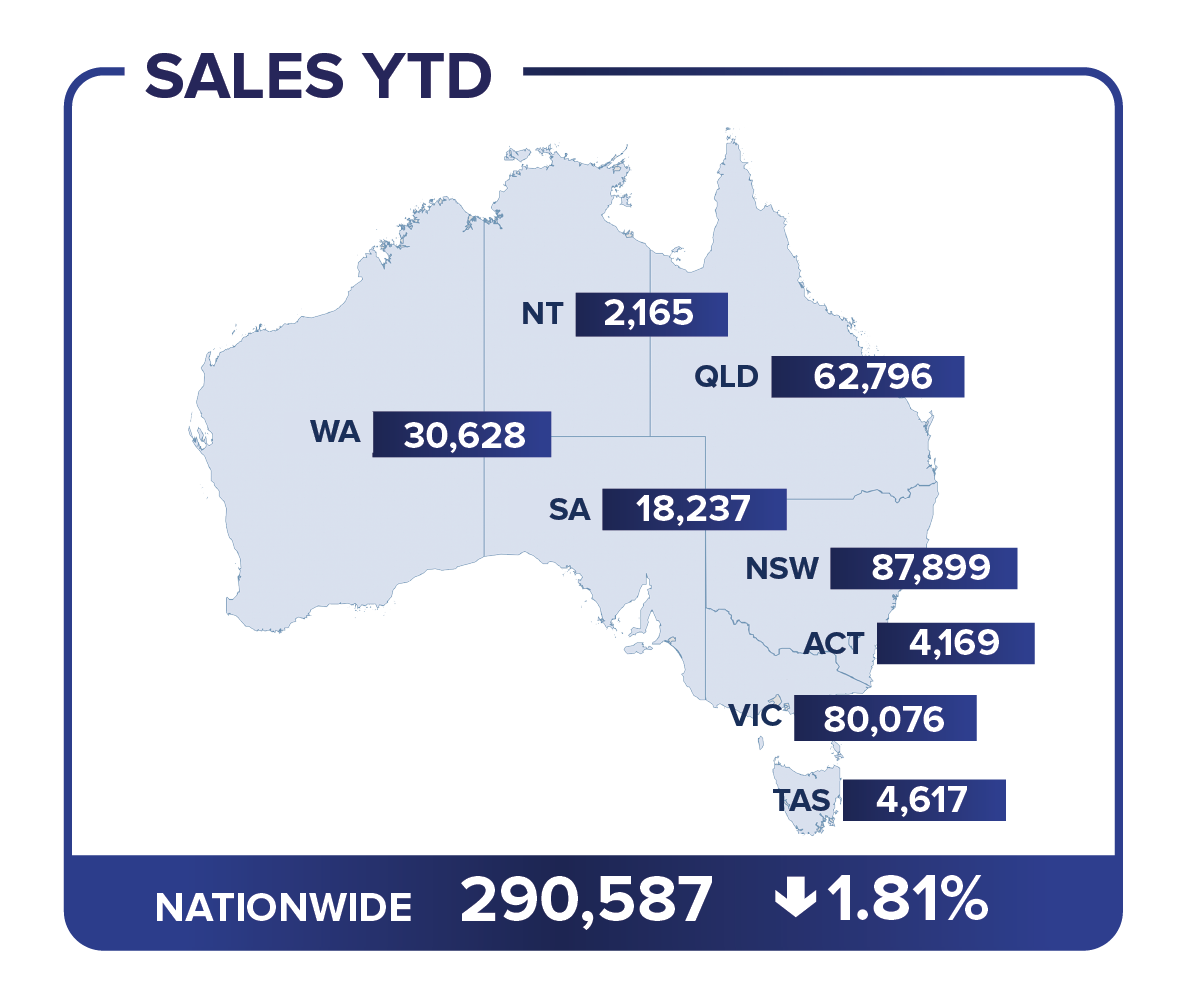
April new cars in Australia totalled 94,049 units, up 2.99 per cent, compared to same time last year. Year to date, sales declined by 0.68 per cent to 384,638 units.

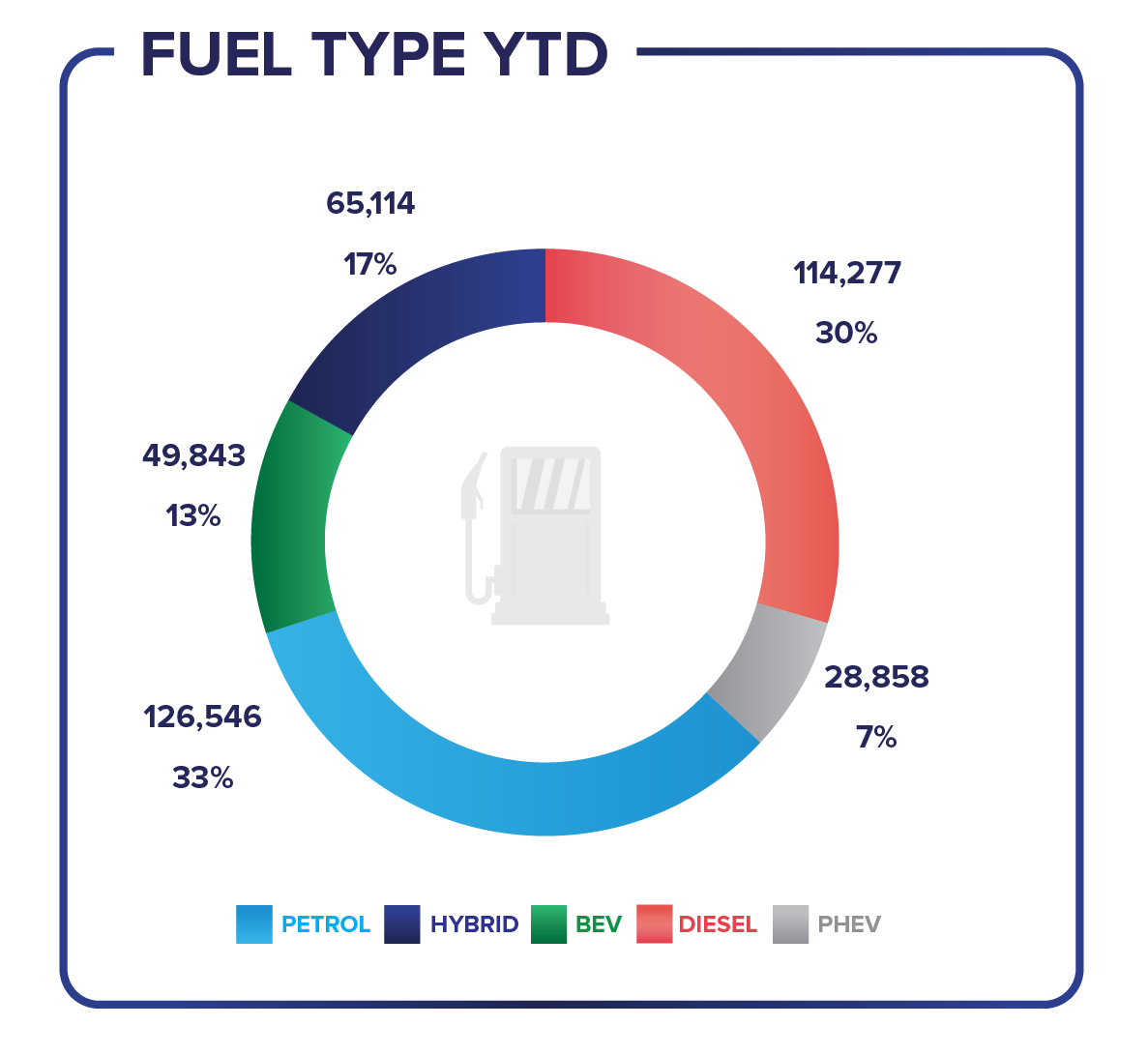
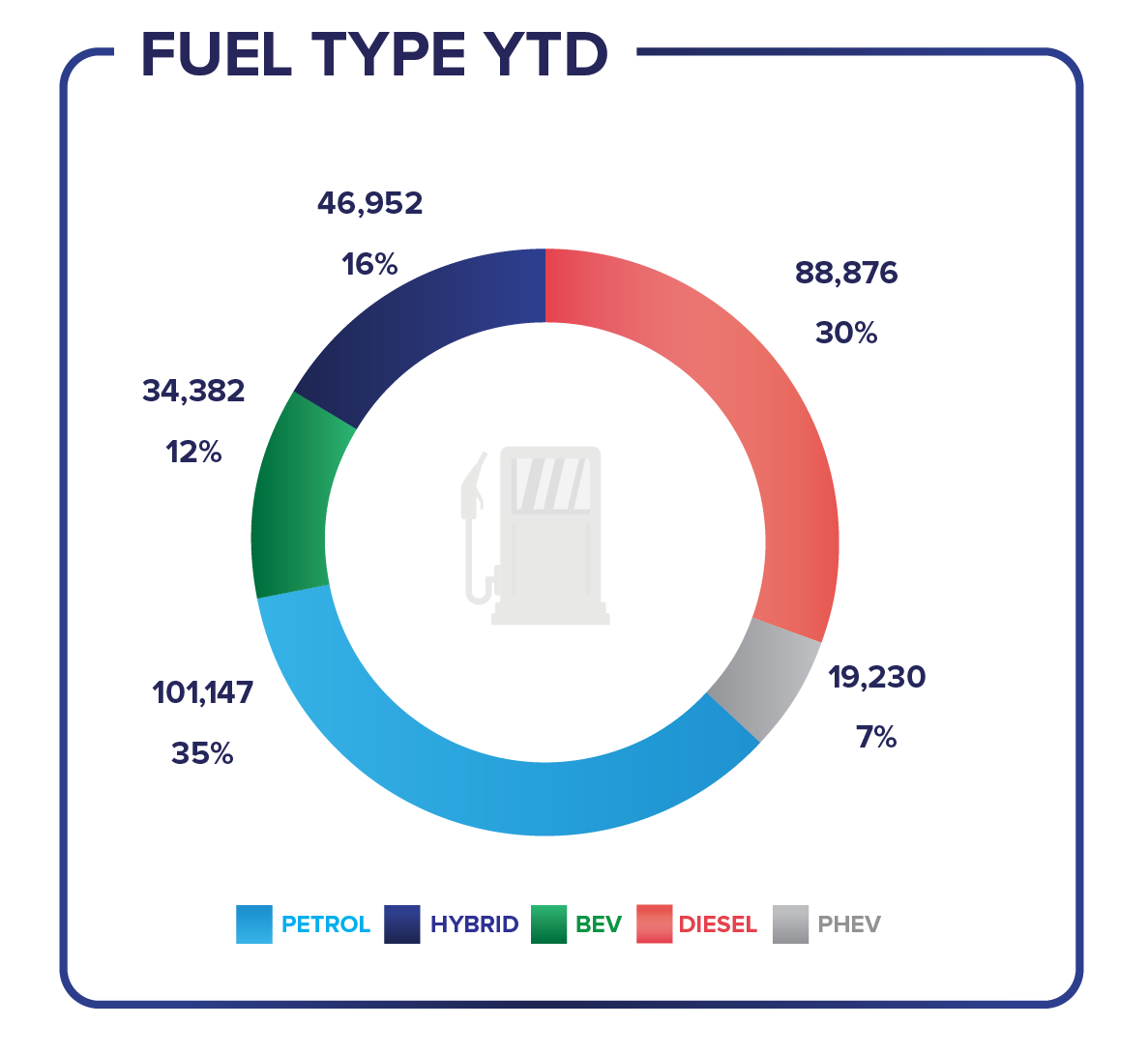
The share of battery electric vehicles rose to 16.4 per cent of total sales in April, as buyers continue to shift toward low-emissions vehicles amid ongoing fuel price pressures.

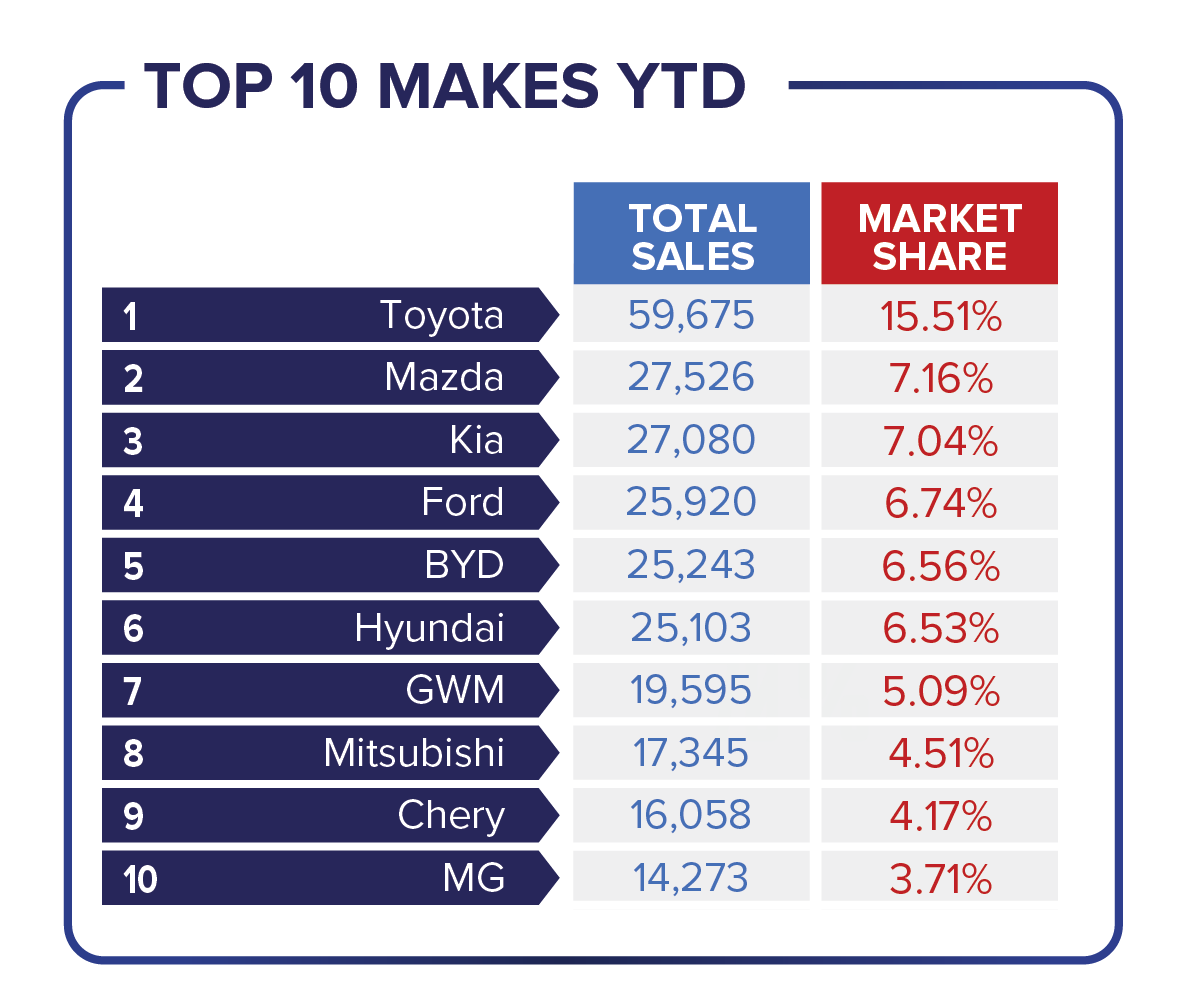
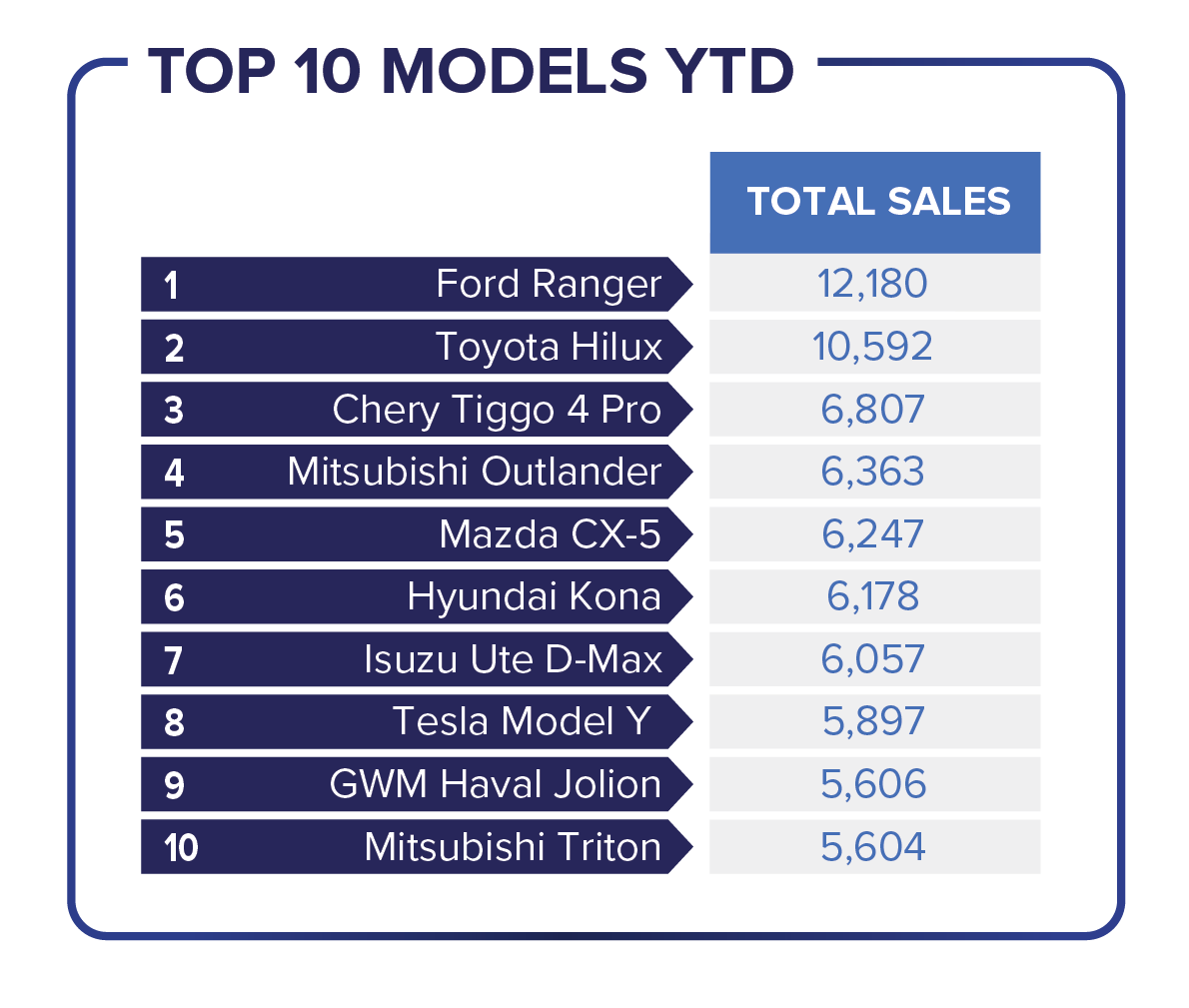
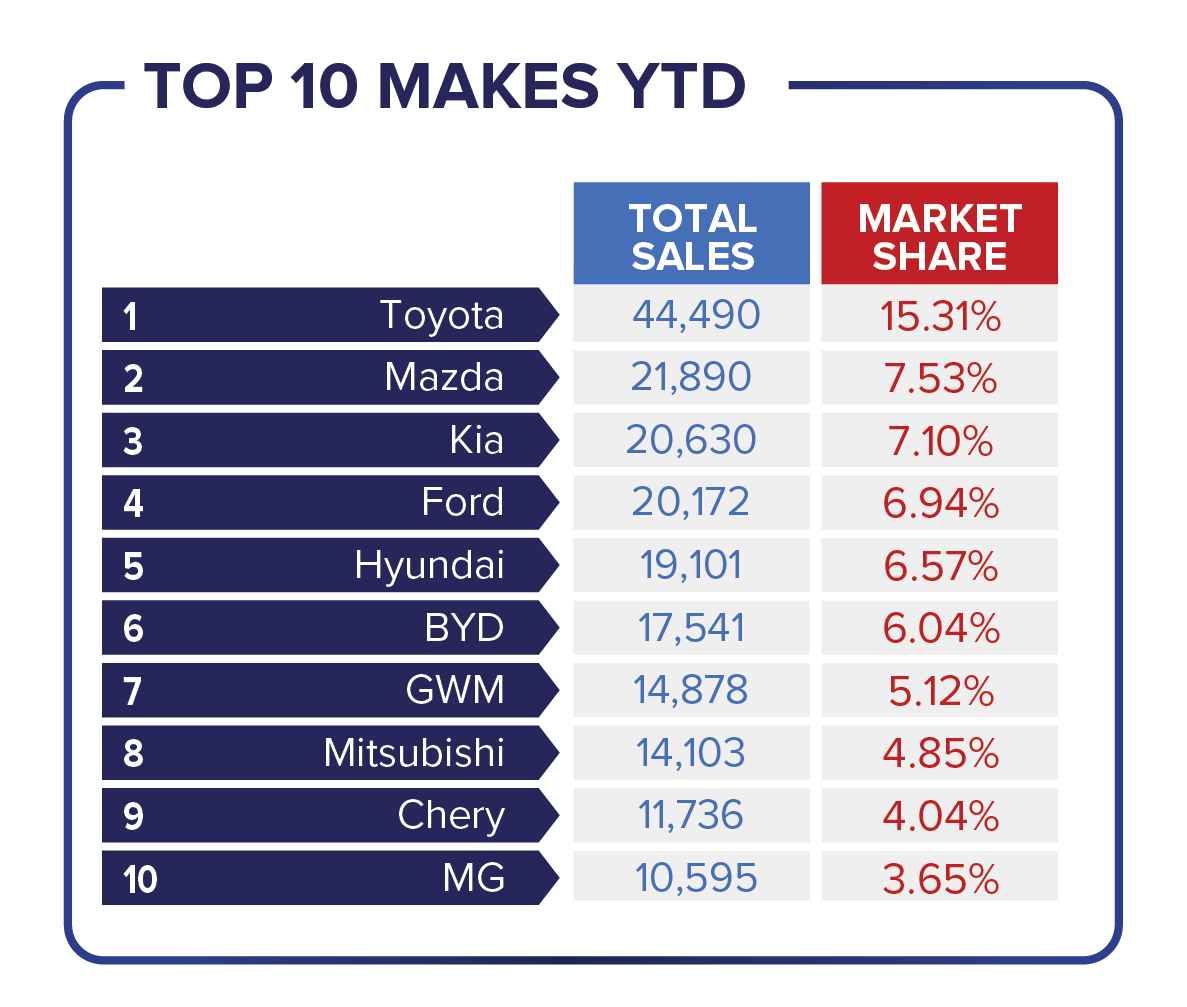
While Toyota retained its position as market leader with 15,185 sales in April, Chinese car brands maintained a strong presence, with four of the top 10 sellers for the month again being Chinese marques: BYD in second, GWM in seventh, Chery in eighth and MG in ninth.

SUVs continue to be the preferred vehicle type, accounting for over 60 per cent of total sales. Across the regions, New South Wales recorded the highest sales volume in April with 28,291 units sold, followed by Victoria (with 25,175 units) and Queensland (20,253 units).

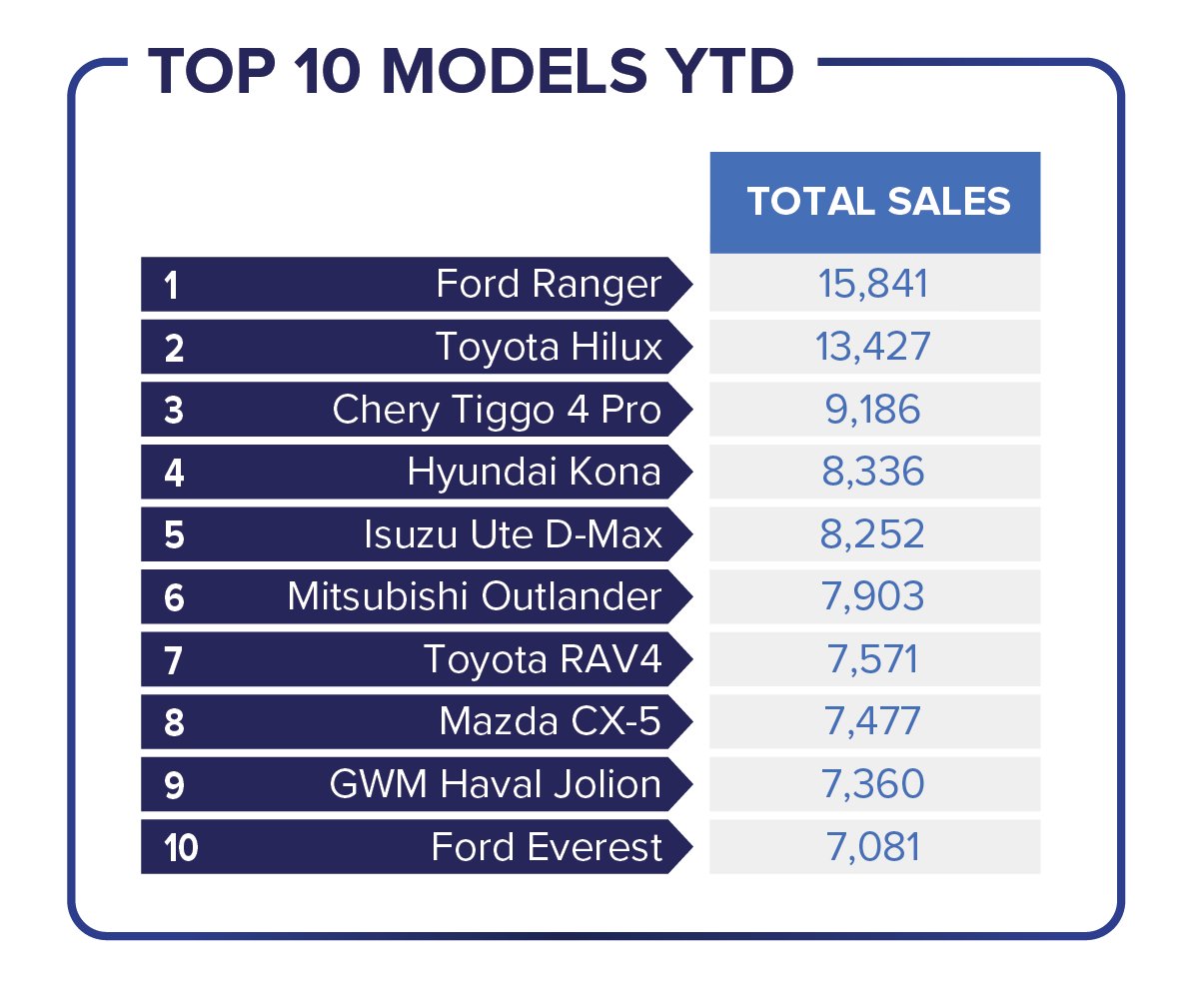
*The AADA has reviewed year-to-date VFACTS and EVC data, ranking vehicles by volume, and continues to analyse new vehicle sales by state, fuel type and market segments to monitor trends shaping the Australian market.

March 2026 New Vehicle Sales

The Australian Automotive Dealer Association (AADA) says March 2026 new vehicle sales data highlights a clear shift in consumer preferences, with rising fuel prices accelerating demand for electric vehicles. 

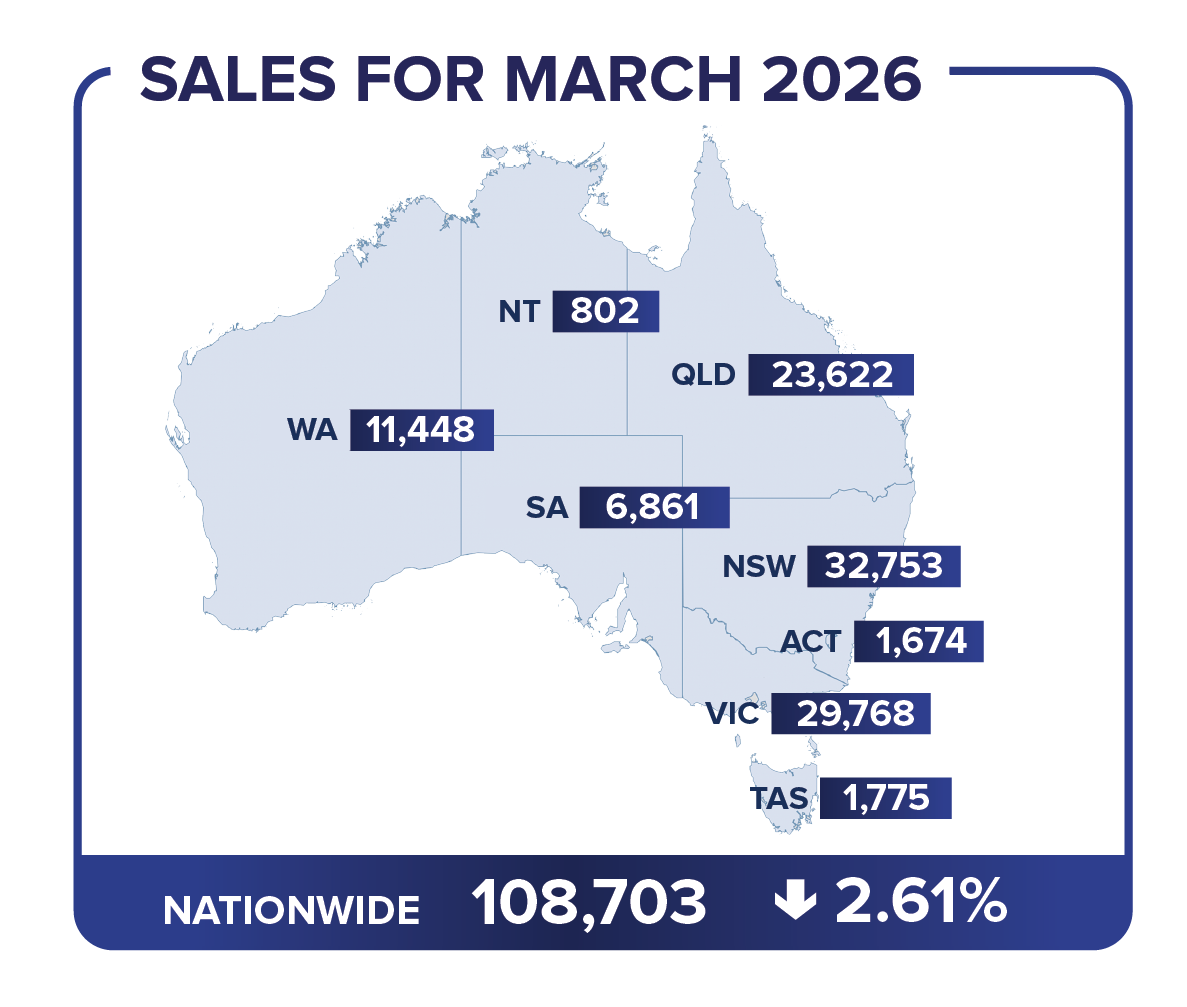
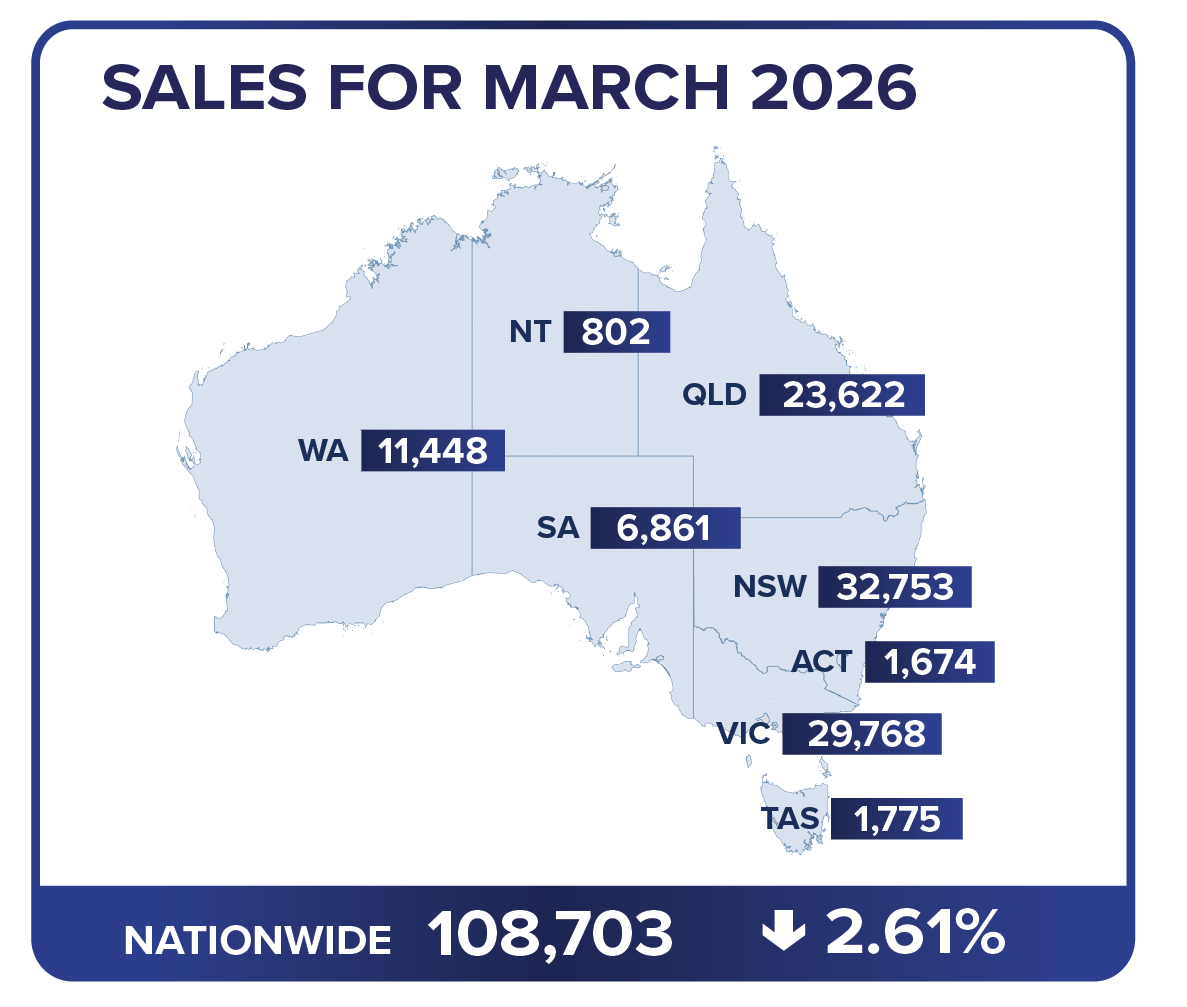
New vehicle sales totalled 108,703 vehicles in March, representing a decrease of 2.61 per cent compared to February 2026 and 1.81 per cent decrease YTD compared to the same period in 2025. 

Battery Electric Vehicle sales reached 15,839 units in March, up 42 per cent month-on-month and 92 per cent year-on-year, accounting for 12 per cent of total new vehicle sales so far this year.

Plug-in Hybrid Electric Vehicle sales reached 8,215 units in March, up 40 per cent month-on-month and 40 per cent year-on-year, accounting for 7 per cent of total new vehicle sales for 2026.

Additionally, China’s market share continues to increase, and Australia is now a leading market for the Chinese automotive industry.

“The AADA is seeing a clear shift in consumer preferences this month, with many buyers who may have previously been on the fence now choosing to buy an electric vehicle,” said James Voortman, CEO of the AADA. 

“Rising fuel prices have brought forward decisions for a lot of consumers, particularly those weighing up the long-term running costs of their next vehicle.” 

“The key question now is whether this is the beginning of a more sustained shift in the market, something we will only know in the coming months.” 

“What this month’s sales figures prove is that it will be Australian consumers that dictate the pace of the transition.” 

“It is now more important than ever to purchase a vehicle from an authorised new car dealer given the large number of automotive brands selling new cars in Australia, and the wide range of vehicles available for sale with state-of-the-art technology.” 

“Dealers have been embedded in their local communities for decades, helping Australians find the vehicle that best suits their individual needs. They are also there to ensure these cars are safely maintained and that warranty, consumer law and recall obligations are upheld.” 

*The AADA has reviewed year-to-date VFACTS and EVC data, ranking vehicles by volume, and continues to analyse new vehicle sales by state, fuel type and market segments to monitor trends shaping the Australian market. 
New Vehicle Sales February 2026

February new car sales show a slight dip to 94,131 units, down 2.67 per cent, compared to same time last year. Year to date, sales declined by 1.33 percent to 181,884 units.

With over 22,000 vehicles sold, China has officially surpassed Japan to become Australia’s largest supplier of new vehicles, breaking a 28-year record, driven by competitive pricing, technology, and design.

New South Wales recorded the highest volume with 28,589 sales, followed by Victoria (25,907) and Queensland (20,305).

Toyota remains the market leader in February with 13,606 sales, followed by Mazda (7,042), Ford (6,907) and Kia(6,710). Evolving consumer preferences are becoming increasingly evident, with battery electric vehicles accounting for over 11 per cent of total sales for the month.

The AADA has assessed VFACTS and EVC Top 10 Makes and Models year-to-date, ranking them by volume, and continues to analyse new vehicle sales by state, fuel type and market segment to track trends shaping the Australian market.

New Vehicle Sales 2025

New vehicle sales for December 2025 and the full calendar year were released this week by the Federal Chamber of Automotive Industries and the Electric Vehicle Council.

New car sales in 2025 edged higher than the previous year, reaching 1,241,037 vehicles sold, representing a 0.3 per cent increase year-on-year.

While December sales were broadly consistent with the same period last year, 2025 still recorded a new annual sales record, defying earlier forecasts of a slowdown amid ongoing cost pressures and intense market competition.

Toyota retained its position as Australia’s leading automotive brand in 2025, recording 239,863 sales and a market share of 19.3 per cent. Ford and Mazda followed in second and third positions, while Kia and Hyundai rounded out the top five. Notably, Chinese-manufactured brands continued to strengthen their presence, with GWM, BYD and MG all featuring in the top ten, highlighting the growing influence of Chinese OEMs in the Australian market.
In terms of fuel types, consumers increasingly turned to electrified options. Plug-in hybrid electric vehicle (PHEV) sales more than doubled year-on-year, seeing a 130 per cent increase and making PHEVs one of the fastest growing segments from 2025. Battery electric vehicles (BEVs) also increased their share, reaching approximately 9 per cent of the market in 2025, while hybrid vehicle sales continued their upward trend, growing from 172,699 in 2024 to 199,133 vehicles in 2025. This reflects a gradual shift in buyer behaviour as more electrified models become available across a wider range of price points and segments.

SUVs and light commercial vehicles continued to dominate consumer preferences, together accounting for almost 74 per cent of total new vehicle sales for the year.

As the industry adjusts to evolving emissions policy settings and intensifying competition, particularly from new market entrants, 2026 is expected to remain a challenging year for dealers and manufacturers alike.

New Vehicle Sales November 2025

November new car sales recorded a slight decline, falling by 1.77 per cent to 99,906 units compared to same time last year. Year to date, sales have inched up by 0.17 per cent on the same period in 2024.

Petrol vehicle sales were down by 18.1 per cent on November 2024, as electrified vehicles continue to gain momentum.

PHEVs sales surged to 4,768 units (up 83.3 per cent on last year), with more buyers opting for lower-emitting vehicles that deliver everyday practicality without range anxiety.

Toyota remains market leader with 19,787 sales, followed by Ford (7,407), Mazda (6,979) and Hyundai (6,707). Once again, SUVs are the most preferred vehicle segment accounting for just over 60 per cent of total new car sales.

The AADA has assessed VFACTs and EVC Top 10 Makes & Models YTD, ranking them by volume. The AADA has also analysed new vehicle sales figures by state for the month of November, as well as fuel types and market segments.

New Vehicle Sales June 2025

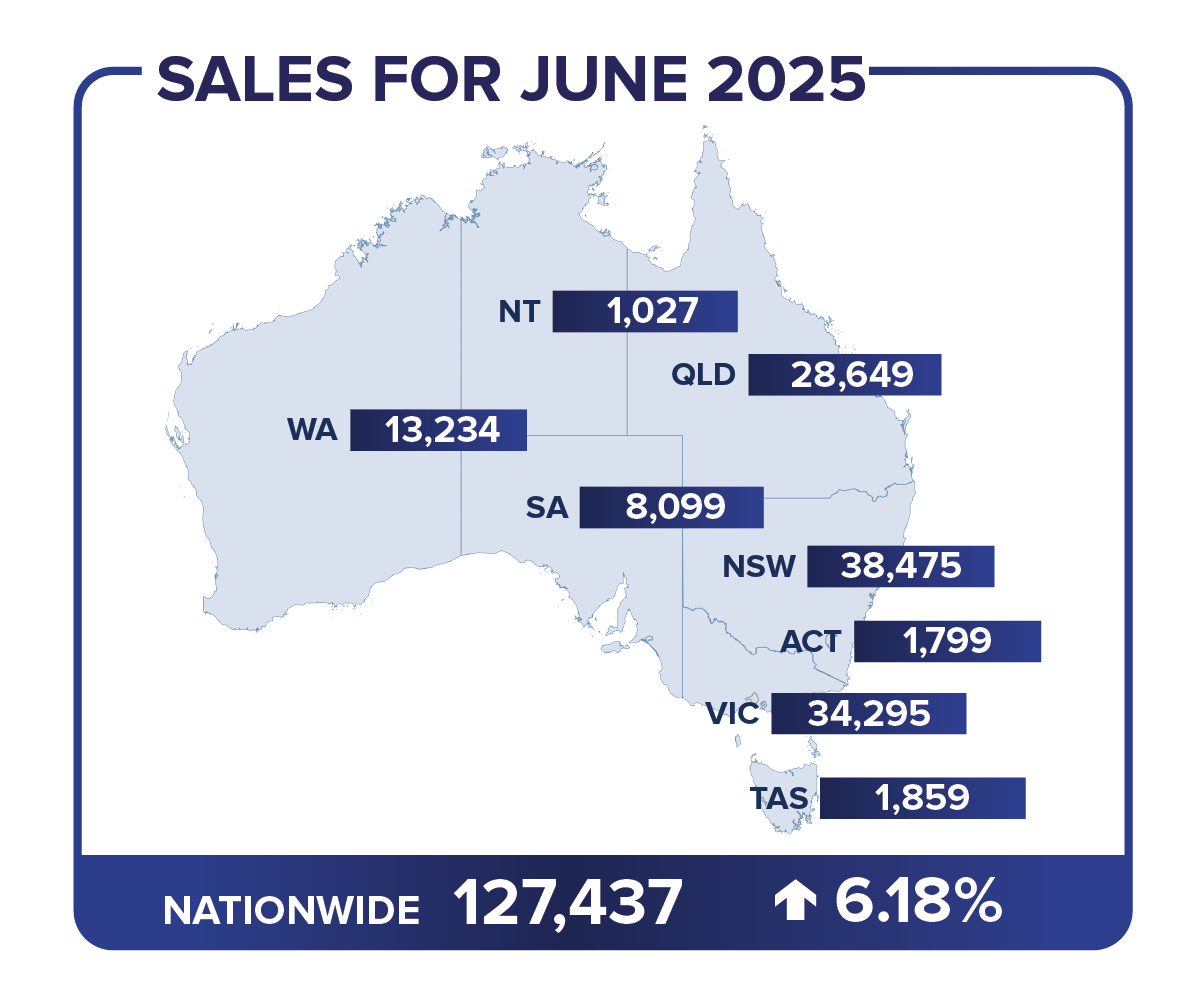
New car sales in Australia increased by 6.18 per cent in June compared to the same month last year, potentially driven by consumers taking advantage of end-of-financial-year discounts. Year to date, sales remain down by 1.42 per cent on the same period in 2024.

Key highlights include:

➡️ Chinese brand BYD continues to grow in popularity, recording a dramatic 367.9 per cent increase in sales, with 8,156 units sold in June 2025 compared to 1743 in June 2024.

➡️ Utes and SUVs once again dominated buyer preferences, taking all ten spots in the list of top-selling new vehicles.

➡️ While Chinese carmakers are on the rise, Toyota remains the market leader, selling 20,225 vehicles in June, reflecting continued brand loyalty in Australia. Toyota was followed by Ford (10,103 units) and Mazda (9,405 units).

The AADA has assessed VFACTs and EVC Top 10 Makes & Models YTD, ranking them by volume. The AADA has also analysed new vehicle sales figures by state for the month of June, as well as fuel types and market segments. 

New Vehicle Sales May 2025

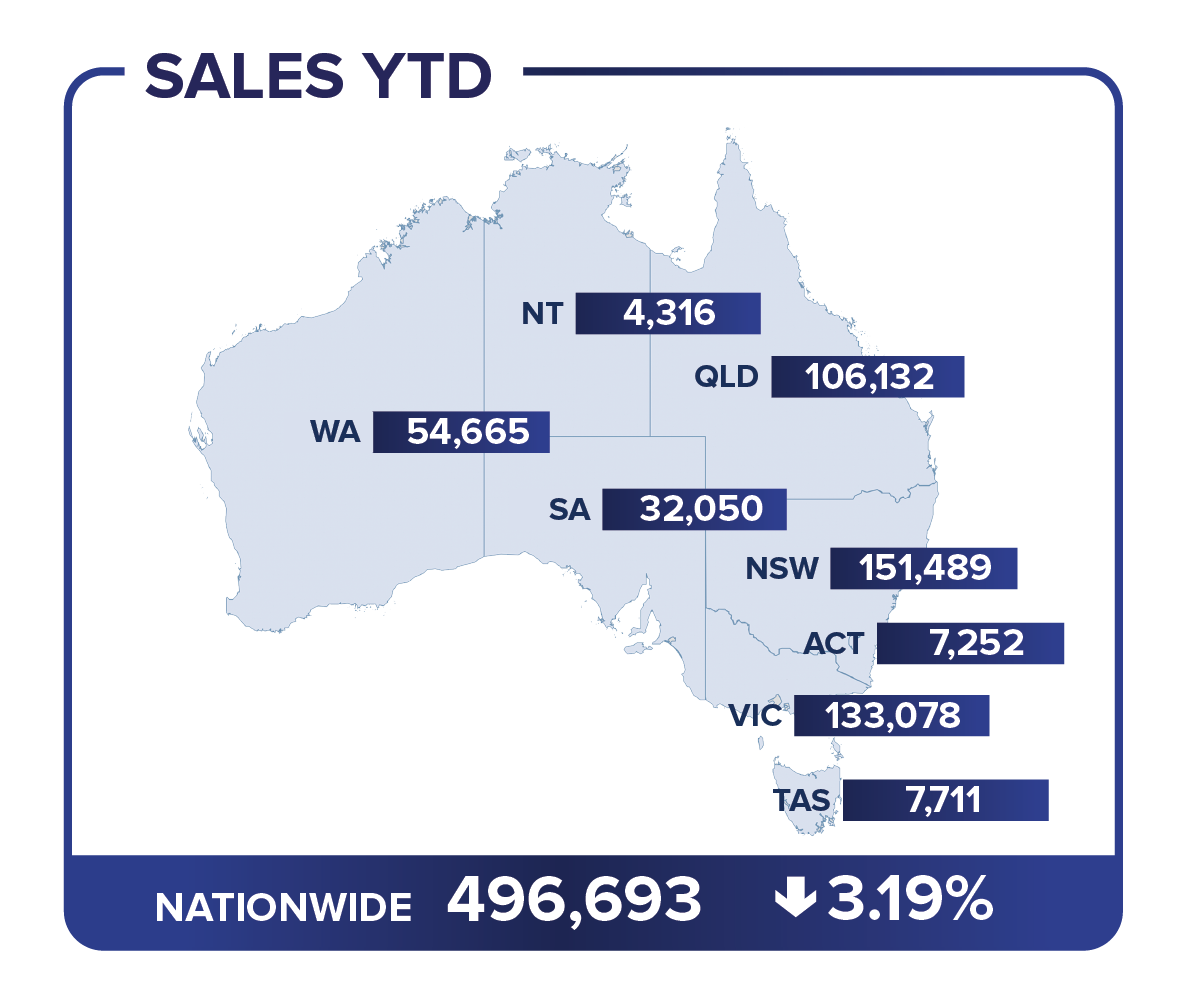
New vehicle sales in May 2025 fell by 1.64 per cent compared to May 2024, continuing the year’s downward trend with a 3.19 per cent decline year-to-date.

Key Market Highlights:

➡️ Chinese manufacturers now hold 15.6 per cent of new vehicle sales in 2025, with GWM and MG sitting in the top 10. Chery and BYD have seen strong growth with 245 per cent and 94 per cent growth year on year respectively, reflecting the increasing competitiveness of these brands across both value and electric segments.

➡️ There are no passenger cars in the top 10 models YTD and the Toyota Corolla was the only traditional passenger car to make the top 20 models list for the month. In contrast, SUVs dominate the YTD figures, holding down 7 of the top 10 spots, joined by 3 utes, reinforcing Australia’s preference for high-riding and utility vehicles.

➡️ Electrified vehicles account for 27 per cent of new vehicle sales when you combine BEV, hybrid and PHEV sales for 2025 so far.

The AADA has assessed VFACTs and EVC Top 10 Makes & Models YTD, ranking them by volume. The AADA has also analysed new vehicle sales figures by state for the month of May, as well as fuel types and market segments. 

February AIR

The February 2025 edition of the Automotive Insights Report (AIR) shows a modest rebound in used car sales. Using data supplied by AutoGrab, February’s AIR saw sales rise 2.2 per cent to 174,762 units, however this came as total listings declined slightly indicating a tightening in some areas.

“While the increase in sales is a positive shift from January, the broader market remains in a state of adjustment,” said AADA CEO James Voortman.

“With supply contracting and demand still below historical levels, it remains a competitive market for sellers,” he said.

“Average days to sell a used vehicle remained stable at 48.5 days, suggesting that vehicles are still moving at a steady pace, albeit with some regional fluctuations,” said Mr Voortman.

The Suzuki Jimny continued its dominance in retained value rankings, holding the highest resale value among passenger cars and SUVs in both age brackets. With an impressive 108 per cent retained value, the Jimny has consistently outperformed larger and more expensive competitors, reflecting its strong demand in the market.

Ford Ranger retained its position as Australia’s best-selling used car, with a 2.5 per cent increase in sales. Toyota models continued to dominate the top-sellers list, with five of the top ten positions.

Highlights from the AIR for February 2025

  • 174,762 used cars were sold, an increase of 2.2 per cent from January.
  • Used vehicle supply fell by 1.8 per cent, with most states experiencing a drop in listings.
  • Sales increased in major markets, with VIC (7.0 per cent) and NSW (3.8 per cent) leading the gains.
  • Electric vehicle sales rebounded, up 11.4 per cent, though retained values remain under pressure.
  • Average days to sell a used car held steady at 48.5 days.
  • Japanese brands dominated, taking 8 of the top 10 best-selling models, with Toyota accounting for 5.

AIR: End of Year Used Car Market Brings More Opportunities to Buyers

The December edition of the Automotive Insight Report (AIR) shows that the used car market observed a 3.8% drop in supply after months of oversupply, with listings falling to 322,532. However, the market continues to favour buyers with sales observing a significant decline of 8.1% to 181,724, offering consumers ample opportunity to strike a good deal during the festive period.

“Average days to sell have increased to 48.7, the highest since October, suggests that sellers are dealing with slower moving stock. This trend is expected to continue in 2025 as the growing oversupply of new vehicles creates a spillover effect into the used car market,” said AADA CEO James Voortman.

“All states but Northern Territory and Western Australia experienced a fall in the number of cars listed for sale,” he said.

Retained values remain on the downward trajectory, with almost every vehicle segment across every age category experiencing a drop in value for the month, with the exception of LCV-Utes in the 2-5 year age categories. Oversupply of new vehicles is negatively impacting retained values for used EVs as well, potentially prompting sellers to hold on to their vehicles for shorter periods of time.

“Average days to sell a used EV have returned to August levels, with Western Australia and South Australia experiencing increased demand, as reflected in a 19.8% and 10.7% rise in EV sales, respectively,” said Mr Voortman.

In the passenger segment, the Ford Mustang holds value best at 97.0% in the 2-4 year age category while the Toyota Yaris maintains top spot at 97.5% in the 5-7 year age category. In the SUV category, the Suzuki Jimny continues to hold top spot at 110.7% in the 2-4 year but is replaced by the Toyota Landcruiser in the 5-7 year old category at 87.9%.

HIGHLIGHTS FROM THE AIR FOR DECEMBER

  • 181,724 vehicles were sold in December, a decline of 8.1% compared to the previous month.
  • Northern Territory and Western Australia were the only two states experiencing a jump in listings by 7.5% and 0.5% respectively.
  • 322,532 used cars were listed for sale in December, a decline of 3.8% from the previous month.
  • All but Western Australia and South Australia experienced a decline in used EV sales.
  • Average time to sell a used car has gone up to 48.7 days.
  • Every vehicle segment across every age category experienced a drop in retained value for the month, with the exception of LCV-Utes in the 2-5 year age categories.
  • The Ford Ranger remains Australia’s best-selling used car, followed by the Toyota Hilux. 
  • In EVs, MG MG4 regained its position as the best-selling vehicle.

VFACTS December 2024

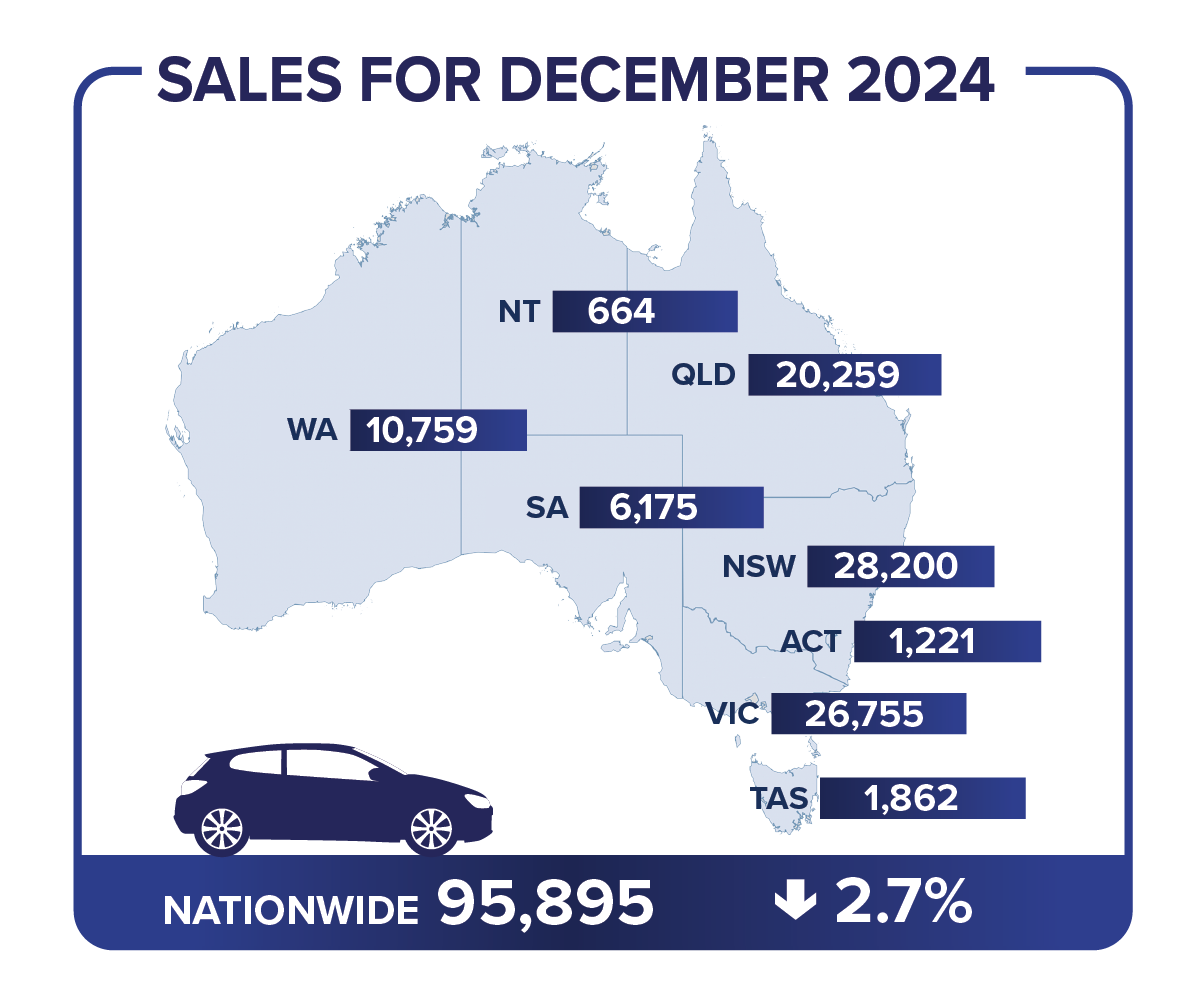
VFACTS for December 2024 and the full calendar year were released this week by the Federal Chamber of Automotive Industries.

New car sales in 2024 surpassed the previous record set in 2023, observing a 0.3% increase to 1,220,607 sales. While rising cost-of-living pressures led to a 2.7% drop in December 2024 sales compared to the same time last year, the overall growth for the year could be attributed to the influx of more affordable Chinese vehicles into the market.

Toyota retained its top spot for 2024, selling 241,296 cars. Despite the arrival of new makes, Toyota remains the most popular car brand for the year, increasing its market share from 17.7% in 2023 to 19.8% in 2024. The top four brands remained unchanged, with Ford (100,170), Mazda (95,987), and Kia (81,787) following Toyota’s lead. Meanwhile, Hyundai was replaced by Mitsubishi in fifth place with 74,547 sales.

While Battery Electric Vehicles (excluding Tesla and Polestar sales from July 2024) recorded a decline in sales by 14.5% compared to 2023, consumers are increasingly opting for fuel efficient vehicles with sale of hybrid vehicles rising by 76% to 172,696 units sold in 2024.

Across vehicle types, consumers continue to hold a strong preference for SUV and light commercial vehicles, collectively representing around 79% of total sales.

With the New Vehicle Efficiency Standard (NVES) commencing this month, 2025 is expected to be a challenging year for the industry as Dealers and OEMs respond to the changing policy environment while continuing to maintain business viability.

The AADA has assessed VFACTs Top 10 Makes & Models YTD, ranking them by volume. The AADA has also analysed new car sales figures by state for both the month of December and YTD, as well as fuel types and market segments.