Electrified Vehicles Buck the Trend as Used Car Sales Fall

Key Headlines

  1. Australia’s used vehicle market recorded 1.3 million sales in the first half of 2026, down 6.6 per cent compared with the first half of 2025.
  2. Year-on-year sales declines widened over the half, with June recording the largest decline of the year to date with sales falling 16.2 per cent compared to June 2025.
  3. Used electric vehicles and plug-in hybrids bucked the broader trend, with EV sales up 54.6 per cent and PHEV sales up 468.4 per cent year-on-year.
  4. The rate of discounting held broadly flat through Q1, then rose from April.
  5. Every State and Territory sold fewer used vehicles in the first half of 2026 than in the equivalent period in 2025. The sales decline was concentrated in passenger cars, with SUVs and Utes recording smaller falls.

1. Market Snapshot

Australia’s used vehicle market softened through the first half of 2026 as buyers were presented with greater choice and increasing negotiating power.
New data from the Australian Automotive Dealer Association (AADA) and AutoGrab shows 1,300,018 used vehicles were sold nationally during the first six months of the year, down 6.6 per cent compared with the same period in 2025.

While overall sales declined, supply continued to build throughout the half, resulting in slower selling times and increased discounting as sellers competed for buyers.
The year-on-year rate of decline widened over the half rather than holding steady. January was still growing year-on-year. By June, sales were down 16.2 per cent on the same month in 2025, the largest monthly decline of the half.

2. Greater Competition Drives Discounting

The balance between supply and demand shifted noticeably during the first half of the year, with listed stock increasing while sales softened.

By June, more than half of all one to five-year-old used vehicles sold had their asking price reduced before sale, while the average discount widened to 3.7 per cent, the largest discount recorded this year.

Petrol and diesel vehicles experienced the greatest increase in discounting, while hybrids remained the most pricing-resilient fuel type throughout the first half.

3. Electrified Vehicles Continue to Gain Momentum

While the broader used vehicle market slowed, demand for electrified vehicles continued to strengthen with EV, PHEV and hybrid sales combining for 7.1 per cent of the market.

Used EV sales increased 54.6 per cent year-on-year during the first half, while PHEV sales rose 468.4 per cent from a relatively small base.

EVs also sold significantly faster as the year progressed, with average days to sell falling from more than 60 days in January to fewer than 40 days by June.

4. Reaction

“The used vehicle market has become increasingly competitive during the first half of 2026. Buyers have more choice than they’ve had for some time, and dealers are responding to that environment through more competitive pricing and discounting,” said AADA CEO James Voortman.

“While overall sales have softened compared with last year, it’s encouraging to see continued growth in used electric vehicles and plug-in hybrids as more Australians consider lower-emission vehicles in the second-hand market,” said Mr Voortman.

“Year-on-year sales declines widened over the half, with June recording the largest decline of the year to date. Every State and Territory sold fewer used vehicles in the half of 2026 than in the equivalent period in 2025. And the sales decline was concentrated in passenger cars, with SUVs and Utes recording smaller falls,” said AutoGrab Chief Commercial Officer Saxon Odgers.

“By June, more than half of all one-to-five-year-old vehicles were selling below their asking price, and the average discount had widened to 3.7 per cent. In that environment, accurate and current pricing is the difference between a car that sells and one that sits. Petrol and diesel are carrying most of the pressure, while hybrids have held their value best.”

“Electrified vehicles are the clear exception. Used EV sales rose 54.6 per cent and sold faster as the year progressed, with average days to sell falling from over 60 in January to under 40 by June. The volume growth is now well established in the Australian market,” said Mr Odgers.
June 2026 New Vehicle Sales

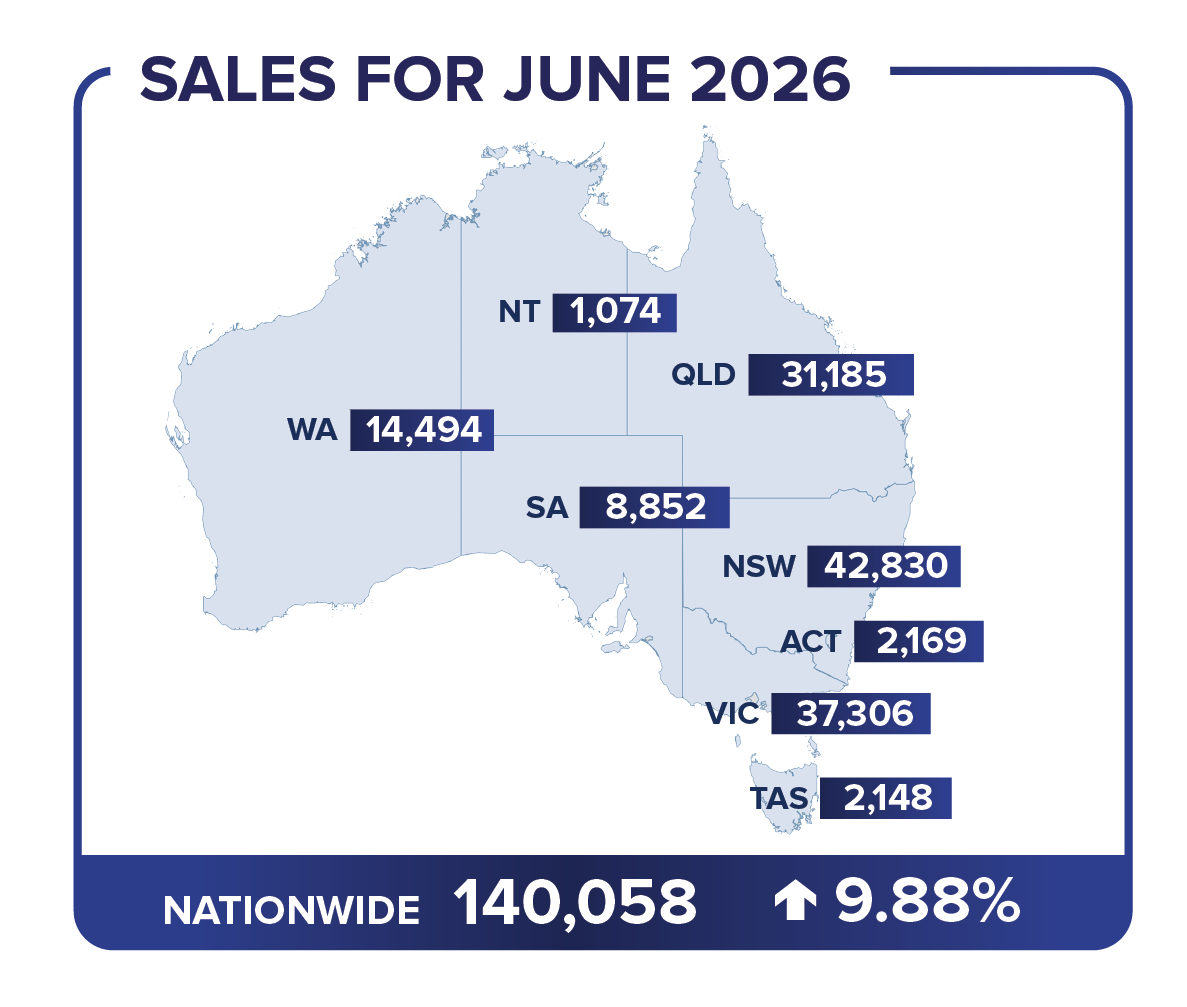
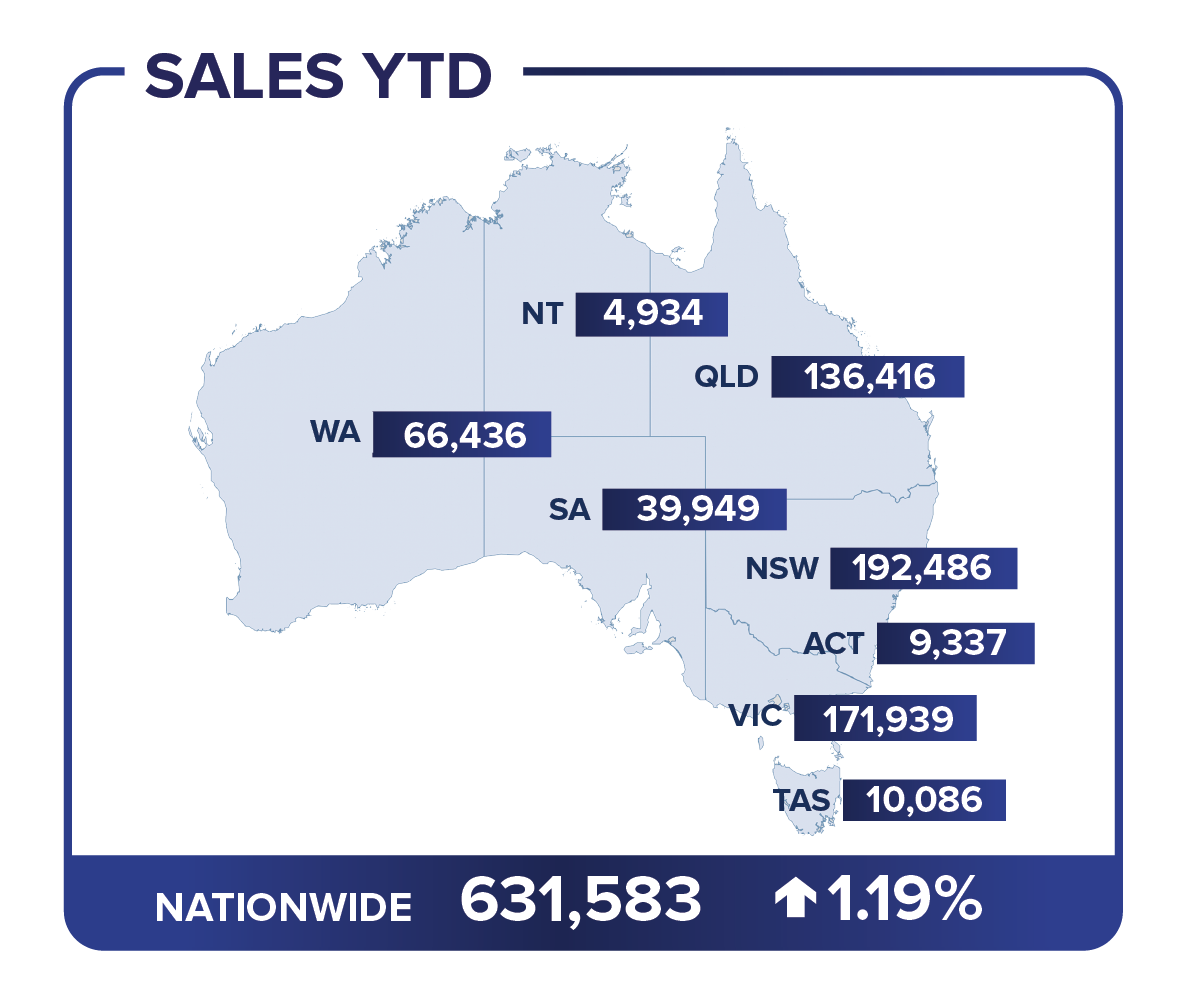
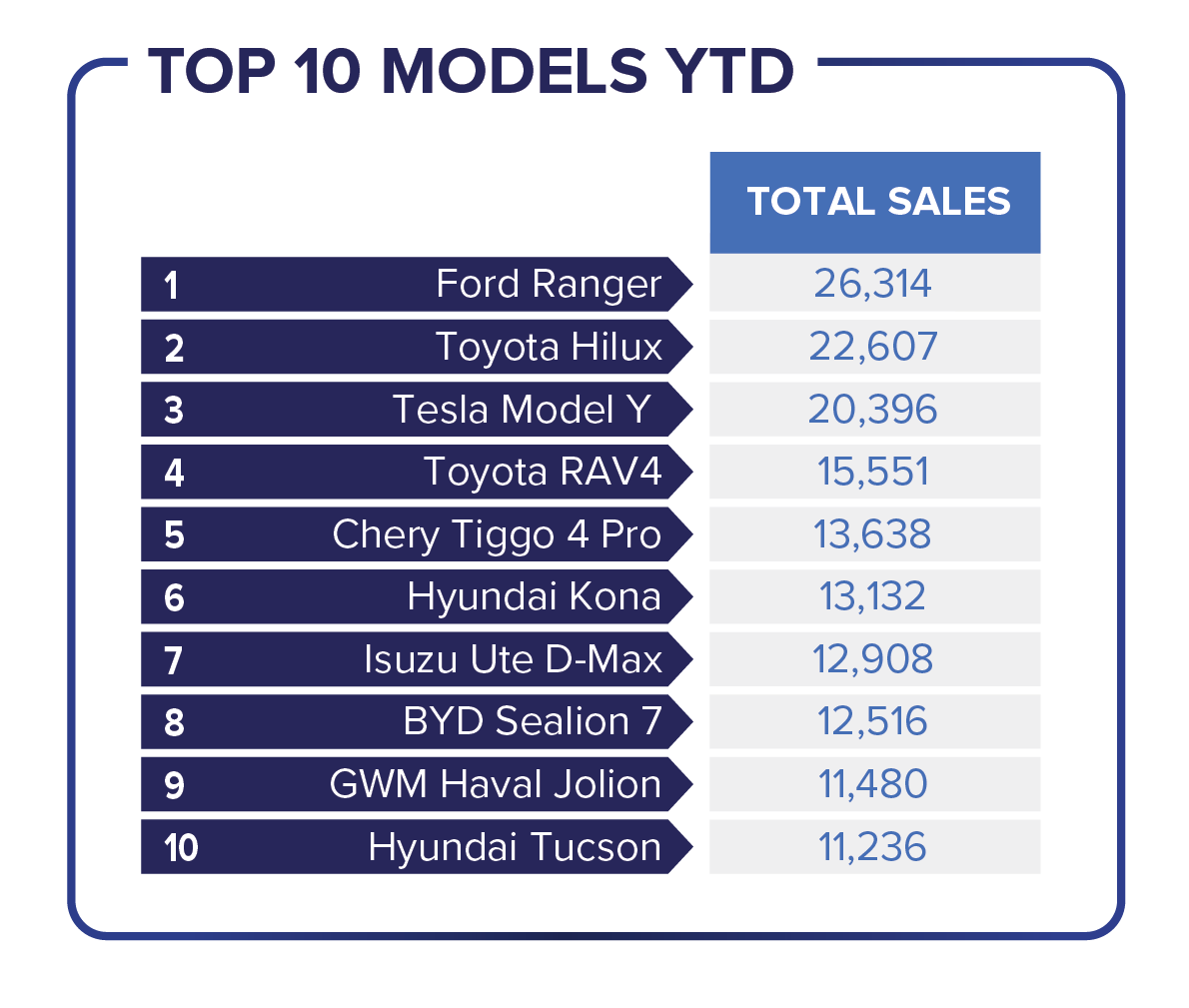
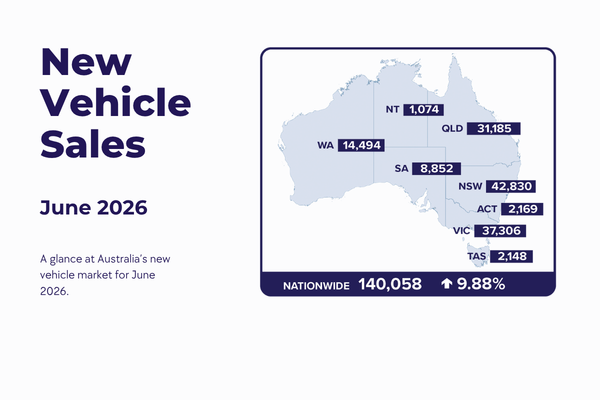
New vehicle sales in Australia totalled 140,058 units in June, up 9.88 per cent compared to the same month last year. Year-to-date sales increased by 1.19 per cent to 631,583 units.

The Australian new vehicle market recorded its strongest June on record, with many brands pushing significant volumes into the market during what is traditionally the busiest trading month of the year. Competition appeared strong across the industry as manufacturers sought to capitalise on end-of-financial-year demand.

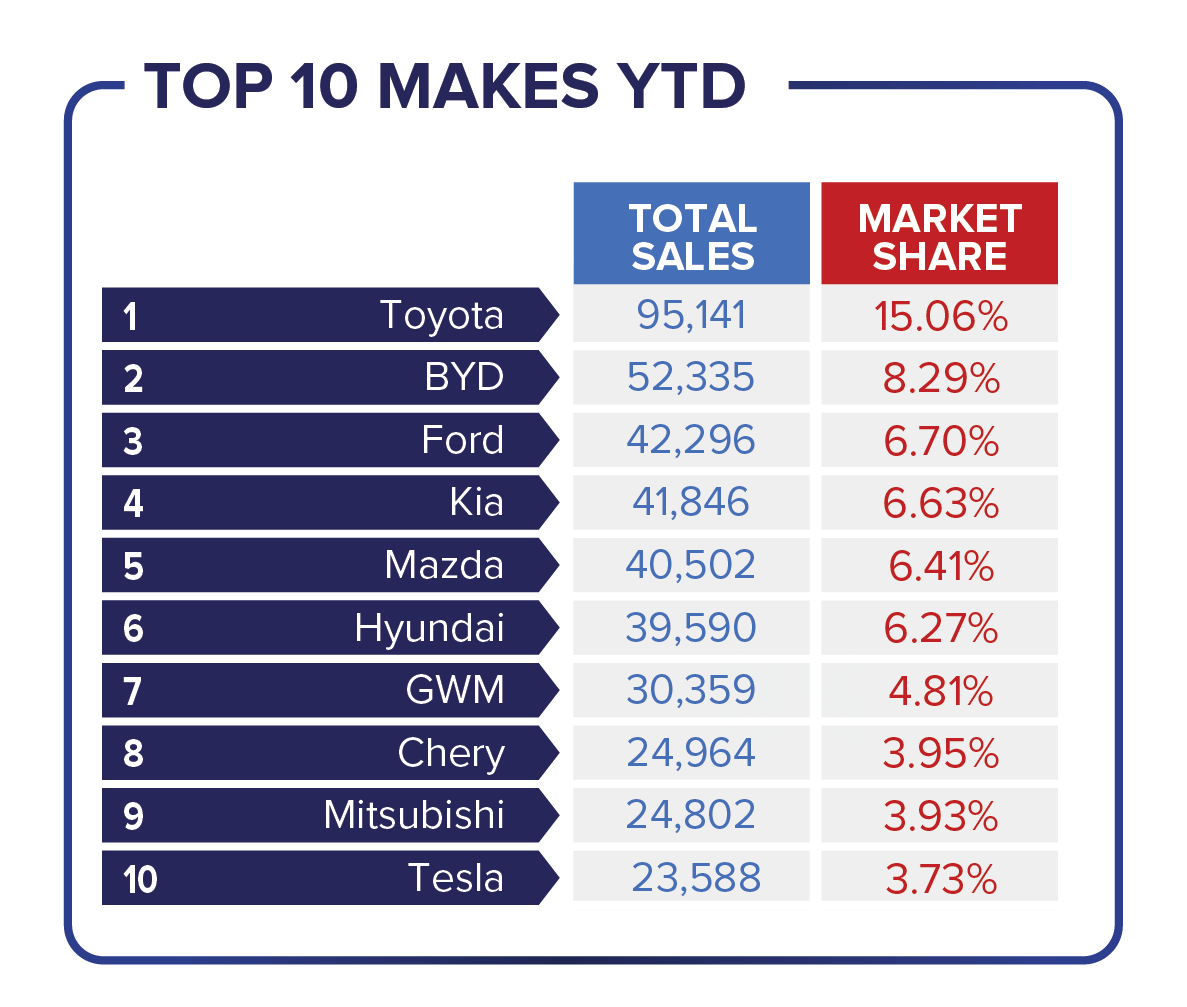
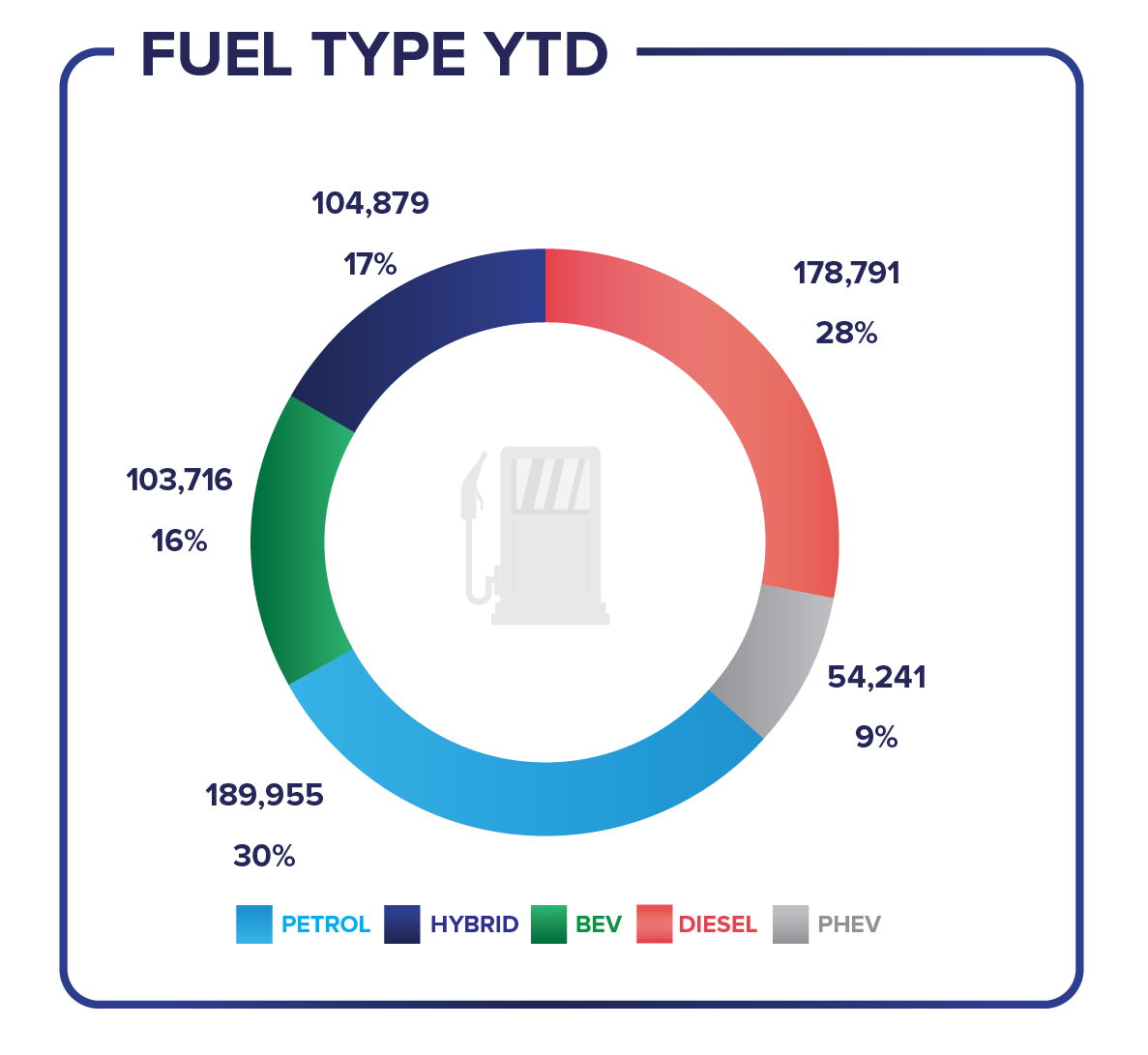
Battery electric vehicles recorded a strong month in June, overtaking hybrids and diesel to become the second most popular drive train behind petrol vehicles for the month. Toyota retained its position as market leader with 95,141 sales year to date, while BYD strengthened its hold on second place, ahead of Ford, Kia and Mazda.

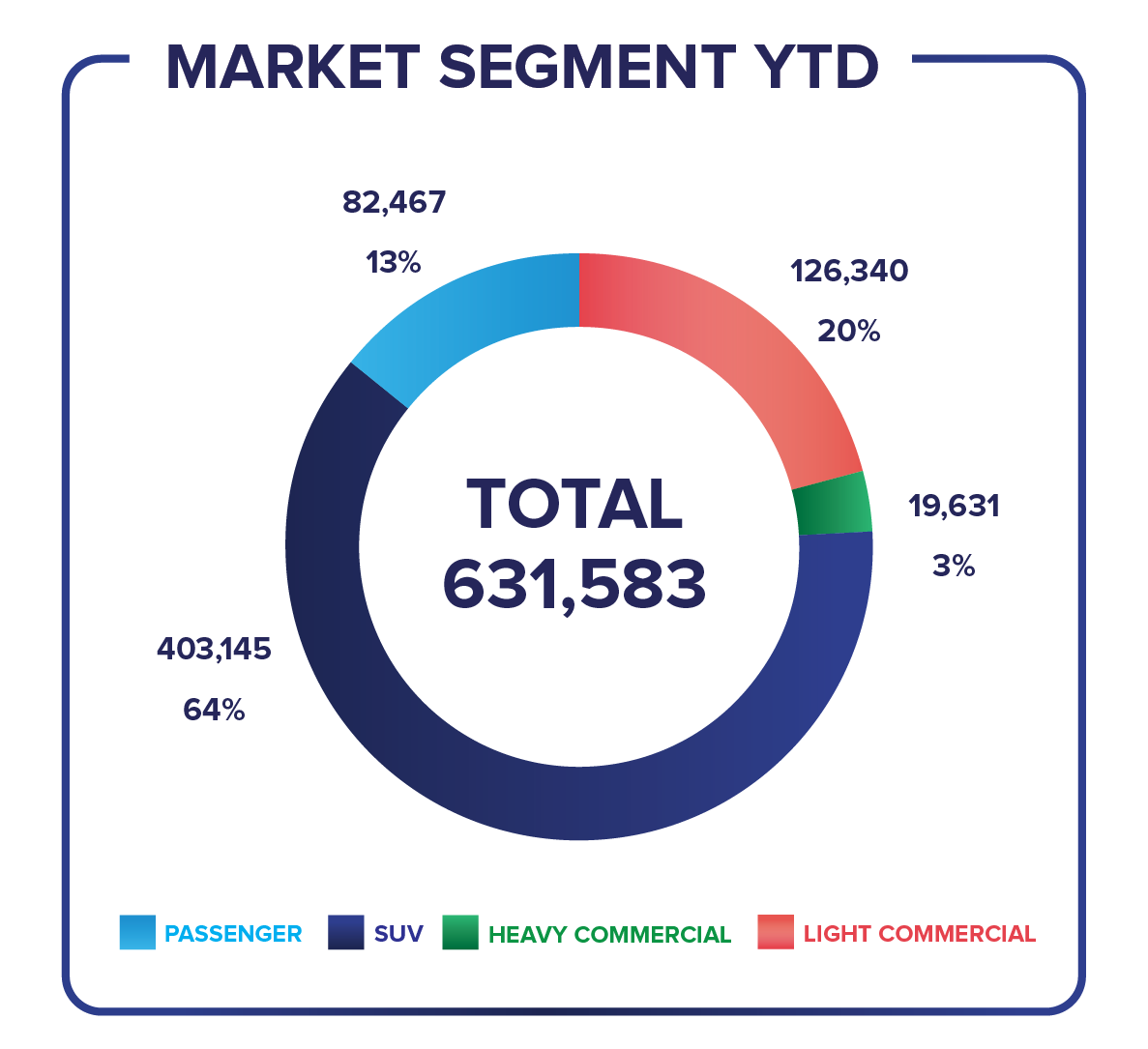
SUVs remain the dominant vehicle type, representing 64 per cent of all new vehicle sales year to date. New South Wales recorded the highest sales volume in June with 42,830 vehicles sold, followed by Victoria (37,306 units) and Queensland (31,185 units).

*The AADA has reviewed year-to-date VFACTS and EVC data, ranking vehicles by volume, and continues to analyse new vehicle sales by state, fuel type and market segments to monitor trends shaping the Australian market.

May 2026 New Vehicle Sales

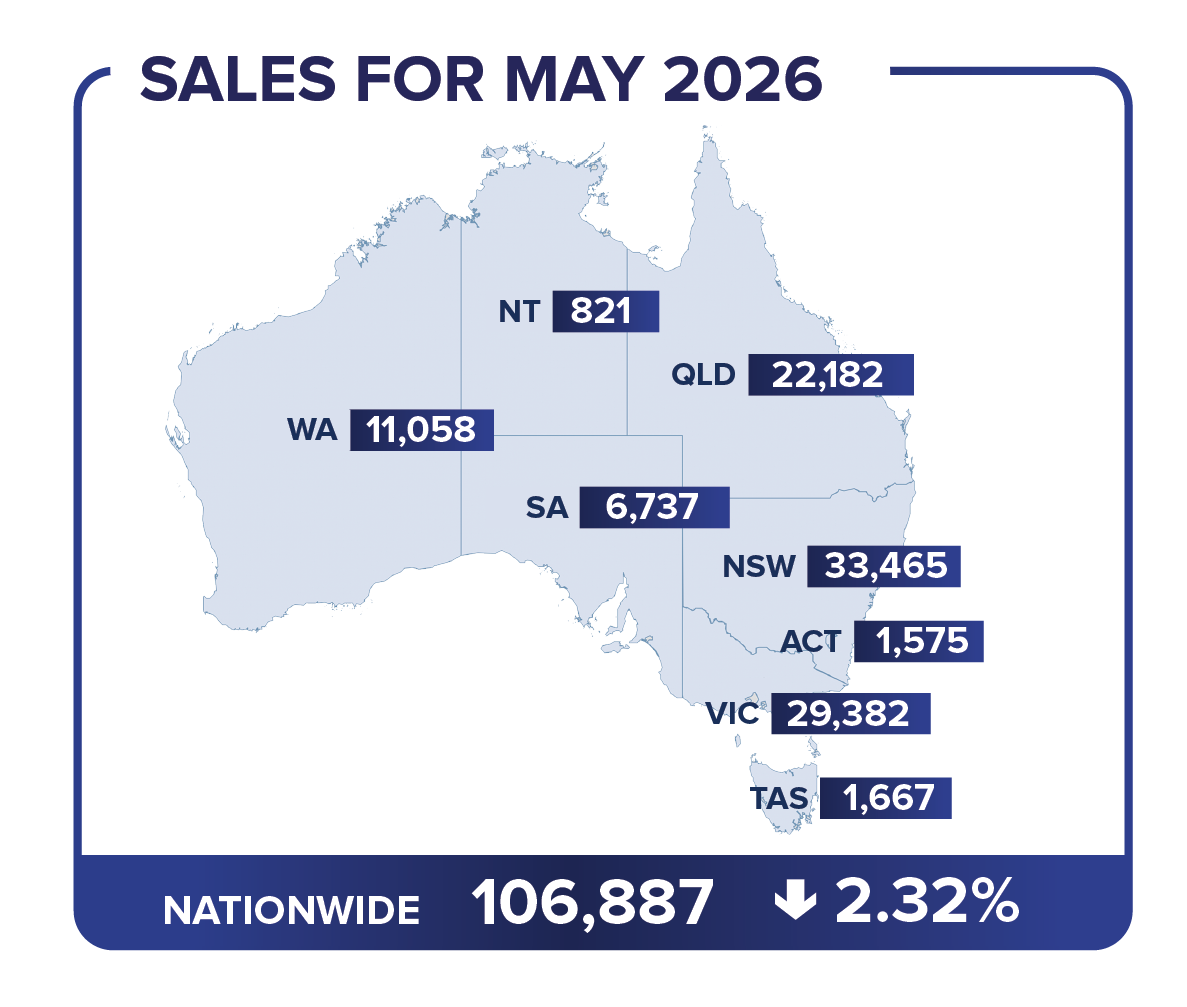
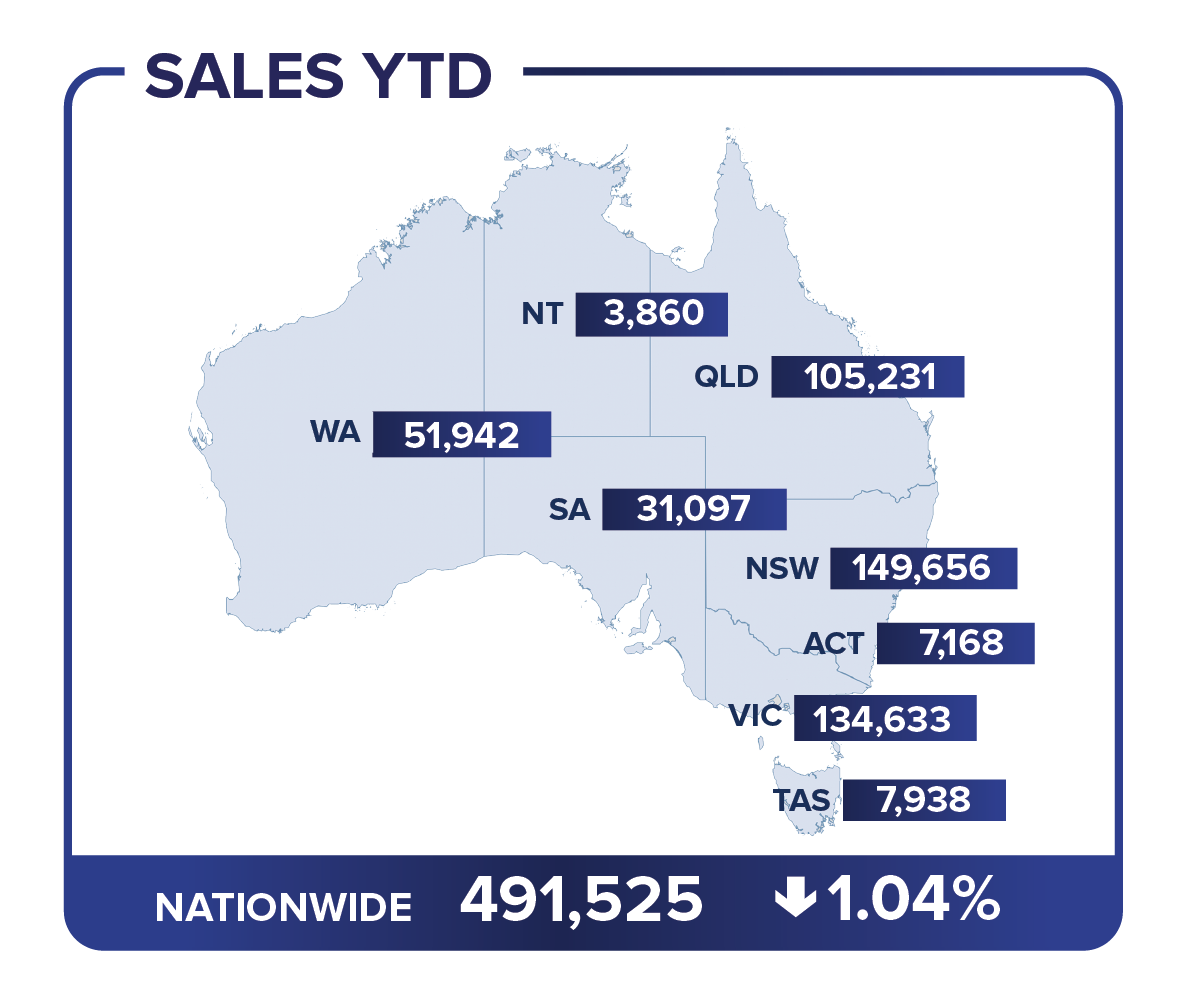
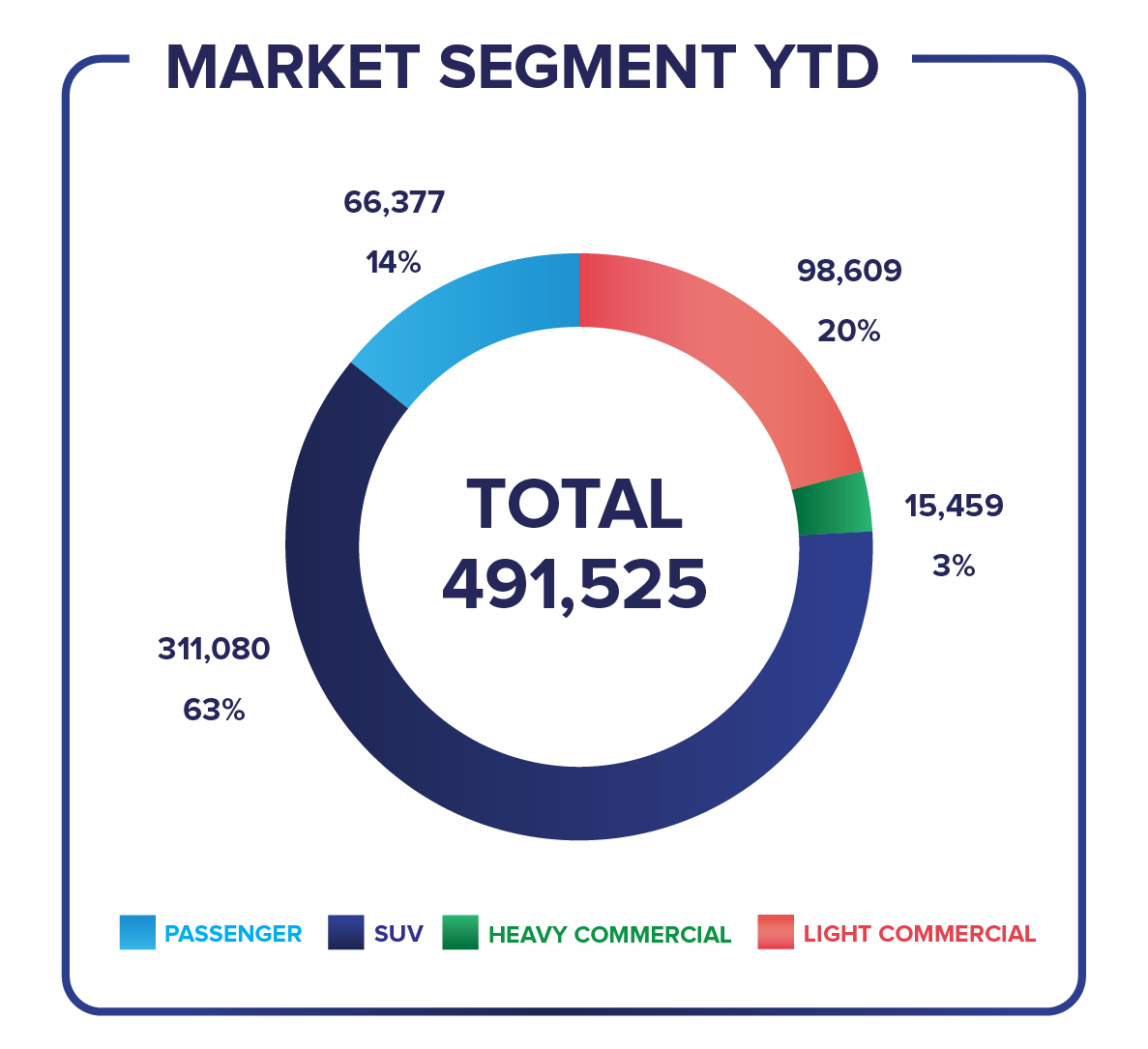
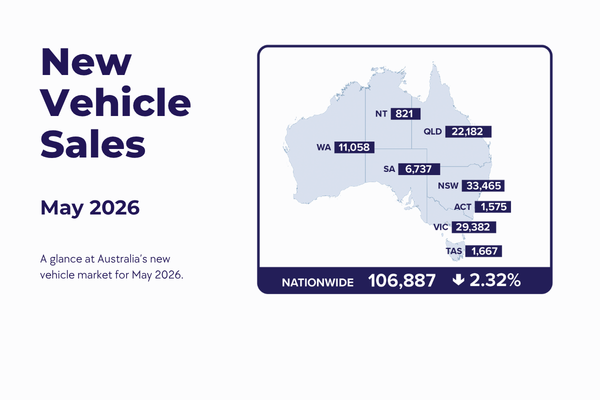
New vehicle sales in Australia totalled 106,887 units in May, down 2.32 per cent compared to the same month last year. Year-to-date sales declined by 1.04 per cent to 491,525 units.

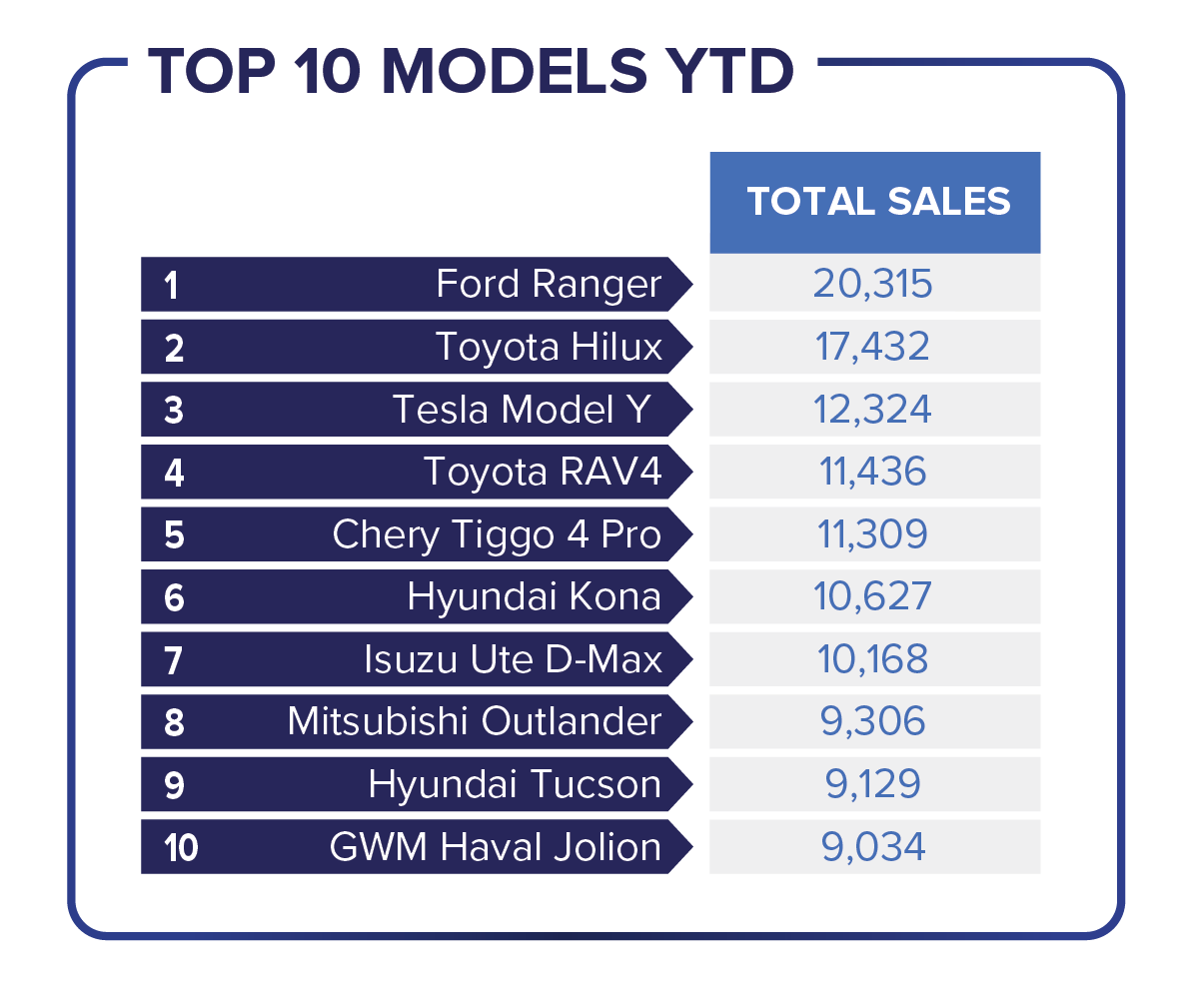
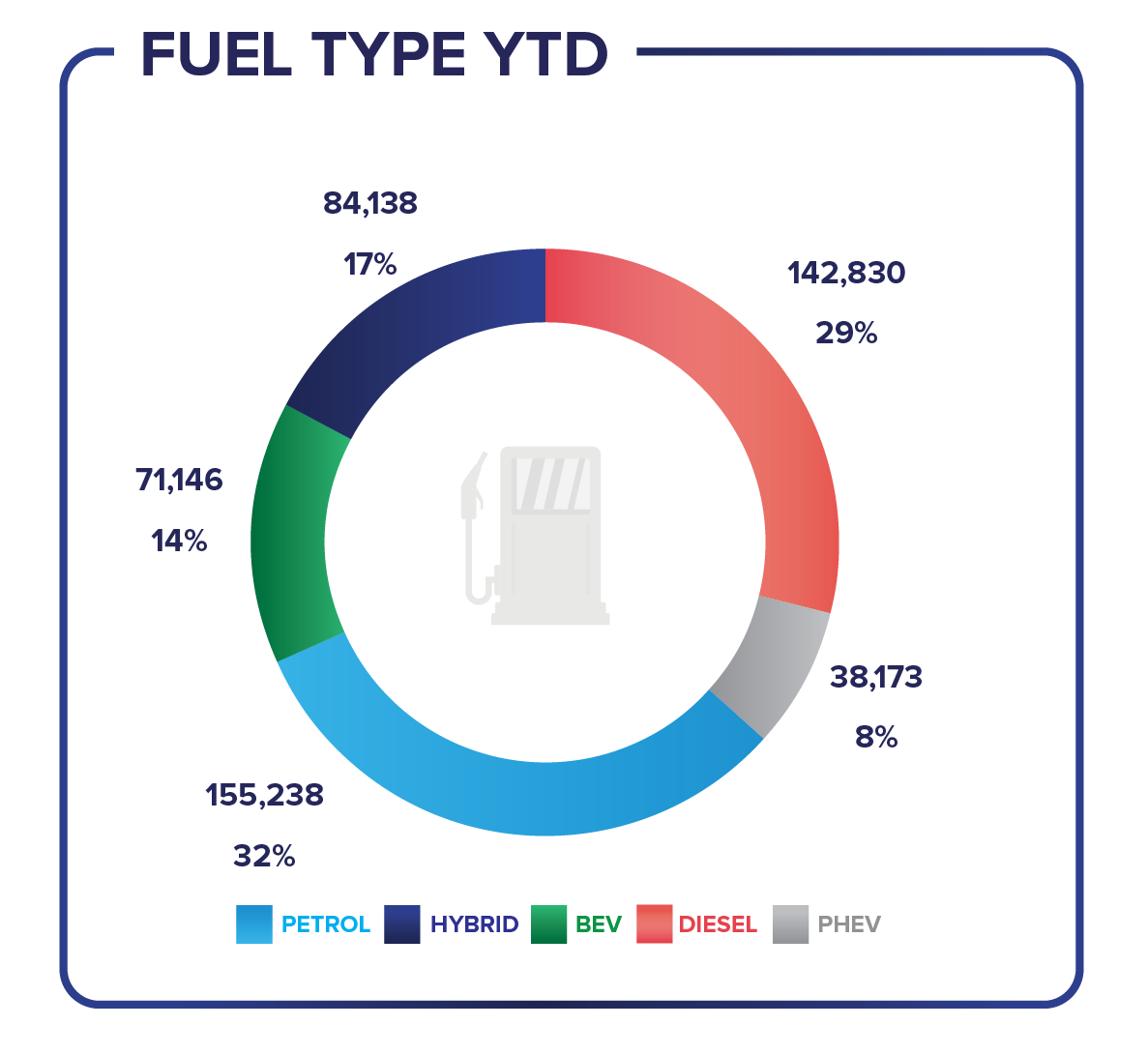
Electrified vehicles continued to gain momentum throughout May, accounting for 46 per cent of all new vehicle sales. Battery electric vehicles reached a record 20 per cent market share for the month, with the Tesla Model Y becoming the first EV to top Australia’s monthly sales charts, recording 5,606 deliveries ahead of the Ford Ranger and Toyota HiLux.

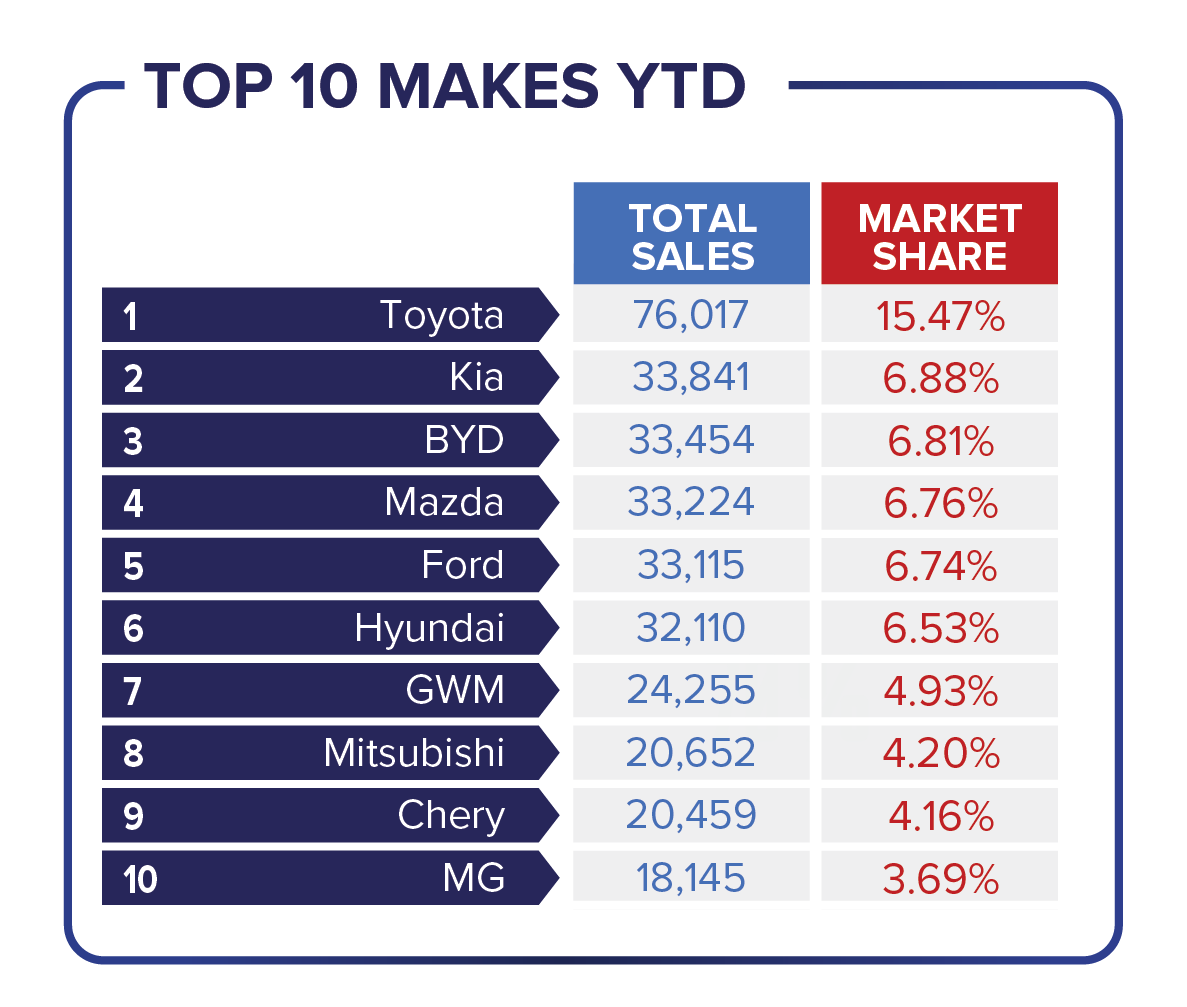
Toyota retained its position as the market leader year to date with 76,017 sales, while Kia and BYD occupied second and third respectively. SUVs remained the dominant vehicle type, accounting for 63 per cent of total sales. Across the states and territories, New South Wales recorded the highest sales volume in May with 33,465 units sold, followed by Victoria (29,382 units) and Queensland (22,182 units).

*The AADA has reviewed year-to-date VFACTS and EVC data, ranking vehicles by volume, and continues to analyse new vehicle sales by state, fuel type and market segments to monitor trends shaping the Australian market.

Australians Chase Lower Running Costs in Used Vehicles

Key Headlines

  1. Impacts of the Middle East conflict continues to influence buyer priorities. Heightened running cost considerations are pushing purchase decisions towards electrified vehicles.
  2. Used hybrid vehicles are the standout performer in used electrified stock. Demand is strong, supply is tightening, and values are holding across all model years.
  3. PHEV momentum is more uneven. The segment absorbed a fuel-driven demand surge in March, but stock velocity splits sharply by model and age.
  4. Chinese PHEV brands have entered the used market in volume. Brand openness among buyers is growing, but it is not yet universal.

Market Snapshot – Hybrid and PHEV

Australians are increasingly moving to electrified vehicles as rising fuel prices and cost-of-living pressures reshape buying behaviour, according to new market intelligence data from AutoGrab and the Australian Automotive Dealer Association (AADA).

While much of the public conversation continues to focus on EVs, which experienced a sharp surge in March 2026, the shift towards lower running cost vehicles has not stopped at EVs. The economic case for electrified options has become hard to ignore and reframed how buyers think about BEVs, PHEVs and hybrid vehicles.

Hybrids Lead the Electrified Market

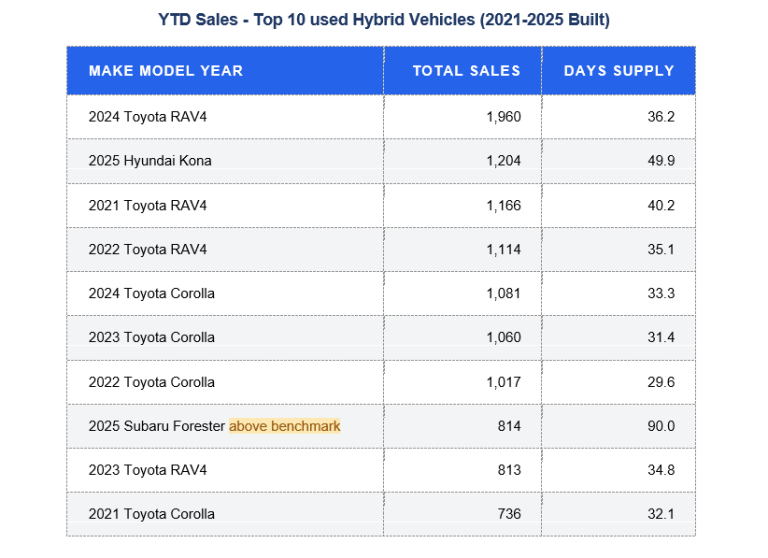
A total of 28,395 used hybrid vehicles were sold nationally between January and April 2026, representing 11.2 per cent of all used vehicle sales for 2021-2025 model year vehicles.

While EVs continue to dominate much of the public conversation around electrification, the data shows hybrids are a strong performing segment of the used electrified market, with buyers attracted to lower running costs without needing to change driving or charging habits.

Used hybrid supply tightened significantly during the first four months of the year, falling from 53.8 days supply in January to just 42.3 days in April – well below petrol and diesel vehicles, which both increased over the same period.

Toyota dominates the used hybrid market, with the Toyota RAV4 and Corolla accounting for eight of the top ten hybrid models by sales volume. Both vehicles recorded consistently strong selling times and tight stock levels, reinforcing Toyota’s position as the benchmark brand in Australia’s used hybrid market.

The analysis also found hybrid retained values remained exceptionally strong, with 2025 model year vehicles averaging more than 100 per cent retained value across the reporting period. Even 2021 model year hybrids retained an average 88.2 per cent of original purchase price.

PHEVs Gain Momentum as BYD Emerges

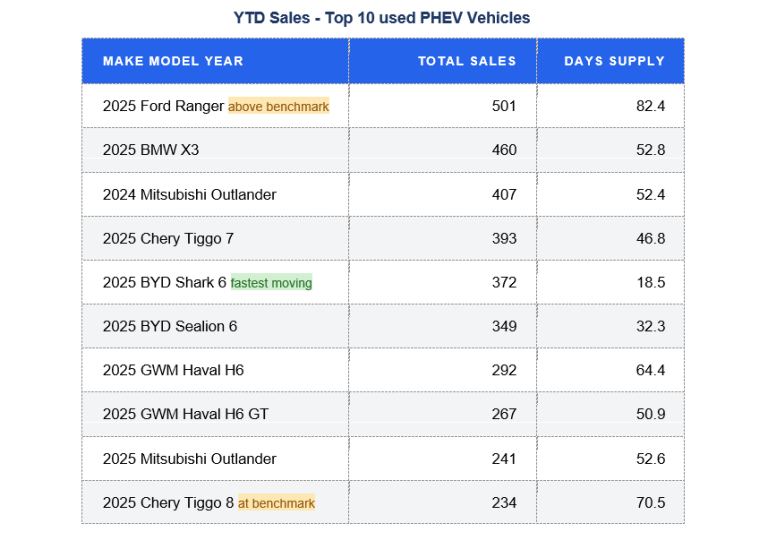
Used plug-in hybrid vehicle (PHEV) sales also strengthened during the period, with 7,536 vehicles sold nationally year-to-date, representing 3.0 per cent of used vehicle sales.

The segment experienced a sharp uplift in March as fuel prices surged, although demand varied significantly by brand and model.

Chinese brands are beginning to establish themselves in the used PHEV market, led by BYD. The 2025 BYD Shark 6 recorded just 18.5 days’ supply, the fastest-moving PHEV in the segment, highlighting particularly strong buyer demand.

However, the data shows the broader PHEV market remains uneven, with newer models performing strongly while older stock experience softer retained values and slower selling times.

General Market Statistics

  • The broader used vehicle market also remained active in April, with 343,021 vehicles listed for sale nationally, representing a 4.7 per cent increase month-on-month.
  • A total of 203,525 vehicles were sold during the month, down 8.7 per cent compared to March.
  • Dealer activity continued to account for a significant share of the market, representing 44.1 per cent of all used vehicle sales nationally.
  • Market efficiency also improved slightly, with average days to sell falling to 44.6 days, indicating continued resilience in transaction times despite softer overall sales volumes.

Reaction

Australian Automotive Dealer Association CEO James Voortman said the data showed Australians were increasingly prioritising practicality and affordability when choosing their next vehicle.

“The fuel price spikes earlier this year clearly pushed many buyers toward electrified vehicles, particularly hybrids and plug-in hybrids.”

“While EVs attract much of the attention, this data is a reminder that hybrids are playing a major role in Australia’s transition, because they offer lower running costs without requiring major changes to driving habits or charging behaviour.”

“The retained value figures for hybrids are particularly remarkable and are one of the clearest indicators of genuine consumer demand we have seen in the used vehicle market.”

AutoGrab Chief Commercial Officer Saxon Odgers said heightened running cost considerations, in part precipitated by the Middle East conflict, has boosted the economic case for Australians to choose electrified transport as their next vehicle purchase.

“Used vehicle data in the Australian market points to a discernible shift towards electrified transport options, in a timeframe compressed by external factors and an increasingly dynamic marketplace.”

“Used hybrid supply tightened from 53.8 to 42.3 days between January and April, while petrol and diesel inventory moved in the opposite direction. That gap is a clear signal of where buyers are spending.”

For more detailed market analysis beyond the national snapshot, including state-level insights and additional market segmentation, visit AutoGrab AIR Pro for further information.

Used EV Market Gains Momentum Amid Rising Fuel Costs

Key Headlines

  1. Australia’s used electric vehicle market experienced a sharp and sudden surge in activity during March 2026, coinciding directly with the escalation of the Middle East conflict and the resulting spike in domestic fuel prices.
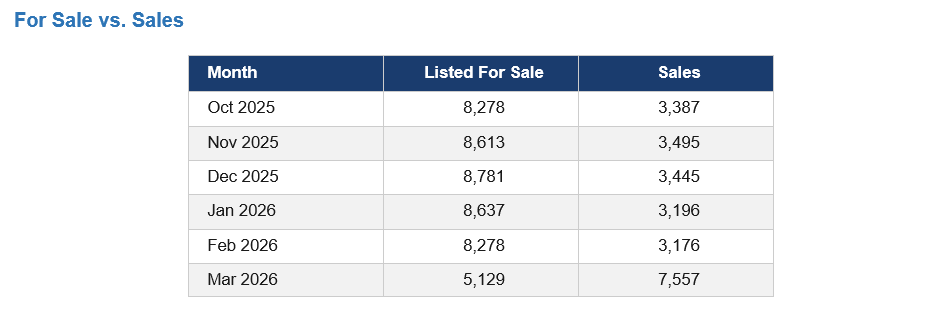
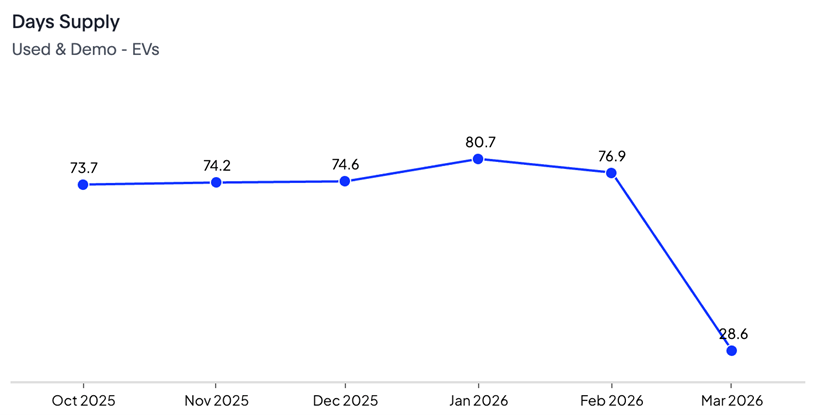
  2. Used EV sales more than doubled between February and March 2026, rising from 3,176 to 7,557 units nationally. At the same time, available stock dropped by 38%, leaving the market with just 28.6 days of supply at the current rate of sales.
  3. Chinese origin and value positioned EVs dominate consumer demand.
  4. Used EVs prices have increased since January but the recovery is uneven.

Market Snapshot – What the Numbers Say

Australia’s used electric vehicle (EV) market experienced a sharp surge in March, with activity accelerating rapidly as fuel prices climbed following escalating tensions in the Middle East.

Used EV sales more than doubled month-on-month, jumping from 3,176 units in February to 7,557 in March, in one of the most significant shifts seen in the segment to date.

At the same time, supply tightened dramatically. Available stock fell by 38%, leaving the market with just 28.6 days of supply – well below the 60–90-day range typically considered balanced – and signaling a clear shift toward a seller’s market.

The surge has been led by value-oriented and Chinese-origin EV models, alongside strong dealer representation across the top-selling vehicles, reinforcing the role of competitively priced offerings in driving adoption.

While prices had softened through late 2025, residual values have begun to stabilise and recover since January, suggesting the recent lift in demand is starting to flow through to pricing—although conditions remain uneven across different model years.

The sustainability of this surge will depend on how long fuel prices remain elevated, but the March data points to a clear shift in buyer behaviour toward lower running-cost vehicles.

General Market Statistics

The broader used vehicle market also showed solid figures in March, with 327,762 vehicles listed for sale, marking a 1.9% increase month-on-month.

A total of 222,810 vehicles were sold, representing a 4.2% rise compared to February, signalling continued resilience in consumer demand.

Dealer activity remained a key component of the market, accounting for 45.22% of all sales, reinforcing the important role dealers play in connecting buyers with vehicles. Market efficiency improved slightly over the month, with the average days to sell falling to 45.6 days, down from 46.6 in February, indicating a modest acceleration in transaction times.

“Rising fuel prices are clearly influencing consumer behaviour, with more Australians turning to used EVs as a practical and cost-effective alternative,” said AADA CEO James Voortman.

“At the same time, the broader used vehicle market remains resilient, with steady sales growth and improving turnaround times indicating healthy underlying demand.”

“Dealers have consistently demonstrated their ability to adapt to changing market conditions, and the growing presence of EVs being offered by dealers in the used market is another example of that evolution in action,” said Mr Voortman.

“The Australian automotive market can change almost overnight. As we’ve seen recently, macro events whether an interest rate decision, a tariff announcement, an oil crisis, or a shift in consumer confidence – can ripple through the used car and demonstrator market within weeks, reshaping which segments are moving, which are stalling, and where the value sits, “said AutoGrab Chief Commercial Officer Saxon Odgers.

“What we saw in March wasn’t a gradual shift. Used EV sales more than doubled in the space of a month while available stock fell by 38%, compressing days of supply to under 29 days. For dealers who are well-positioned with the right stock, the opportunity is significant.”

“Residual values on used EVs have been stabilising since January, and the March demand surge is now adding upward pressure. Whether this marks a lasting inflection point will depend on how long fuel prices stay elevated, but the data is clear: cost of ownership is now front of mind for buyers, and that’s reshaping how they think about their next vehicle.”

February Automotive Insights

The Australian Automotive Dealer Association (AADA), in partnership with AutoGrab, has released the February 2026 Automotive Insights Report (AIR), providing a national snapshot of used car sales and listings each month.

February continued the year’s steady momentum, with used car sales holding firm following January’s strong rebound. Listings tightened further, reinforcing ongoing supply constraints across the market.

February recorded 213,856 used cars sold, down 4.3 per cent from January. Active listings declined a further 6.9 per cent, continuing the supply squeeze that has characterised the past several months.

“Sales have remained solid following January’s lift, and while the days to sell eased slightly for the first time since September 2025, consumers are still taking their time when making purchasing decisions. It’s a more rational market than the peak periods we saw in recent years and speaks to the economic tensions Australia is facing,” said AADA CEO James Voortman.

The Ford Ranger once again topped the models leader board, maintaining its long‑standing position as Australia’s best‑selling used vehicle.

Key insights from the February 2026 AIR include:

  • Stable demand: National used car sales declined to 213,856 vehicles, down 4.3 per cent month on month.
  • Listings tighten: Active listings fell to 321,602, down 6.9 per cent from January.
  • Selling times: Average days to sell decreased to 46.6, bucking the gradual upward trend seen since September.
  • Top model: The Ford Ranger remained Australia’s best selling used vehicle.

Important updates to AIR methodology and coverage:

To improve the accuracy and representativeness of the Automotive Insights Report, several significant enhancements have been introduced in the February edition:

  • Vehicle volume coverage has been expanded to include vehicles up to 20 years of age, providing a more complete view of Australia’s used car market.
  • Demo vehicles are now included in the reporting, capturing a segment that plays an increasingly important role in consumer purchasing behaviour.
  • A major classification improvement has been implemented to more accurately distinguish plug‑in hybrid electric vehicles (PHEVs) from conventional hybrids. This refinement results in lower reported hybrid volumes and higher PHEV volumes, better reflecting the true composition of the national fleet.

These updates represent one of the most impactful methodological improvements since AIR was first released, and the AADA is committed to communicating these changes clearly and transparently to ensure media and industry stakeholders understand their significance.

January Automotive Insights: Used Car Sales Up

The Australian Automotive Dealer Association (AADA), in partnership with AutoGrab, has released the January 2026 Automotive Insights Report (AIR), a national snapshot of used car sales and listings each month.

The new year has begun with stronger activity in the used car market, with sales increasing month on month while listings continued to tighten. At the same time, vehicles are still taking longer to sell compared with a spring low point, pointing to a more balanced market and more cautious buyer behaviour.

January recorded 188,421 used cars sold, up 9.7 per cent from December. On the supply side, vehicle listings declined by 5.4 per cent month on month.

“A solid lift in sales to start the year suggests buyers have returned to the market after the typical December slowdown, but conditions remain more balanced than the highs we saw in previous years,” said AADA CEO James Voortman.

“Even with stronger volumes, days to sell have continued trending higher since the lows recorded in September, which tells us consumers are taking their time and shopping carefully.”

Alternative powertrains again stood out and led the way with increases. Hybrid and electric vehicle sales both increased month on month, with hybrids up 15.3 per cent and EVs up 20.1 per cent, reflecting steady growth in demand for lower-emission options across the used market.

The Ford Ranger maintained its long-held position as Australia’s top-selling used vehicle, continuing its consistent run at the head of the models leaderboard.

Key insights from the January 2026 AIR include:

  • Sales rebound: National used car sales increased to 188,421 vehicles, up 9.7 per cent month on month.
  • Listings ease: Active listings declined to 291,666, tightening 5.4 per cent from December.
  • Slower turnover: Average days to sell rose to 49.4 days, continuing the gradual increase since September’s low.
  • Alternative growth: Hybrid sales lifted 15.3 per cent and EV sales climbed 20.1 per cent month on month.
  • Top model: Ford Ranger retained its position as the nation’s best-selling used vehicle.

View the full January 2026 AIR below.

New Vehicle Sales January 2026

New vehicle sales opened 2026 on a steady footing, with 87,753 vehicles delivered nationwide in January, broadly in line with market performance at the same time last year.

New South Wales recorded the highest volume with 26,557 sales, followed by Victoria (24,401) and Queensland (18,869).

SUVs continue to dominate buyer preferences, accounting for 61 per cent of year-to-date sales. Light commercial vehicles represent 20 per cent of the market, passenger vehicles 16 per cent, and heavy commercials 3 per cent.

Electrified vehicles remain a growing part of the mix. Hybrid models lead the transition with 17 per cent of sales, followed by battery electric vehicles at 8 per cent and plug-in hybrids at 6 per cent, reflecting continued consumer interest in these power trains.

Toyota leads the market year-to-date with 14,310 sales and a 16.31 per cent share, ahead of Mazda (7,692) and Kia (6,600).

At a model level, the Ford Ranger remains Australia’s top-selling vehicle so far this year with 3,403 sales, followed by the Toyota Hilux (2,800) and Mazda CX-5 (2,289). Popular SUVs and utes continue to feature prominently across the top 10.

The AADA has assessed VFACTS and EVC Top 10 Makes and Models year-to-date, ranking them by volume, and continues to analyse new vehicle sales by state, fuel type and market segment to track trends shaping the Australian market.

Used Car Market Stabilises as Dealers Play a Greater Role

The Australian Automotive Dealer Association (AADA), in partnership with AutoGrab, has released the Annual 2025 Automotive Insights Report (AIR), providing a comprehensive overview of Australia’s used car market over the past calendar year.

National used car sales totalled 2.32 million vehicles in 2025, down 0.37 per cent compared to 2024, highlighting a broadly stable market year on year. After several years of disruption, the used car market settled into a more sustainable operating environment in 2025, with conditions improving for both buyers and sellers and less extreme movement in prices and stock availability.

A notable shift during the year was the growing share of dealer-led transactions. Dealer sales accounted for 48.6 per cent of the used car market in 2025, up from 39.1 per cent in 2024, reflecting stronger consumer confidence in the dealer channel and improved availability of dealer stock.

“The increase in dealer market share reflects growing consumer confidence in what purchasing through a dealer provides,” said AADA CEO James Voortman. “Dealers are playing a more prominent role as consumers seek greater certainty around pricing, vehicle quality and after-sales support in a more balanced market environment.”

Vehicle preferences continued to evolve throughout 2025, with SUVs further strengthening their dominance of the used car market, while passenger vehicles continued to lose share. At the same time, electrified vehicles including hybrids, electric vehicles and plug-in hybrid electric vehicles continued to grow their presence in market share.

“The Annual 2025 Automotive Insights Report confirms the used car market has moved beyond the distortions of recent years and into a more stable, sustainable phase. What we’re seeing now is a structurally healthier market, where disciplined pricing, better stock availability and data-led decision-making are once again central to dealer performance,” said AutoGrab COO Saxon Odgers. “With supply chains normalising and transparency improving, the 2025 results provide a constructive foundation for 2026. Dealers and OEMs now have a clearer line of sight to pricing, risk and inventory planning than at any point in the last five years.”

Key insights from the Annual 2025 Automotive Insights Report include:

  • Stable annual sales: National used car sales declined by just 0.37 per cent compared to 2024.
  • Dealer share rises: Dealer transactions increased to 48.6 per cent of total sales, up from 39.1 per cent in 2024.
  • Electrification gains ground: Hybrid, EV and PHEV vehicles all increased their share of the used car market.

EV Purchase Intentions Steady

Over the past 3 years, Australian’s intentions to purchase an electric vehicle has flatlined despite new EV brands coming into the market at cheaper prices with declines found in regional Australia.

The Australian Automotive Dealer Association (AADA) has surveyed Australian drivers annually since 2022 to understand their intention to purchase an EV, helping new car dealers respond to changing consumer demand.

The latest survey shows that, despite three consecutive years of growth in the overall new car market, intention to purchase an electric vehicle as a main car has remained unchanged. This is despite the entry of new EV brands at lower price points and the introduction of government incentives designed to accelerate EV uptake.

The consumer survey also found that there has been a national decline in intention to purchase an electric vehicle in regional and rural Australia. This is a significant finding backing up direct evidence from new car dealers of the reluctance of regional drivers to make the transition to electric vehicles.

“Our members are committed to supporting Australia’s transition to lower-emissions vehicles and want to meet Australian driver’s needs,” said AADA CEO James Voortman. “However new car dealers are not yet seeing a significant increase in the number of consumers intending to purchase an EV at the scale required.”

In 2025 the Government released the Climate Change Authority’s modelling for Australia to meet its 2035 emissions targets. A significant part of that modelling was the reliance of Australians buying electric vehicles, with 50 per cent of all new car sales every year to 2035 needing to be electric. Based upon the results from the fourth edition of this survey, this will be challenging.

However, there are positive indicators where there is an increase in consumers’ intention to purchase a hybrid or plug in hybrid electric vehicle which is also demonstrated in recent sales data.

“What we are seeing is the automotive transition is happening but at the pace of the consumers choosing,” said Mr Voortman.