QLD Regional Dealer Roadshow

AADA and MTAQ are delighted to host the Queensland Regional Dealer Roadshow – a key initiative under our recent partnership aimed at strengthening dealer representation at both the state and national levels. Read more about our collaboration here.

This roadshow is your opportunity to shape the policy agenda by highlighting the critical dealer-facing issues that matter most to Queensland’s regional dealerships.

Why attend?

The roadshow provides a unique platform for franchise dealers to engage directly with the industry bodies that advocate on their behalf both federally and in Queensland.

Who will be there?

The events will be facilitated by MTAQ CEO Rod Camm and AADA CEO James Voortman, who will provide key updates on pressing industry issues, including:

  • State Motor Vehicle Duty and reforms sought for Queensland dealers
  • Skills development and jobs programs
  • Licensing of salespeople
  • Queensland’s Industrial Relations landscape
  • Dealer concerns under Australian Consumer Law
  • New Vehicle Efficiency Standard, EV transition and what it means for regional Queensland
  • Challenges with DMS and online classifieds providers
  • Franchise Code update
  • The 2025 Federal Election
  • Re-invigoration of the AADA Queensland Committee.

Other locations

Other major Queensland regional centres such as Rockhampton, Gladstone, Mackay, Mt Isa and Kingaroy will have dates and venues announced at some stage in mid-May 2025.

Who should attend the AADA-MTAQ Regional Dealer Roadshow?

Ideally your dealership should be represented by the Dealer Principal/ General Manager, Service Manager, CFO or other senior dealership staff.

How to register?

Secure your spot by completing the registration form below.

AADA Webinar – Understanding the Latest Industry Reforms

Following our recent media release on the Federal Government’s commitment to banning unfair trading practices and the use of unfair contract terms, we invite all members and industry partners to join an exclusive AADA webinar to gain further insights.

Date: Friday 28 March 2025
Time: 12:30pm – 1:30pm AEDT
Location: Microsoft Teams
Register:https://bit.ly/4hA6wbK

This session will feature the AADA team, who will break down the key details of the announcement, what it means for Dealers, and provide a federal budget briefing covering critical industry developments.

We will also discuss the Government’s commitment to shifting the NVES point of compliance to the point of sale and what this means moving forward. Members will have the opportunity to ask questions throughout the session.

Holden Dealers Handed Devastating Judgment in Supreme Court

The Australian Automotive Dealer Association (AADA) has expressed disappointment with the decision handed down in the Supreme Court of Victoria today which found that General Motors did not breach its agreement with Holden Dealers by failing to supply them with vehicles.

The case was brought forward by a group of Dealers who did not accept GM’s controversial compensation offer at the time the Detroit-based company killed off the Holden brand in Australia. The Dealers are now considering their options.

“Today will come as a massive blow to those Dealers who have gone through the exhausting and emotional process of taking on a giant multinational car company,” said AADA CEO James Voortman.

“The legal argument successfully put forward by GM that they had no obligation under the Dealer Agreement to supply cars to their retailers is incredibly disappointing and sets a dangerous precedent for the automotive industry,” he said.

“These Dealers upheld their end of the bargain. They invested in facilities, employed staff and dedicated their talents to selling Holden vehicles in the communities in which they operate because they were led to believe that the Holden brand was set to stay in Australia for the long haul.”

This is just another unedifying chapter in the story of how GM killed off one of Australia’s most iconic brands and harmed its 200 Dealers in the process.

“The way in which Holden pressured its Dealers into accepting compensation offers resulted in rebukes by Commonwealth Ministers, a censure by the Australian Parliament and criticism from the competition watchdog,” said Mr Voortman.

“This highlights the importance of the franchising protections announced by the Government earlier this week and it is critical that we achieve bi-partisan support and enact these measures as soon as possible.”

“There also needs to be a conversation about how franchisees access justice. Large companies are only too happy go through a court process which is costly and can takes years to get an outcome,” he said.

Government Responds to AADA Call to Protect Australian Automotive Dealers

The Australian Automotive Dealer Association (AADA) welcomes today’s Federal Government announcement to strengthen protections for new car and truck franchisees. The Government has committed to extending protections against unfair trading practices and unfair contract terms to all franchisees, including Australian new car and truck Dealers. The Government has also committed to prioritise work to ensure compliance with the New Vehicle Efficiency Standard is at the point of sale, rather than the point of import.

These reforms will go some way towards addressing the power imbalance which exists between new vehicle Dealers and the global manufacturers to which they are franchised. The AADA and its members have played an important and longstanding role in advocating for these additional protections.

The automotive industry is undergoing a period of great change, driven by a worldwide transition towards new technologies and business models. As this shift unfolds, there will be winners and losers – but these new protections will level the playing field for Dealers and allow them to make informed business decisions with greater security.

“These changes are a major step forward for Australian Dealers who are navigating the most significant transformation in automotive history,” said AADA CEO James Voortman.

“The exit of Holden from the Australian market, along with the ongoing court cases between Dealers and Honda and Mercedes-Benz, have underscored the urgent need for stronger protections. Dealers deserve fair treatment, reasonable contractual terms, and the ability to make business decisions with confidence. These reforms deliver on that need,” he said.

With the global automotive industry shifting rapidly due to electrification and the emergence of many new manufacturers to our shores, these strengthened protections come at a critical time. By establishing a fairer and more balanced framework for franchise relationships, the reforms will bolster investment in the market, secure jobs, and provide a level playing field for Australian businesses.

“The transition we are witnessing presents both challenges and opportunities,” Mr Voortman added. “Ensuring fairness in contracts and trading conditions is essential to allowing Australian Dealers to compete and thrive in a changing world.”

“The AADA also welcomes the additional funding provided to the ACCC to enforce the Code and looks forward to working with the regulator to ensure franchisees are protected through a tough cop on the beat,” he said.

The AADA commends the government for its leadership on this issue and remains committed to working alongside policymakers to ensure a strong and competitive franchising environment for all Australian businesses.

February AIR

The February 2025 edition of the Automotive Insights Report (AIR) shows a modest rebound in used car sales. Using data supplied by AutoGrab, February’s AIR saw sales rise 2.2 per cent to 174,762 units, however this came as total listings declined slightly indicating a tightening in some areas.

“While the increase in sales is a positive shift from January, the broader market remains in a state of adjustment,” said AADA CEO James Voortman.

“With supply contracting and demand still below historical levels, it remains a competitive market for sellers,” he said.

“Average days to sell a used vehicle remained stable at 48.5 days, suggesting that vehicles are still moving at a steady pace, albeit with some regional fluctuations,” said Mr Voortman.

The Suzuki Jimny continued its dominance in retained value rankings, holding the highest resale value among passenger cars and SUVs in both age brackets. With an impressive 108 per cent retained value, the Jimny has consistently outperformed larger and more expensive competitors, reflecting its strong demand in the market.

Ford Ranger retained its position as Australia’s best-selling used car, with a 2.5 per cent increase in sales. Toyota models continued to dominate the top-sellers list, with five of the top ten positions.

Highlights from the AIR for February 2025

  • 174,762 used cars were sold, an increase of 2.2 per cent from January.
  • Used vehicle supply fell by 1.8 per cent, with most states experiencing a drop in listings.
  • Sales increased in major markets, with VIC (7.0 per cent) and NSW (3.8 per cent) leading the gains.
  • Electric vehicle sales rebounded, up 11.4 per cent, though retained values remain under pressure.
  • Average days to sell a used car held steady at 48.5 days.
  • Japanese brands dominated, taking 8 of the top 10 best-selling models, with Toyota accounting for 5.

Early-Bird Registrations 2025 AADA Convention & Expo

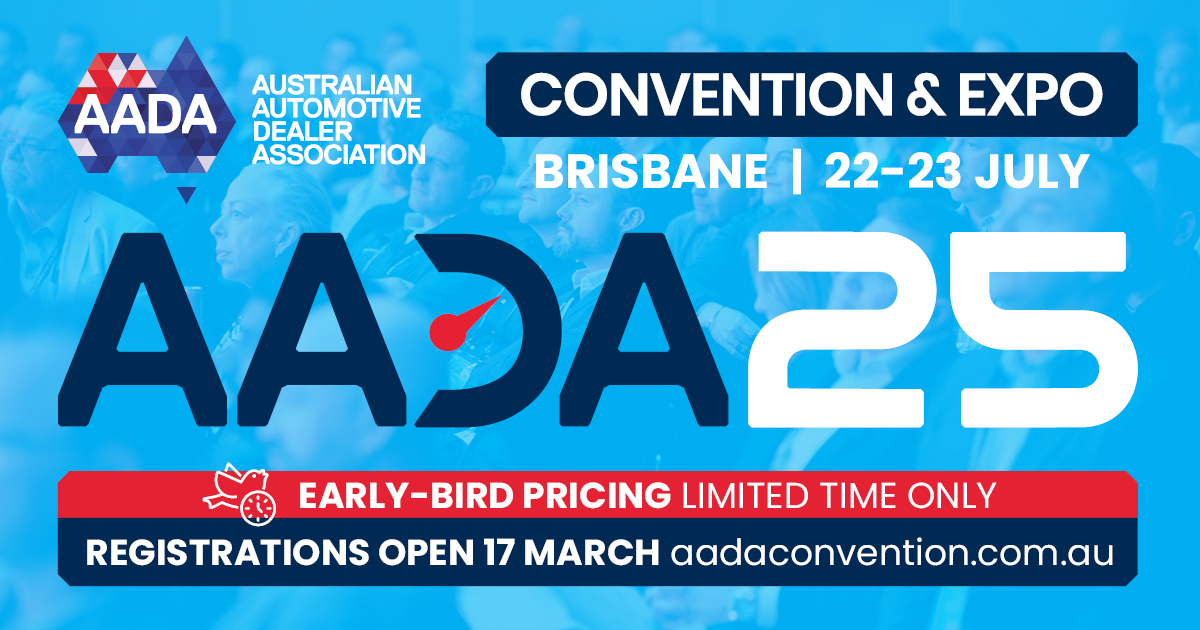
Get ready to shift into high gear! The highly anticipated 2025 AADA Convention & Expo is set to take place at the Brisbane Convention & Exhibition Centre (BCEC) on Tuesday 22 and Wednesday 23 July, and we are excited to announce that Early-Bird Registrations open on 17 March.

This year’s theme, ‘Changing Lanes’ reflects the ever-evolving landscape of the automotive industry. With new technologies, shifting consumer behaviours, and regulatory changes shaping the future, this convention is designed to help dealers and industry leaders navigate the road ahead with confidence and innovation.

Don’t miss out on securing your spot at Australia’s premier automotive retail event at the best possible rate. Early-bird pricing is available for a limited time, so mark your calendars and be among the first to register.

Stay tuned for more details on keynote speakers, workshop sessions, and networking opportunities.

New Vehicle Sales February 2025

New vehicle sales data for February is in! Total sales have hit 184,335 vehicles YTD, a decrease of 5.3% on the same period last year. Toyota continues to dominate, leading YTD sales with 37,256 units, followed by Mazda. The Toyota RAV4 takes the top spot for best-selling model, while the Ford Ranger follows closely behind.

PHEV sales soared by 346 per cent, in contrast to EV sales which saw another monthly decline. This increase can largely be attributed to deliveries of the BYD Shark 6 which charged its way into the top 10 sales chart for the month with 2,026 deliveries.

SUVs and light commercial vehicles remain the top choices for buyers, reinforcing the market’s strong preference for versatility and practicality. See below for more insights on fuel trends and regional breakdowns.

The AADA has assessed VFACTs and EVC Top 10 Makes & Models YTD, ranking them by volume. The AADA has also analysed new vehicle sales figures by state for the month of February as well as fuel types and market segments.

Clock is Ticking for Automotive Franchising Reform

This week the appeal being lodged by Dealers against Mercedes-Benz is being heard by the Full Court of the Federal Court of Australia. This is the latest chapter in this dispute which commenced in 2021 when Mercedes-Benz Australia made the decision to issue non-renewal notices to all its Dealers as part of a restructuring of its business from a dealer to an agency model.

This has been referred to as the most important case in Australian franchising history and the precedent set will be of consequence to every franchised new car and truck Dealer across Australia as well as other sectors of the franchise industry. Dealers argue that when Mercedes-Benz Australia issued the non-renewal of franchise agreements, they did so not to merely bring an end to the agreements. Rather, the agreements were terminated to pressure its franchisees into accepting a new agency business model which leveraged the Dealers’ existing investments in infrastructure and customers to its own benefit without paying any compensation and which severely curtailed their ability to run their businesses profitably. The result was that all those Dealers experienced a significant reduction in the value of the goodwill of their businesses and by extension the value of their businesses.

In handing out his judgment, Justice Beach, found that while the Dealers put forward a strong case, he was critical of the Franchising Code of Conduct providing no protection for goodwill to Dealers. He even went as far as to say that the Franchising Code of Conduct needed to be revisited in this regard. Unfortunately, a recent review by Dr Michael Schaper of our Franchising laws did not address the observations made by Justice Beach. The case also demonstrates how unachievably high the bar is set to prove unconscionable conduct in a commercial context under the Australian Consumer Law. The high cost of litigating in Court is also prohibitive and barrier to justice for most Dealers.

This leaves Dealers in a very vulnerable position. Left unchallenged, the Mercedes-Benz move to Agency has set an alarming blueprint for any other multinational car brand or franchisor for that matter to follow. In short, a business model built on the investment of franchisees can now be appropriated by a franchisor without the need to pay any compensation to the franchisees.

The situation has been compounded by several other factors, namely the development of the New Vehicle Emissions Standard by our Federal Government. The NVES is incredibly stringent and the way it has been designed will allow unethical OEMs to shift much of the financial pressure onto their Dealer networks. The other dynamic is the emergence of dozens of new Chinese brands, a factor being encouraged by the NVES due to the Chinese brands being predominantly focussed on electric vehicles.

For many years, the AADA has been campaigning for fit for purpose automotive franchising protections like those which have existed for more than 50 years in the United States. There have been recent changes to our franchising laws, including the development of an automotive specific schedule to the Franchising Code. However, on balance the pendulum of power firmly favours OEMs, as demonstrated by the Mercedes-Benz case.

The Dealers appeal against Mercedes-Benz Australia will be challenging Justice Beach’s interpretation of unconscionable conduct. Justice Beach said in his judgement that unconscionable conduct claim was the strongest part of the Dealers’ case and although he considered Mercedes-Benz’s conduct was harsh and unfair, he did not consider it to be unconscionable within the meaning of the law. In reaching that conclusion, the Dealers consider Justice Beach applied an impermissibly narrow interpretation of unconscionable conduct.

While we hope that the Dealers will be successful, it is widely accepted that unconscionable conduct sets the bar too high. It’s a reason the New South Wales Government in 2011 introduced statutory protections for Dealer against unjust and unfair conduct in their dealings with OEMs.

We need Dealers and all franchisees to be protected against unfair trading practices and against unfair contract terms. These are simple reforms that will make a massive difference to a significant sector of our economy. A sector of the economy that is Australian-owned and located in communities throughout the country. A sector which employs more than 75,000 people and is responsible for over $90 billion of sales.

As we head to a Federal election, Australia’s nearly 4,000 car and truck Dealers located in almost every electorate will be looking to the major parties for action. Such is the pace of change in this industry that the next three years are expected to bring much disruption. We need our leaders to respond to the risks made so clear by the Mercedes-Benz trial and compounded by the coming NVES and the rise of China.

Picture of James Voortman

James Voortman

Chief Executive Officer

January AIR

The January 2025 edition of the Automotive Insight Report (AIR) highlights a shift in the Australian used car market, with supply increasing by 3.4 per cent to 333,386 listings, reversing previous months of decline. However, consumer demand remains subdued, with total sales dropping by 5.9 per cent.

“The increase in listings, coupled with declining sales, suggests that the market continues to favour buyers,” said AADA CEO James Voortman. “Sellers are facing longer wait times to move stock, with average days to sell holding at 48.5. This trend may persist as the growing availability of new vehicles continues to impact the used car sector.”

“Retained values remained under pressure, with most vehicle segments showing declines. However, retained values for light commercial vehicles saw slight increases in some age categories, continuing to buck the trend.”

“The EV segment also experienced weakening demand, with total EV sales down by 7.9 per cent, and listing-to-sale ratios remaining the highest among all vehicle categories. This reflects the ongoing impact of new vehicle oversupply, which is putting downward pressure on used EV prices,” Mr Voortman added.

In retained value rankings, the Ford Mustang held the highest value among passenger vehicles (in the 2-4 year category), while the Suzuki Jimny continued a 15 month hold on the top spot in the SUV category. Toyota further cemented its market strength, holding 7 of the top 10 SUV retained value rankings.

HIGHLIGHTS FROM THE AIR FOR JANUARY 2025

  • 171,007 used cars were sold in January, a decrease of 5.9 per cent from the previous month.
  • Dealer contribution to both sales and listings is at its highest level in recent history.
  • Sales declined across all states, with NT (-10.1 per cent) and VIC (-9.9 per cent) experiencing the largest drops.
  • Average days to sell a used vehicle remained steady at 48.5 days.
  • Passenger and SUV retained values declined across most model years, with LCV-Utes showing minor gains.
  • Ford Ranger remains Australia’s best selling used car.
  • Japanese manufacturers dominated the top sellers list, with 8 of the top 10 models originating from Japan, and Toyota alone accounting for 5 of the top 10.
  • EV retained values continued to lag significantly behind other segments.

AADA 2025 Election Platform

The AADA presents its 2025 Election Platform, outlining key policy recommendations to support franchised new vehicle dealers across Australia. This platform addresses critical issues such as unfair trading practices, franchisee protections, access to justice, and the transition to a low-emission vehicle market.

AADA advocates for fairer industry regulations and policy reforms to ensure a sustainable and competitive automotive retail sector. Download the document to explore the full policy recommendations.