Early-Bird Registrations 2025 AADA Convention & Expo

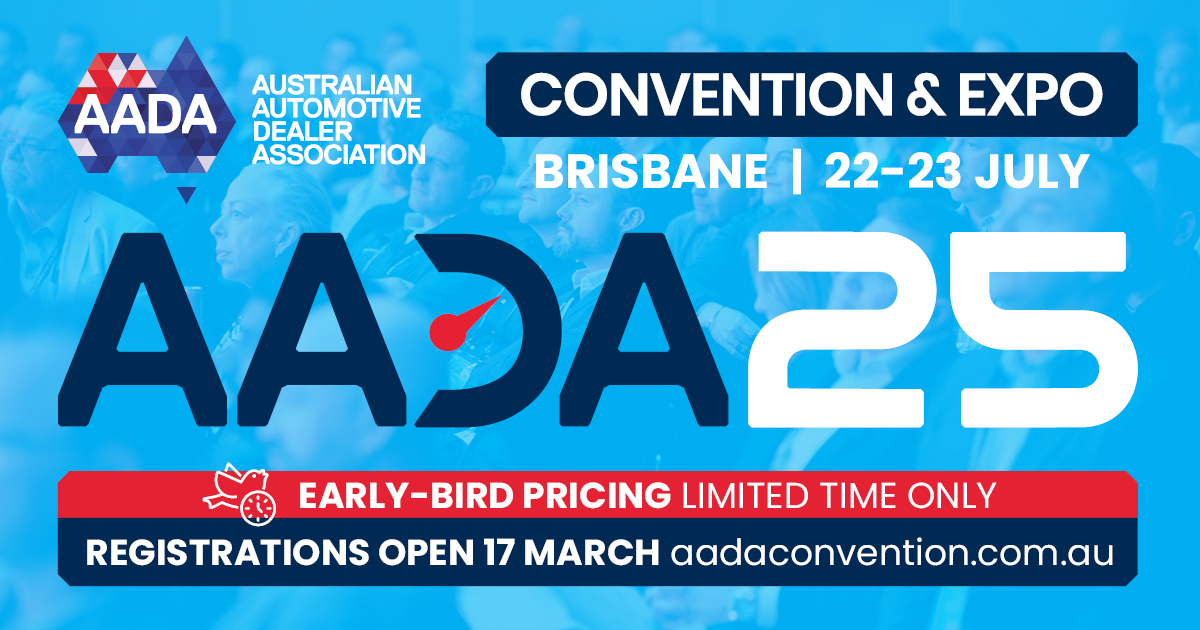
Get ready to shift into high gear! The highly anticipated 2025 AADA Convention & Expo is set to take place at the Brisbane Convention & Exhibition Centre (BCEC) on Tuesday 22 and Wednesday 23 July, and we are excited to announce that Early-Bird Registrations open on 17 March.

This year’s theme, ‘Changing Lanes’ reflects the ever-evolving landscape of the automotive industry. With new technologies, shifting consumer behaviours, and regulatory changes shaping the future, this convention is designed to help dealers and industry leaders navigate the road ahead with confidence and innovation.

Don’t miss out on securing your spot at Australia’s premier automotive retail event at the best possible rate. Early-bird pricing is available for a limited time, so mark your calendars and be among the first to register.

Stay tuned for more details on keynote speakers, workshop sessions, and networking opportunities.

New Vehicle Sales February 2025

New vehicle sales data for February is in! Total sales have hit 184,335 vehicles YTD, a decrease of 5.3% on the same period last year. Toyota continues to dominate, leading YTD sales with 37,256 units, followed by Mazda. The Toyota RAV4 takes the top spot for best-selling model, while the Ford Ranger follows closely behind.

PHEV sales soared by 346 per cent, in contrast to EV sales which saw another monthly decline. This increase can largely be attributed to deliveries of the BYD Shark 6 which charged its way into the top 10 sales chart for the month with 2,026 deliveries.

SUVs and light commercial vehicles remain the top choices for buyers, reinforcing the market’s strong preference for versatility and practicality. See below for more insights on fuel trends and regional breakdowns.

The AADA has assessed VFACTs and EVC Top 10 Makes & Models YTD, ranking them by volume. The AADA has also analysed new vehicle sales figures by state for the month of February as well as fuel types and market segments.

Clock is Ticking for Automotive Franchising Reform

This week the appeal being lodged by Dealers against Mercedes-Benz is being heard by the Full Court of the Federal Court of Australia. This is the latest chapter in this dispute which commenced in 2021 when Mercedes-Benz Australia made the decision to issue non-renewal notices to all its Dealers as part of a restructuring of its business from a dealer to an agency model.

This has been referred to as the most important case in Australian franchising history and the precedent set will be of consequence to every franchised new car and truck Dealer across Australia as well as other sectors of the franchise industry. Dealers argue that when Mercedes-Benz Australia issued the non-renewal of franchise agreements, they did so not to merely bring an end to the agreements. Rather, the agreements were terminated to pressure its franchisees into accepting a new agency business model which leveraged the Dealers’ existing investments in infrastructure and customers to its own benefit without paying any compensation and which severely curtailed their ability to run their businesses profitably. The result was that all those Dealers experienced a significant reduction in the value of the goodwill of their businesses and by extension the value of their businesses.

In handing out his judgment, Justice Beach, found that while the Dealers put forward a strong case, he was critical of the Franchising Code of Conduct providing no protection for goodwill to Dealers. He even went as far as to say that the Franchising Code of Conduct needed to be revisited in this regard. Unfortunately, a recent review by Dr Michael Schaper of our Franchising laws did not address the observations made by Justice Beach. The case also demonstrates how unachievably high the bar is set to prove unconscionable conduct in a commercial context under the Australian Consumer Law. The high cost of litigating in Court is also prohibitive and barrier to justice for most Dealers.

This leaves Dealers in a very vulnerable position. Left unchallenged, the Mercedes-Benz move to Agency has set an alarming blueprint for any other multinational car brand or franchisor for that matter to follow. In short, a business model built on the investment of franchisees can now be appropriated by a franchisor without the need to pay any compensation to the franchisees.

The situation has been compounded by several other factors, namely the development of the New Vehicle Emissions Standard by our Federal Government. The NVES is incredibly stringent and the way it has been designed will allow unethical OEMs to shift much of the financial pressure onto their Dealer networks. The other dynamic is the emergence of dozens of new Chinese brands, a factor being encouraged by the NVES due to the Chinese brands being predominantly focussed on electric vehicles.

For many years, the AADA has been campaigning for fit for purpose automotive franchising protections like those which have existed for more than 50 years in the United States. There have been recent changes to our franchising laws, including the development of an automotive specific schedule to the Franchising Code. However, on balance the pendulum of power firmly favours OEMs, as demonstrated by the Mercedes-Benz case.

The Dealers appeal against Mercedes-Benz Australia will be challenging Justice Beach’s interpretation of unconscionable conduct. Justice Beach said in his judgement that unconscionable conduct claim was the strongest part of the Dealers’ case and although he considered Mercedes-Benz’s conduct was harsh and unfair, he did not consider it to be unconscionable within the meaning of the law. In reaching that conclusion, the Dealers consider Justice Beach applied an impermissibly narrow interpretation of unconscionable conduct.

While we hope that the Dealers will be successful, it is widely accepted that unconscionable conduct sets the bar too high. It’s a reason the New South Wales Government in 2011 introduced statutory protections for Dealer against unjust and unfair conduct in their dealings with OEMs.

We need Dealers and all franchisees to be protected against unfair trading practices and against unfair contract terms. These are simple reforms that will make a massive difference to a significant sector of our economy. A sector of the economy that is Australian-owned and located in communities throughout the country. A sector which employs more than 75,000 people and is responsible for over $90 billion of sales.

As we head to a Federal election, Australia’s nearly 4,000 car and truck Dealers located in almost every electorate will be looking to the major parties for action. Such is the pace of change in this industry that the next three years are expected to bring much disruption. We need our leaders to respond to the risks made so clear by the Mercedes-Benz trial and compounded by the coming NVES and the rise of China.

Picture of James Voortman

James Voortman

Chief Executive Officer

January AIR

The January 2025 edition of the Automotive Insight Report (AIR) highlights a shift in the Australian used car market, with supply increasing by 3.4 per cent to 333,386 listings, reversing previous months of decline. However, consumer demand remains subdued, with total sales dropping by 5.9 per cent.

“The increase in listings, coupled with declining sales, suggests that the market continues to favour buyers,” said AADA CEO James Voortman. “Sellers are facing longer wait times to move stock, with average days to sell holding at 48.5. This trend may persist as the growing availability of new vehicles continues to impact the used car sector.”

“Retained values remained under pressure, with most vehicle segments showing declines. However, retained values for light commercial vehicles saw slight increases in some age categories, continuing to buck the trend.”

“The EV segment also experienced weakening demand, with total EV sales down by 7.9 per cent, and listing-to-sale ratios remaining the highest among all vehicle categories. This reflects the ongoing impact of new vehicle oversupply, which is putting downward pressure on used EV prices,” Mr Voortman added.

In retained value rankings, the Ford Mustang held the highest value among passenger vehicles (in the 2-4 year category), while the Suzuki Jimny continued a 15 month hold on the top spot in the SUV category. Toyota further cemented its market strength, holding 7 of the top 10 SUV retained value rankings.

HIGHLIGHTS FROM THE AIR FOR JANUARY 2025

  • 171,007 used cars were sold in January, a decrease of 5.9 per cent from the previous month.
  • Dealer contribution to both sales and listings is at its highest level in recent history.
  • Sales declined across all states, with NT (-10.1 per cent) and VIC (-9.9 per cent) experiencing the largest drops.
  • Average days to sell a used vehicle remained steady at 48.5 days.
  • Passenger and SUV retained values declined across most model years, with LCV-Utes showing minor gains.
  • Ford Ranger remains Australia’s best selling used car.
  • Japanese manufacturers dominated the top sellers list, with 8 of the top 10 models originating from Japan, and Toyota alone accounting for 5 of the top 10.
  • EV retained values continued to lag significantly behind other segments.

AADA 2025 Election Platform

The AADA presents its 2025 Election Platform, outlining key policy recommendations to support franchised new vehicle dealers across Australia. This platform addresses critical issues such as unfair trading practices, franchisee protections, access to justice, and the transition to a low-emission vehicle market.

AADA advocates for fairer industry regulations and policy reforms to ensure a sustainable and competitive automotive retail sector. Download the document to explore the full policy recommendations.

Used Car Market Slows After Strong 2024 – Cautious Outlook for 2025

The Australian Automotive Dealer Association (AADA), in partnership with AutoGrab, has released the 2024 Year That Was Automotive Insights Report (AIR), providing a comprehensive analysis of the Australian used car market. While the market experienced strong growth for most of 2024, momentum slowed in the final months, signalling a more measured outlook for 2025.

According to the report, total used car sales in 2024 reached 2,324,805 units, a 12.1 per cent increase compared to 2023. Sales peaked in July, with sustained demand throughout much of the year before easing towards the end. Listings, on the other hand, peaked in November, highlighting a softening in consumer demand relative to supply.

“AADA is pleased to publish the second annual release of the Year That Was AIR. The 2024 results highlight a dynamic used car market that showed strong growth through much of the year before slowing in the final quarter,” said AADA CEO James Voortman.

“While demand remains healthy, we are seeing signs of cooling, particularly in the latter months, as affordability pressures and economic factors come into play.”

Toyota remained the top-selling brand, with 390,298 used vehicles sold, followed by Mazda and Ford. Among individual models, the Ford Ranger led with 82,448 sales, ahead of the Toyota Hilux and Toyota Corolla.

“Profit margins tightened, and days to sell increased by 15 per cent for listings between August and October, further indicating a slowdown in demand. As we head further into 2025, we anticipate a more subdued market, with sales likely to stabilise rather than grow at the rapid pace we saw earlier in 2024,” said Mr Voortman.

“This is good news for those in the market for a used car, with opportunities for a good deal,” Mr Voortman added.

AADA Expands Resources

The AADA has bolstered its leadership team with the appointment of two key industry professionals to strengthen its advocacy efforts. Matthew Hawkes has been named Head of Public Affairs, while Michael (Mick) McKenna steps into the role of Director of Industry Affairs. These appointments reflect AADA’s commitment to enhancing Dealer representation at both state and national levels, ensuring a strong and unified voice for the industry.

Matthew Hawkes has over 15 year’s experience working in Government, Public Policy and Government Relations. Prior to commencing at AADA, Matthew was employed at GRA Cosway where he advised some Australia’s largest companies on their government relations strategies. He has previous been employed as the Policy Manager at the Financial Services Council. In addition, he served as Chief of Staff to Senator Deborah O’Neill for five years. It was during this time with Senator O’Neill, Matthew developed a strong understanding of franchised new car Dealers working on key parliamentary inquiries including the 2019 Parliamentary inquiry into Franchising reforms and the 2021 Parliamentary inquiry into the relationship between car manufacturers and car dealers in Australia. 

Prior to his appointment, Mick McKenna led the secretariat of the Victorian Automobile Dealers Association (VADA), a key division of the Victorian Automotive Chamber of Commerce (VACC) for 16 years. Mick has a very strong understanding of the issues facing franchised new car and truck Dealers in Australia. Over the years he has developed strong relationships with state Government as well as regulatory agencies and has a strong track record of successfully advocating on behalf of car, truck, motorcycle and farm machinery Dealers.

 “AADA is pleased to announce the appointment of both new secretariat members,” said AADA CEO James Voortman.

 “Matthew has a very good understanding of the inner workings of government and has developed strong experience in a number of issues important to AADA members including franchising reform and finance and insurance issues.”

 “Mick is particularly well known and respected amongst Victorian AADA members and enjoys an excellent reputation amongst dealers in Victoria and throughout Australia. We look forward to him applying his vast experience and practical approach to addressing key issues for franchise new car and truck dealers across the country.”

 “AADA believes now is a good time to strengthen its resources in supporting both state and national dealer issues. The addition of these two staff members will help us better address member concerns at both levels, ensuring dealers have strong representation and a unified voice in Canberra.”

Release of 2025 Edition of DealerNomics

AADA is proud to release the 2025 edition of the DealerNomics Automotive Statistics booklet. DealerNomics 2025 remains an essential resource, offering key insights into the latest automotive industry trends. This year’s edition continues to provide a comprehensive summary of the most relevant data, helping members stay informed in an ever-evolving market.

For 2025, we’ve expanded our coverage to include:

  • Analysis of the new vehicle market, combining sales data from multiple sources for a comprehensive view
  • For the first time, truck Dealer network performance and economic data
  • Used vehicle sales trends • Australia’s in-service vehicle fleet
  • The economic contribution of dealerships
  • Dealer network sales performance
  • Highlights from our latest consumer sentiment survey on EV adoption
  • Motor industry benchmarking insights

MTAQ and AADA Conclude Memorandum of Understanding

The MTAQ and the AADA have signed a Memorandum of Understanding which commits the two organisations to stronger cooperation for the benefit of Queensland’s automotive franchised Dealers. 

The MoU recognises the MTAQ, as the peak body representing franchised Dealers in Queensland and the AADA as the peak industry body representing franchised Dealers nationally. It commits both associations to closer cooperation and sharing of resources and paves the way for Queensland Franchised Dealers to be represented by one voice. 

“This model of advocacy will bring significant benefits to Franchised Dealers in Queensland, and I am looking forward to combining the strengths and resources of the MTAQ and the AADA as the industry embraces a period of change,” said MTAQ CEO Rod Camm. “MTAQ has a strong and proud history of providing essential core services to dealers and the broader industry by the way of workforce development and skills training, apprenticeship programs, Industrial relations and state based advocacy. This will remain our core purpose. 

“We have heard from so many Dealers that they want coordination and cooperation between their national and state bodies and this agreement with MTAQ puts us a step closer to having Dealers represented by one voice,” said AADA CEO James Voortman.

By signing this MoU, AADA and MTAQ agree to the following immediate actions:

  • Coordination of messaging on policy positions, submissions and media releases
  • Acknowledging AADA as the peak industry body representing Queensland franchised Dealers at a national level
  • Acknowledging MTAQ as the peak industry body representing franchised Dealers at in Queensland       
  • MTAQ representation at AADA committee meetings 
  • AADA representation at MTAQ dealer committee meetings

By signing this MoU, AADA and MTAQ agree to work towards the following actions:

  • Embedding a shared resource within the MTAQ
  • Considering whether opportunities exist for Dealers to streamline the payment of membership fees for AADA/MTAQ services.

New Vehicle Sales January 2025

New vehicle sales for January 2025 were down 2.4 per cent on January last year, continuing the trend from the slow finish to 2024. Economic pressures remain a consideration for consumers and 2025 is expected to be a slower year for the new car market with a decline in sales expected.

Consumer preferences for SUVs and Light Commercial vehicles remain clear, with Ford Ranger, Toyota RAV4, Ford Ranger and Toyota Hilux ranking as the top 3 models year-to-date. Across fuel types, Hybrid and PHEVs continue to be a favourable option over BEVs as brands and consumers adapt to evolving emission standards.

The AADA has assessed VFACTs and EVC Top 10 Makes & Models YTD, ranking them by volume. The AADA has also analysed new vehicle sales figures by state for the month of January, as well as fuel types and market segments.