2024-25 Annual Report

We are pleased to share the second edition of the AADA Annual Report, covering the 2024–25 financial year.

This year’s report captures the breadth of the AADA’s work across policy, research, events, and industry engagement. From securing important commitments on franchising and NVES, to expanding initiatives like the Dealer Satisfaction Survey, the report reflects the ongoing effort to support and strengthen Australia’s new car and truck dealer community. Inside you’ll find:

  • Outcomes from key advocacy campaigns on franchising and the NVES.
  • Expansion of research and insights, including the second Dealer Satisfaction Survey and multiple EV related projects.
  • Highlights from our member communications, submissions, and political engagement.
  • Coverage of the 2025 AADA Convention & Expo and recognition of our Lifetime Achievement Award winners.

The Annual Report is designed to provide a clear view of the year that was, and the work being done to ensure a strong future for franchised new car and truck dealers.

Vale Richard Collins

It is with sadness that the AADA advise of the passing of prominent South Australian dealer and former AADA director, Richard Collins, Chair of the Jarvis Group,

Richard was a highly respected and adept businessperson who earnt a Bachelor of Commerce from the University of Melbourne University, where he majored in Economics and Company Law. Prior to acquiring Jarvis Ford in 1984, Richard worked for 10 years with Ford Australia. Under his watch, the Jarvis Group has grown to employ over 300 South Australians, selling over 7,000 new cars annually from the likes of Ford, Toyota, Subaru, Suzuki, Isuzu Ute, Skoda, Peugeot, Deepal, and Geely franchises.

Richard was well respected in the industry, serving as Chair of the ASX Listed Carsales, and filling the role of the South Australian Director on the AADA Board.

Richard was a noted philanthropist and supported numerous animal welfare and children’s charities in Australia and overseas. Richard and wife Joanna were both recipients of Member of the Order of Australia (AM) in the Queen’s Birthday Honours List in 2021, for their significant service to the community through charitable initiatives.

The Chair, Board and Secretariat of AADA send its deepest condolences to Richard’s wife Joanna, the Collins family and to all employees of the Jarvis Group.

July 2025 AIR

The Australian Automotive Dealer Association (AADA), in partnership with AutoGrab, have released the July 2025 Automotive Insights Report (AIR), offering comprehensive national reporting of used car sales covering both dealer and private transactions. This national, all-channel view helps industry and policy-makers understand real demand, track emerging trends, and make better-informed decisions.

The results from the July AIR shows a slight slowdown in used vehicle sales activity following June’s end-of-financial-year peak, alongside continued softening in retained values across most segments.

Key insights from July include:

  • Sales ease after EOFY surge: National used car sales fell to 206,216 in July, down 2.8 per cent month-on-month. WA, TAS, ACT and NT recorded modest increases, while all other states saw declines.
  • Dealer inventory remains strong: Dealers accounted for 47.5 per cent of sales and 55.5 per cent of listings. Total active listings rose 2.9 per cent to 339,742 nationally, the highest level so far in 2025.
  • Hybrid and EV sales slow: Hybrid sales fell 8.5 per cent month-on-month, while EVs dropped 20.3 per cent. However, hybrid listings increased 13.6 per cent and EV listings rose 4.9 per cent, indicating ongoing supply growth in these segments.
  • Days to sell dropped: Average days to sell across all used vehicles fell to 44.6 days in July, down from 47.0 in June, indicating a quicker turnover for vehicles that matched buyer demand.

“July often sees a cooling in sales activity after EOFY, so these results are in line with seasonal patterns,” said AADA CEO James Voortman.

“Stock levels are building, which is positive for consumer choice, but the ongoing softening in retained values is something dealers will be factoring into pricing and margins,” he said.

“For consumers, the easing in retained values means there’s more opportunity to secure a better deal on a used vehicle than we’ve seen in recent years. With more stock on the market and prices softening across most segments, buyers have greater bargaining power and more choice to find the right car at the right price.” said Mr Voortman.

New Vehicle Sales July 2025

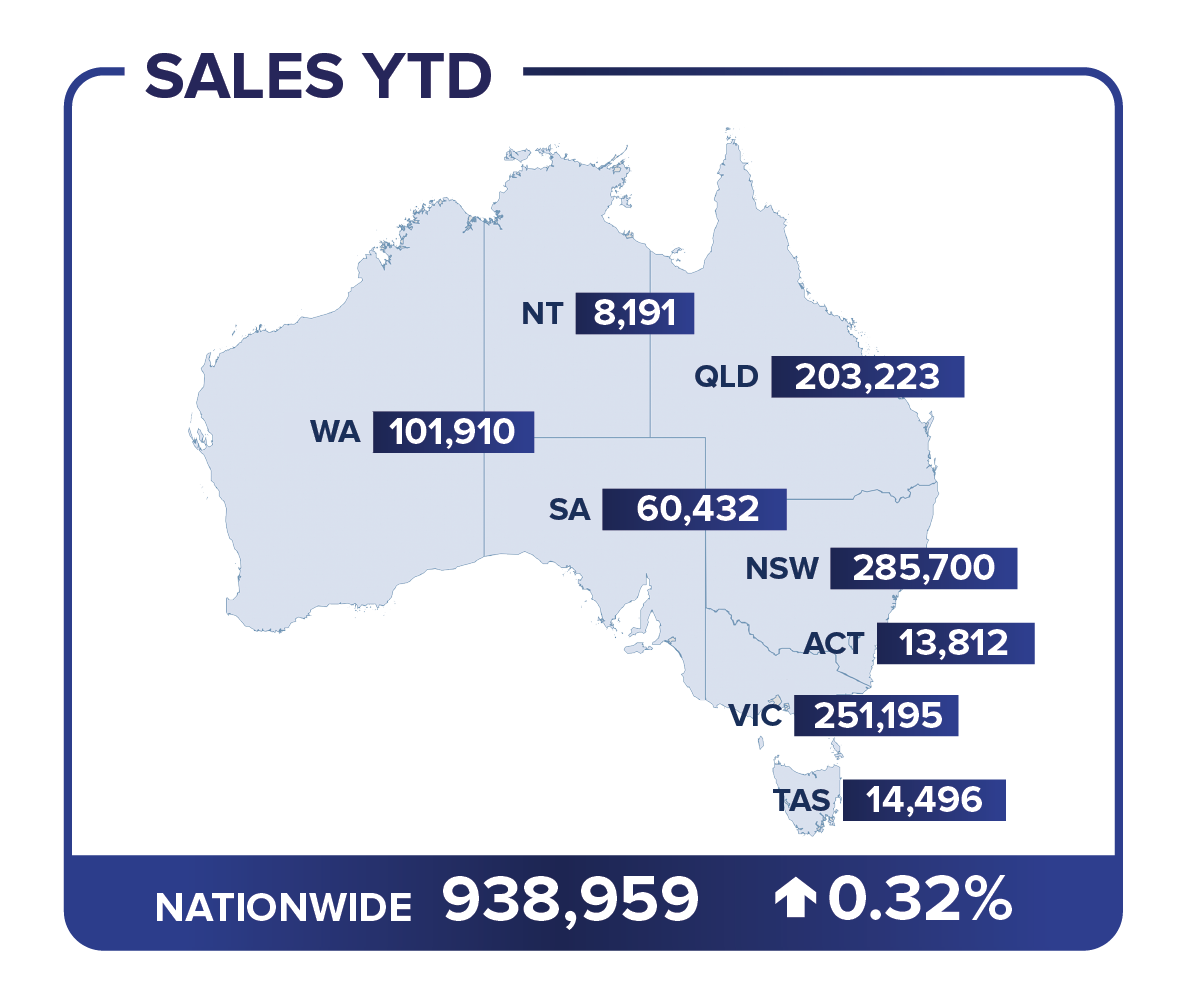
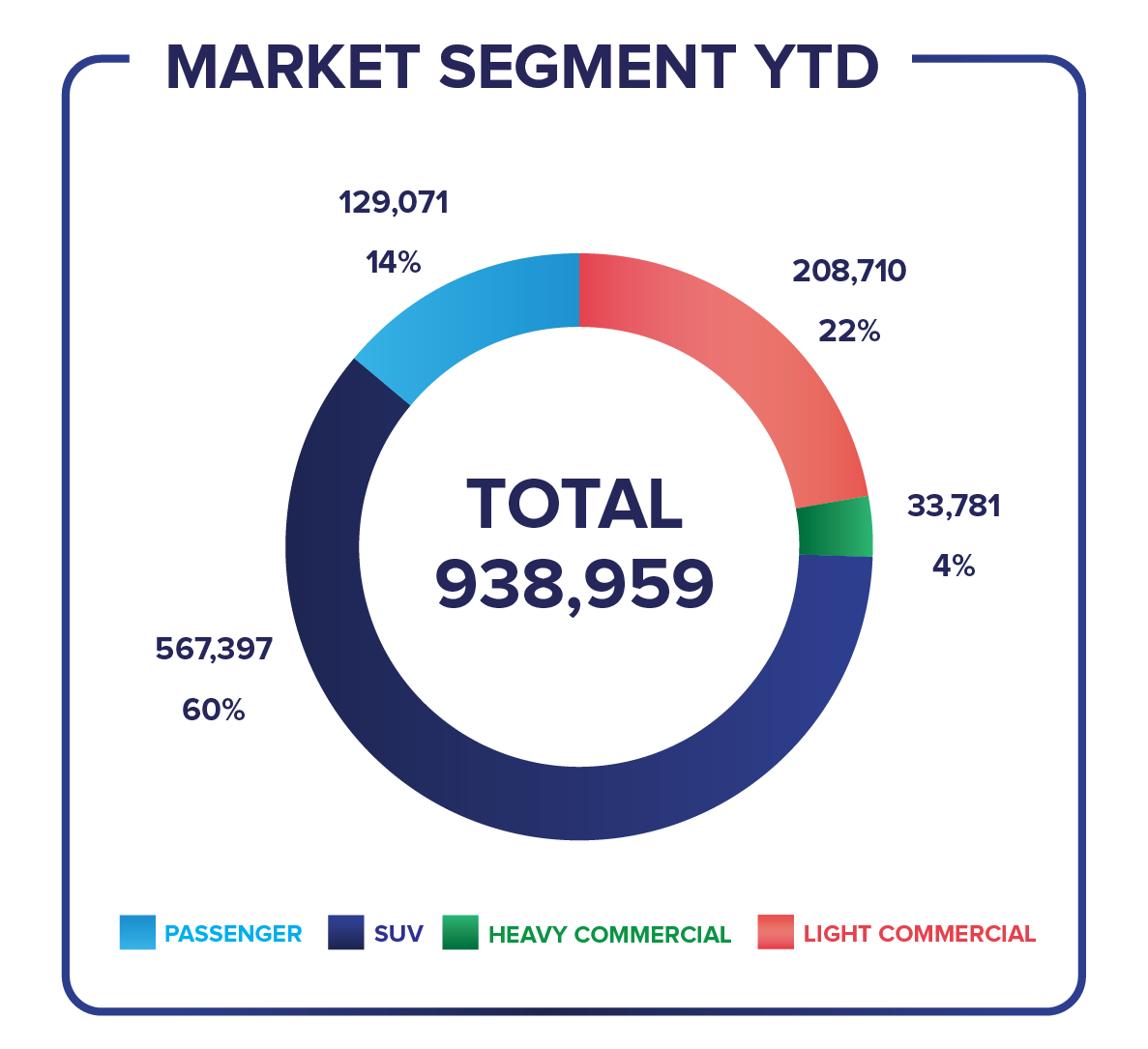
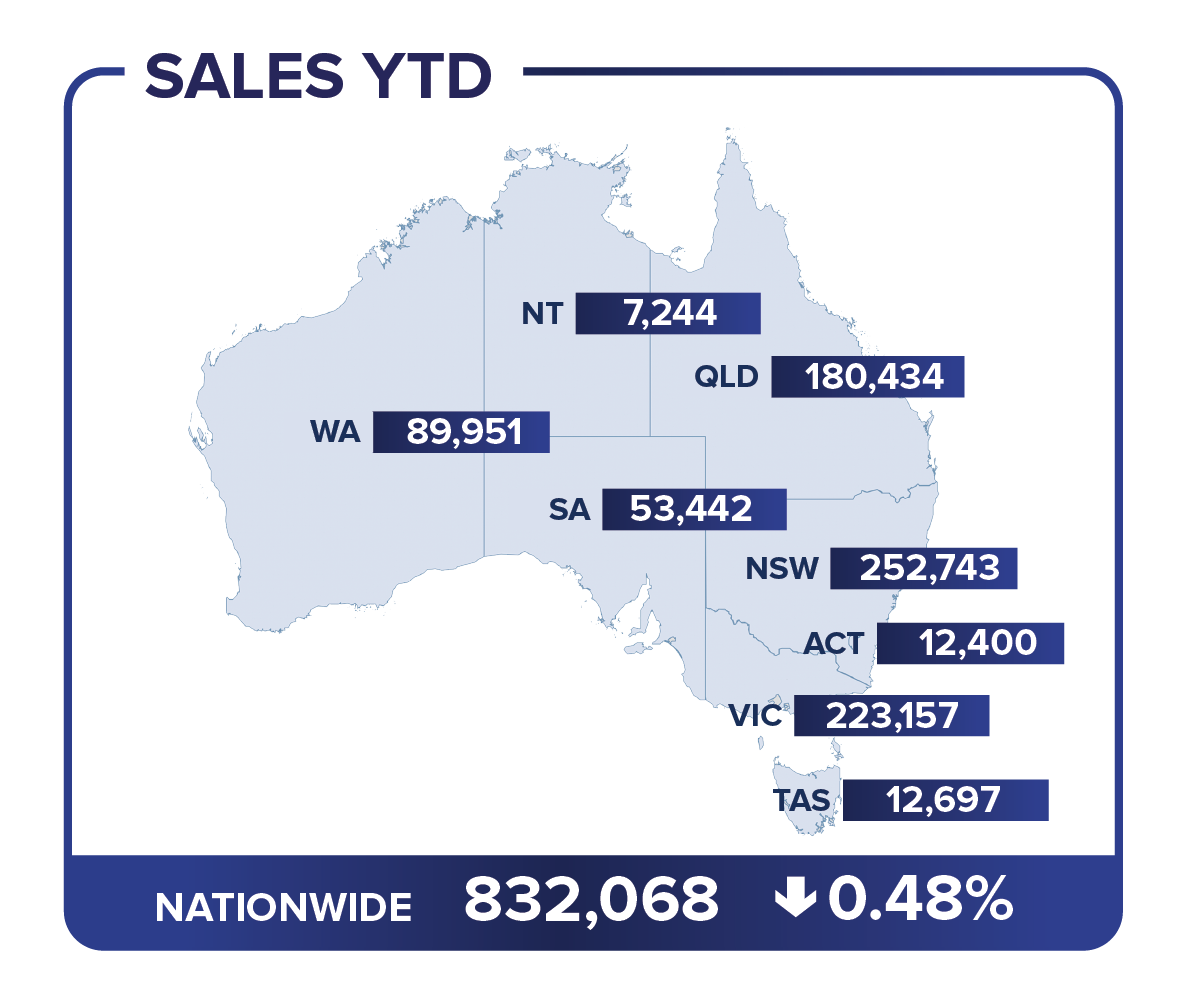
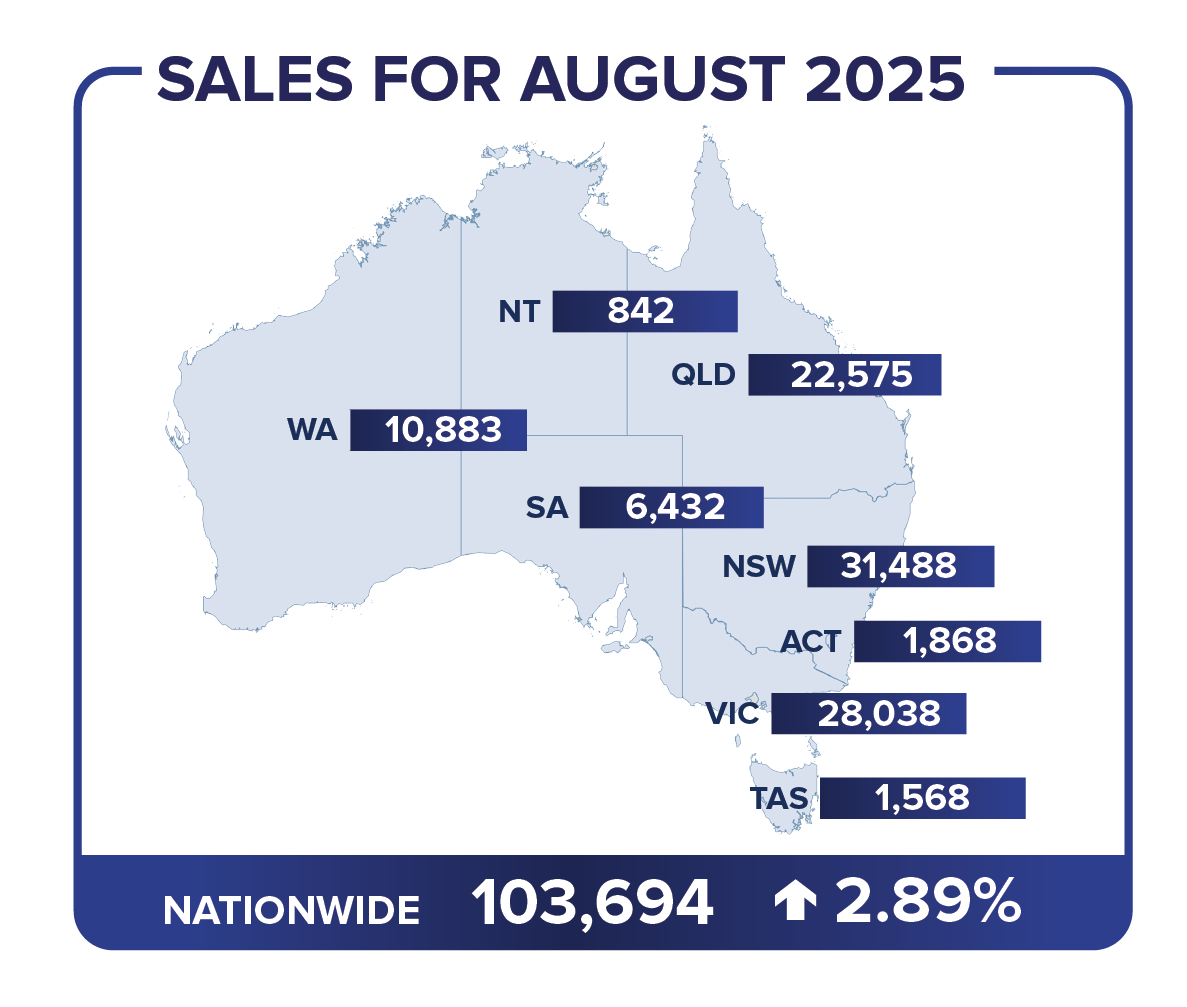
Australia’s new vehicle market recorded 104,244 sales in July, up 2.02 per cent compared to the same month in 2024. While year-to-date sales are down slightly by 0.94 per cent, the July figures highlight continued resilience in the market.

➡️ NSW led the way with over 31,000 sales, followed by VIC and QLD.
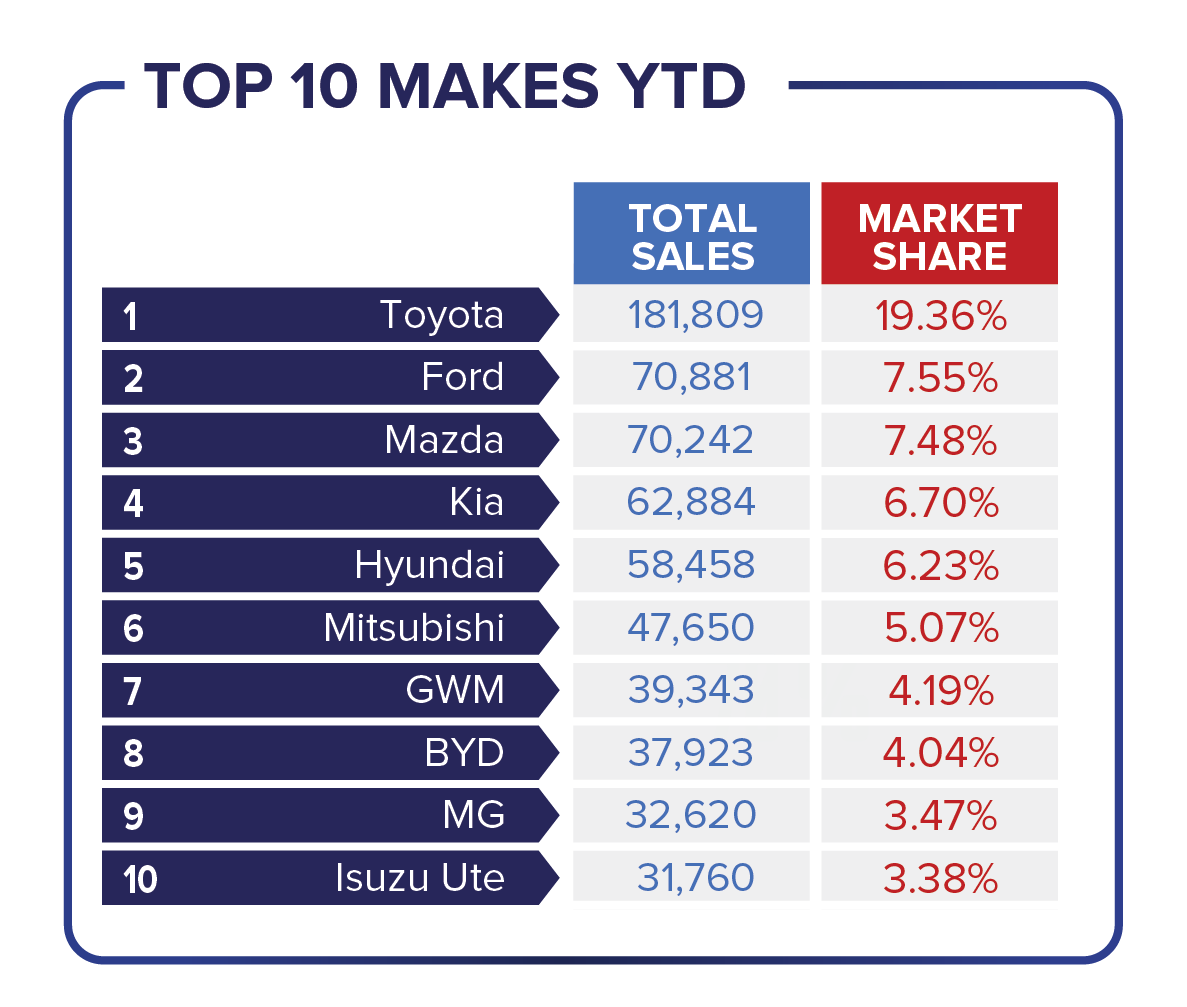
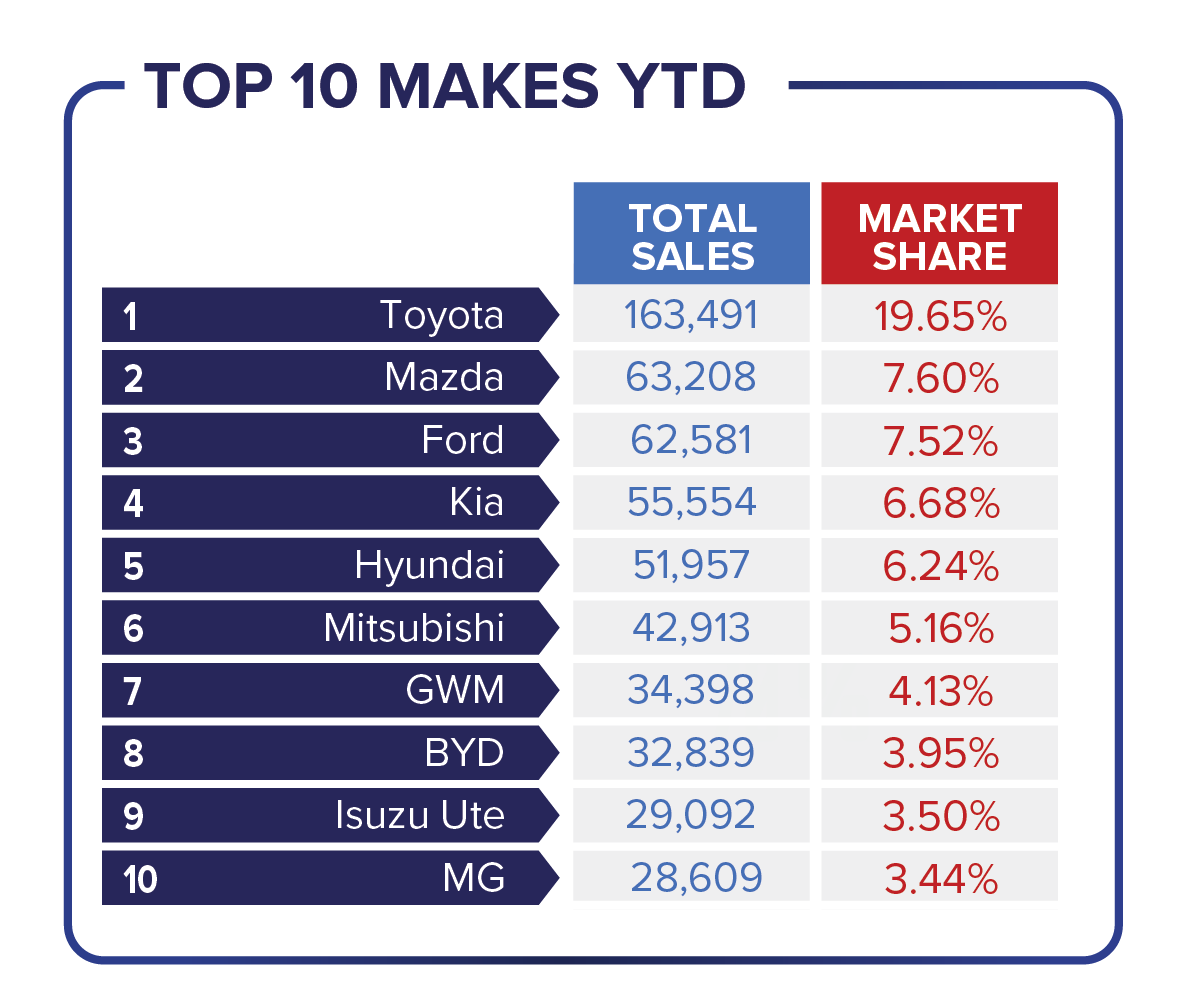
➡️ Toyota remains the market leader, with 142,700 vehicles sold YTD, holding a 19.59 per cent market share.
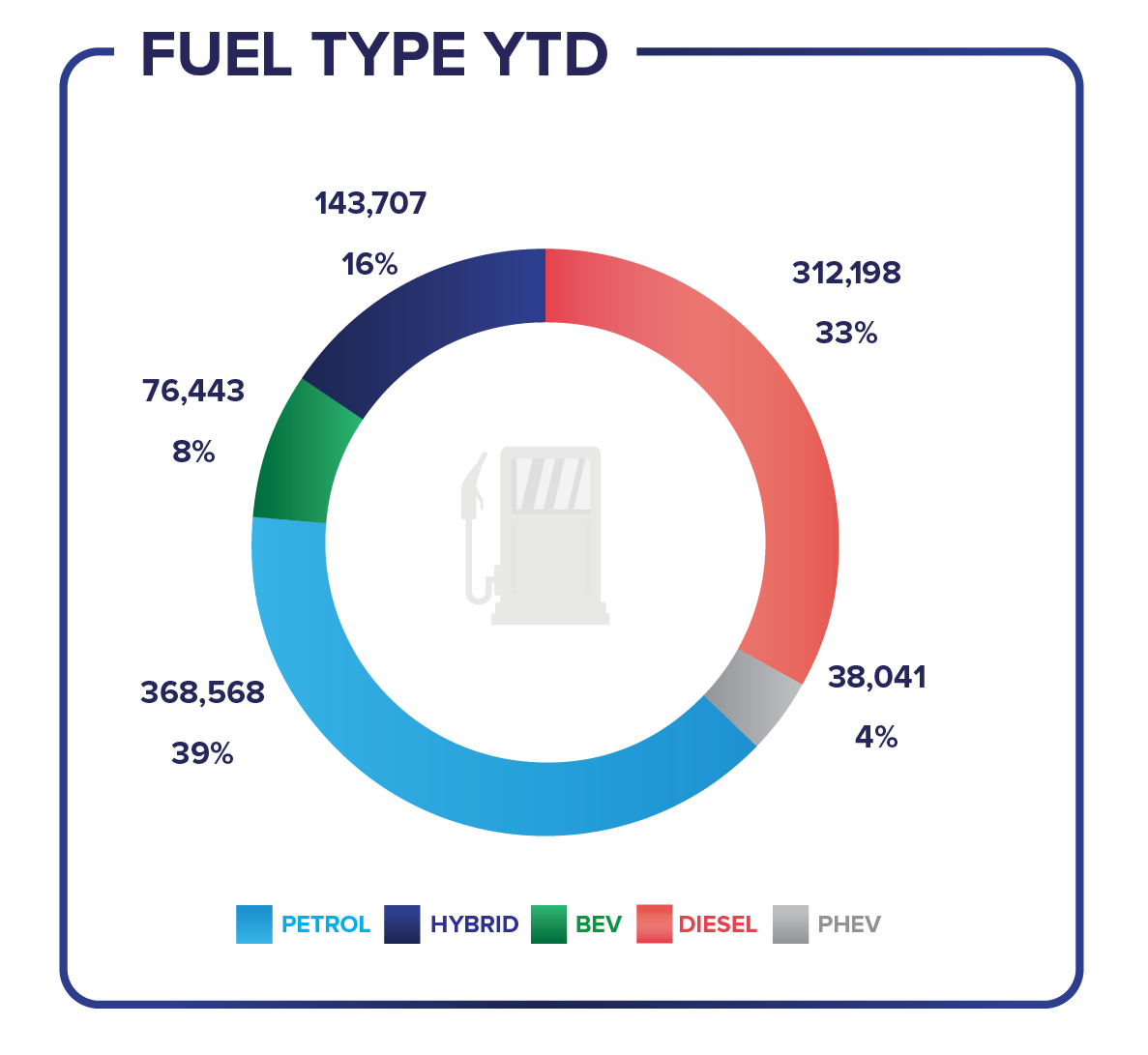
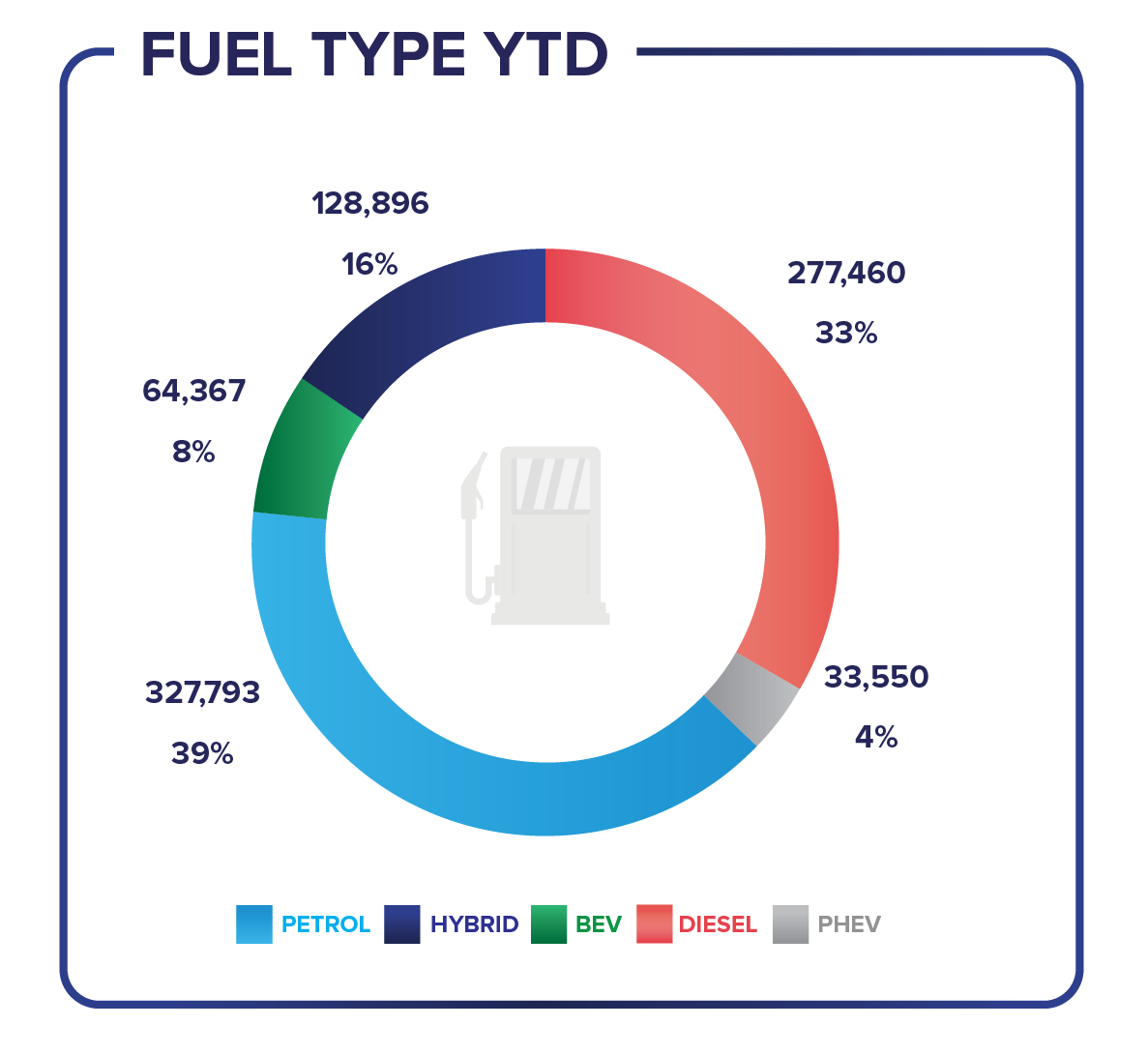
➡️ Petrol continues to dominate (40 per cent), while diesel holds a 33 per cent share.
➡️ Battery electric vehicles (BEVs) account for 8 per cent of sales YTD. Hybrids are tracking slightly higher at 15 per cent.

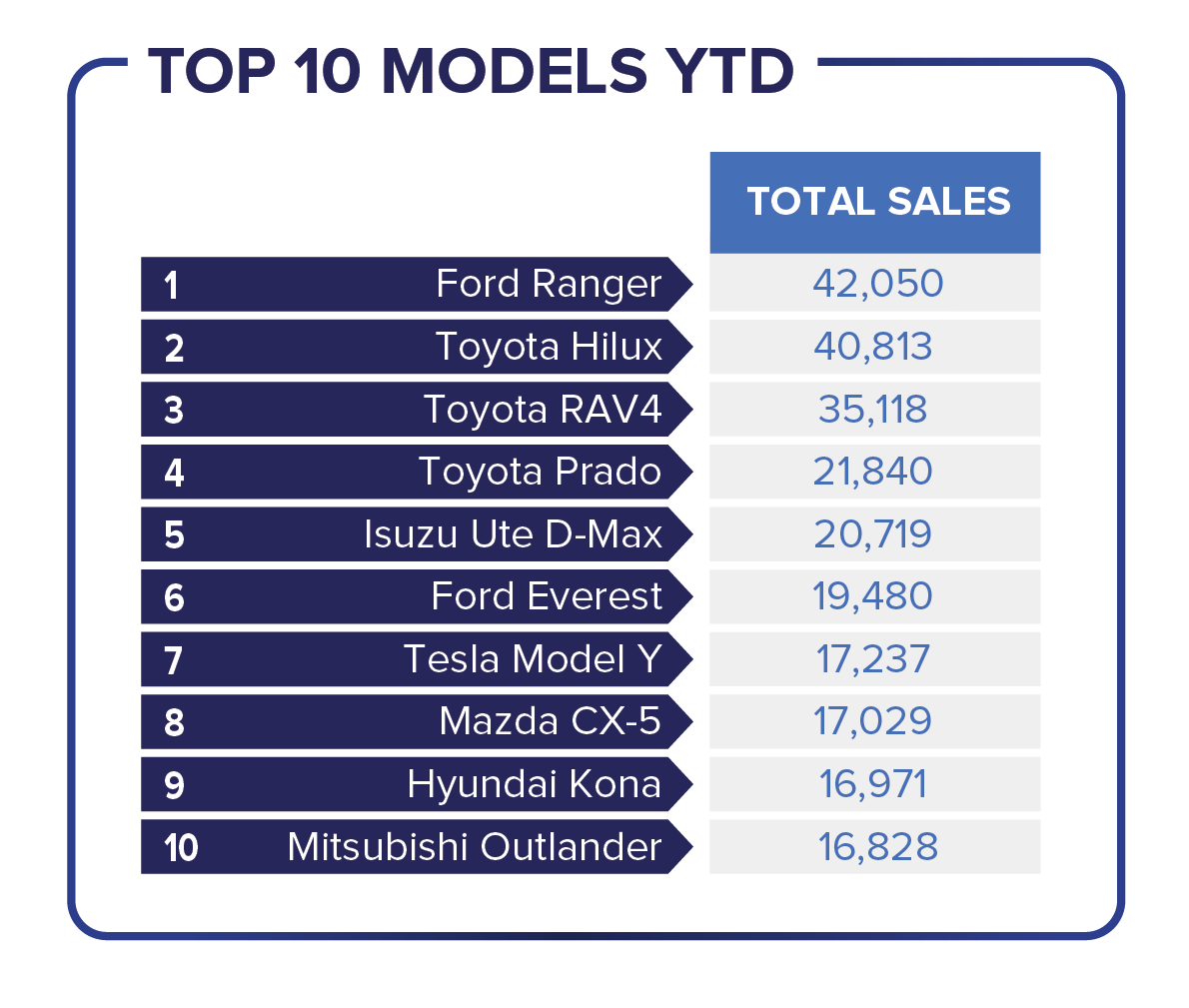
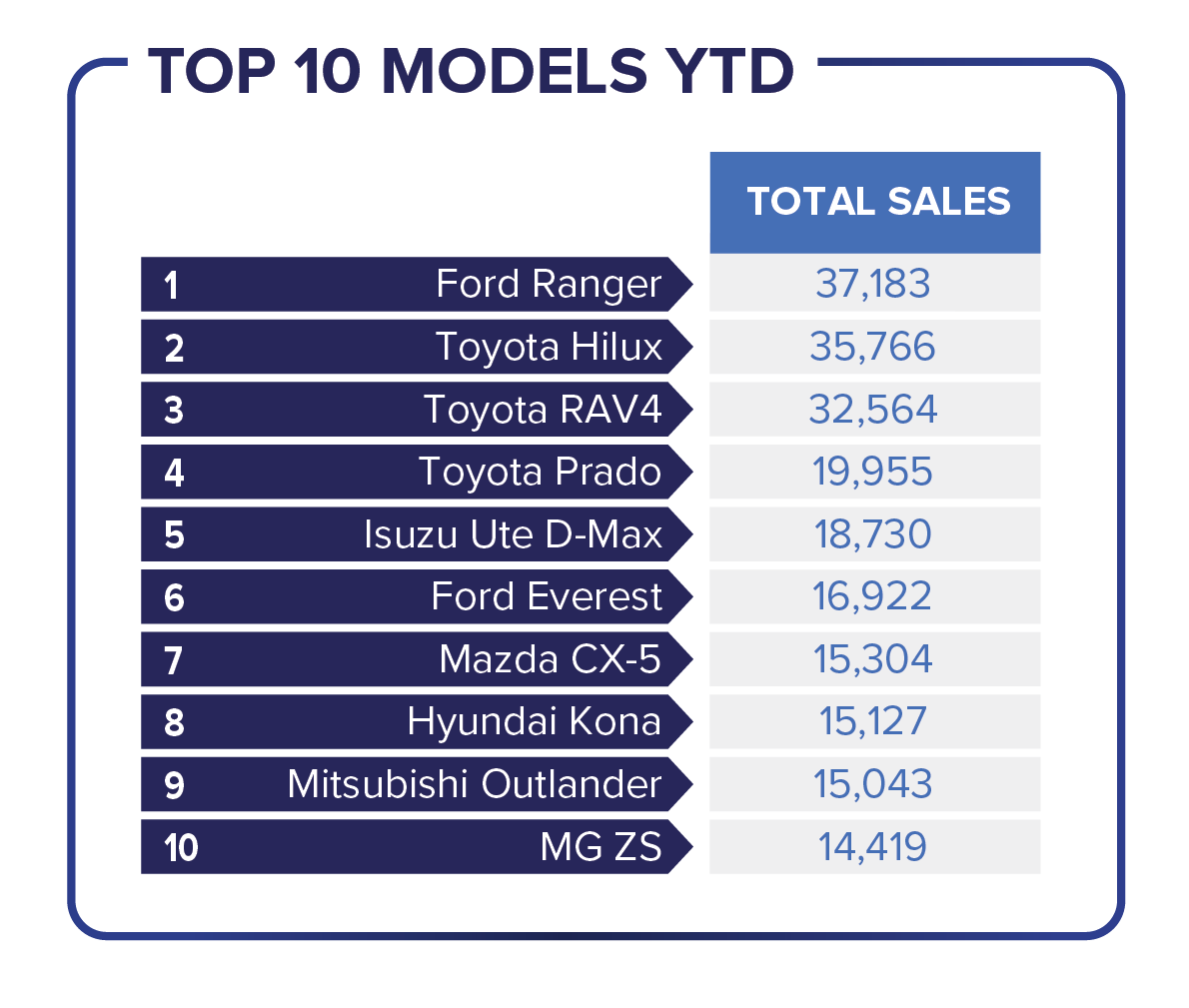
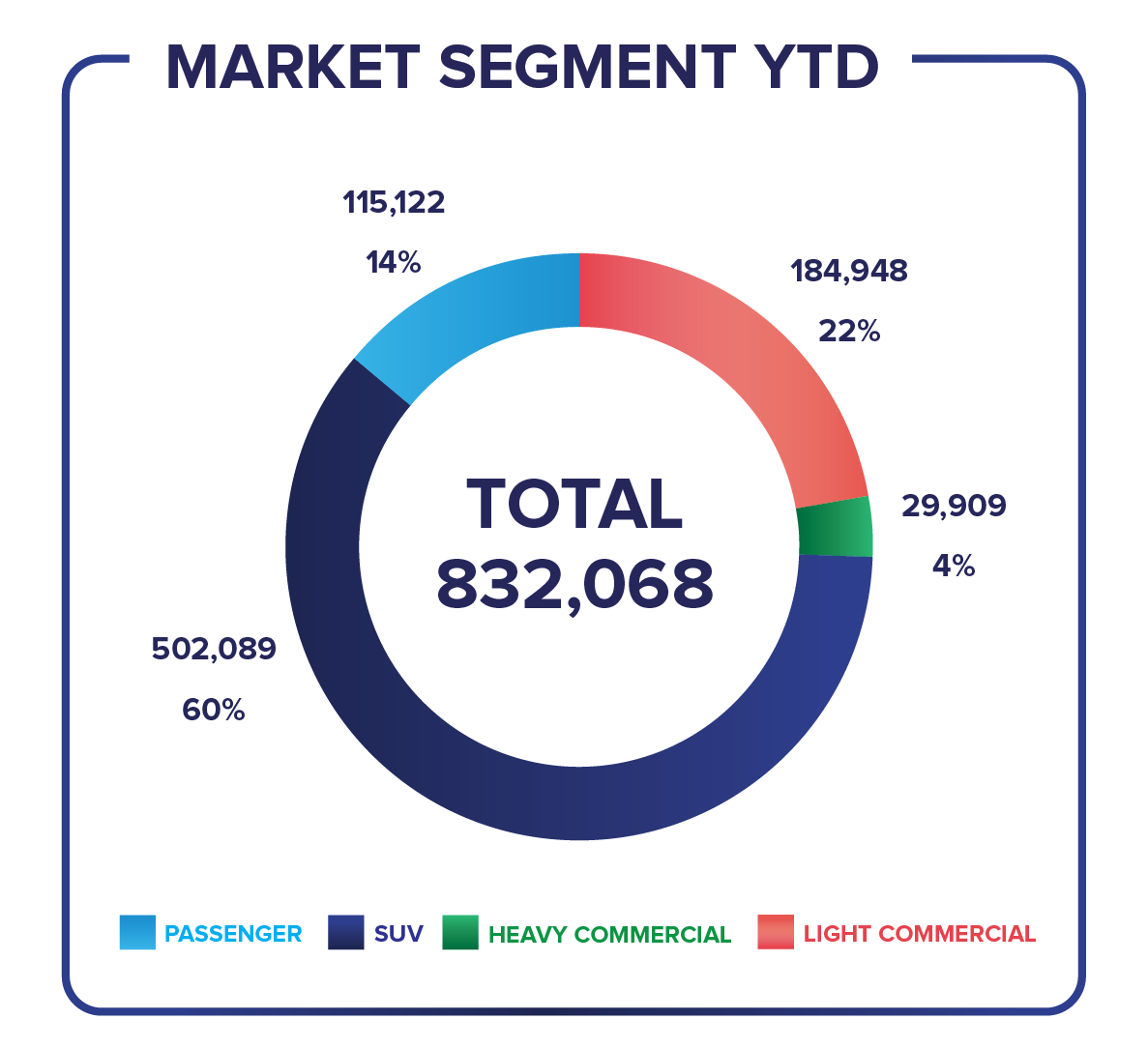
The AADA has assessed VFACTS and the EVC Top 10 Makes & Models YTD, analysing trends across fuel types, segments, and states.

Mid-Year Insights Show Used Car Supply Surging

The Australian Automotive Dealer Association (AADA) and AutoGrab are pleased to release the Mid-2025 Automotive Insights Report (AIR), providing insightful data about the dynamic Australian used car market in the first half of the year.

Used car inventory is surging, with 1,589,491 vehicles listed for sale in the first six months of 2025 which represents an over 30 per cent increase compared to the same period in 2024.

This uplift in supply is matched by stable demand, with 1,133,990 used cars sold so far this year, a slight increase on 2024. Notably, the market is experiencing a continued shift back toward dealership sales, with dealer transactions now representing 46.7 per cent of total sales, up from 36.5 per cent last year.

“After a year of constrained supply and strong retained values, we’re seeing greater balance return to the used car market,” said AADA CEO James Voortman.

“The mix of rising stock levels, stable demand and more stable pricing is creating better conditions for consumers and dealers alike,” said Mr Voortman.

Low emission vehicle adoption continues to gain momentum. Battery electric vehicle (BEV) sales nearly doubled year-on-year, rising 92 per cent, while plug-in hybrid sales grew by 96 per cent. Hybrids also performed strongly, up 42 per cent on the same period last year.

“The growing inventory surplus is likely to place downward pressure on prices and could result in extended selling times during the second half of 2025. The surge in supply is primarily driven by passenger vehicles and SUVs. While SUVs continue to underpin sales growth and utes are stable, demand for passenger vehicles has shown a noticeable decline,” said AutoGrab CCO Saxon Odgers.

“The other standout trend in 2025 is the acceleration of electrified vehicle sales in the used market. While we are coming off a low base, used EV stock is growing, and are becoming far more visible and accessible to buyers,” said Mr Odgers.

Among brands, Toyota remains the market leader for used car sales, though its market share slipped slightly to 15.6 per cent as other brands gained ground. A number of manufacturers have seen significant growth in their sales figures, with GWM, Kia, and MG the headliners.

The Ford Ranger maintained its position as the top-selling used model, with 43,030 units sold, followed by the Toyota Hilux and Toyota Corolla.

Other highlights from the 2025 mid-year AIR include:

  • BEVs now account for 1.1 per cent of all used car sales, up from 0.8 per cent last year.
  • Private sales dropped significantly, now making up 53.3 per cent of all transactions (down from 63.5 per cent).
  • Retained values are lower in 2025 compared to last year, but the rate of decline month-to-month is more gradual, indicating a more stable market.
  • The average number of days to sell a used vehicle remained steady for dealers, though private sellers are taking longer to sell compared to the same period in 2024.

New Research Maps Australia’s Automotive Future

The Australian Automotive Dealer Association (AADA) has released new research today which details Australia’s past, current and future automotive trading partners, with a particular focus on understanding how the New Vehicle Efficiency Standard (NVES) impacts automotive dealers.

The report reveals that China is gaining momentum in supplying vehicles to the Australian market and are on track to become the dominant source of automotive imports by 2035 with 43 per cent of all new vehicles sold by 2035 coming from China.

The research to be released at the 2025 AADA Convention & Expo to over 1,000 new car dealers and industry stakeholders, details how the Australian automotive market has always been in a constant state of flux but this rapid growth of imports from China will fundamentally change the Australian automotive landscape.

Speaking to the research at the Convention, James Voortman, CEO of AADA, notes that:

“Australia is at an inflection point where we are going to see exponential growth of sales and new brands from China which we are already starting to see now. This growth comes on top of the change to electric vehicle drive trains.”

“This rate of growth can have unintended implications to consumer protections such as the supply of parts, wait times to service vehicles, and the long-term ability of manufacturers to guarantee their consumer warranties.”

“Australian consumers have long expected a level of service from AADA members upon purchasing a new vehicle and we want to continue to meet that expectation. To do that, we will be talking to Government about what consumer protections are adequate and appropriate to support Australian dealers and consumers in what is, on average, the second largest asset Australian’s buy in their lifetime.”

Federal Court Appeal Decision Rocks New Car Dealers

The Australian Automotive Dealer Association (AADA) and Mercedes-Benz dealers across the country are bitterly disappointed by today’s decision by the Federal Court to dismiss their appeal and to find in favour of Mercedes-Benz AG.

Commenting, AADA CEO James Voortman, said:

“Australian dealers have been fighting to stop Mercedes-Benz using their power over franchised dealers to force them into one-sided business relationships. Today’s decision is a significant blow to that fight which will have detrimental effects on Australia’s franchising sector.”

“In handing down today’s decision, there is now a clear need to protect Australian franchisees against unfair treatment from franchisors to arbitrarily change business models with no compensation.”

“The presiding Judge in the original court decision clearly articulated the need for further amendments to the Franchising Code to protect the investments dealers make in their businesses.”

“The Australian automotive industry is currently going through a major transition with the move to electric vehicles. This transition will require massive amounts of dealer investment in infrastructure and servicing to ensure consumers have the confidence to purchase an electric vehicle.”

“Today’s decision confirms that current laws in Australia do not adequately protect new car dealers against unfair conduct and particularly are not being supported against unfair decisions being made in head office overseas. It is imperative that the Federal Government moves at speed to implement the commitments it made in the election to protect franchisees against unfair contract terms and unfair trading practices.”

This decision comes on the back of Holden dealers losing their legal action against General Motors (GM) this year where the Judge found that there was no obligation by GM to supply vehicles to Australian dealers under their franchising agreement.

The AADA will advocate directly to the Federal Government to move with haste to ensure that all automotive franchisees are appropriately protected, so that the blueprint created by this court decision is not used by others.

DOWNLOAD MEDIA RELEASE


About the Court Action

  1. Motor vehicle dealers operate over 3,700 dealership sites in Australia, and employ more than 68,000 workers directly and indirectly in sales of new and used cars, and in provision of service and parts.
  2. They are a small business success story in every Australian city, regional centre and town. Almost all dealerships started from the investment by a single individual or family, and over time some of the dealers have become large public and private company operating multiple brands and sites.
  3. The dealership model is under threat from the risk of unrestrained profit grabs by the large, overseas car manufacturers (OEMs) at the expense of Australian dealers, workers and consumers. This risk arises because there are loopholes in the Australian Franchising Code, that were exposed in a recent Federal Court judgment involving the Mercedes-Benz dealers which the dealers lost.[i]
  4. On 1 January 2022, Australia was one of the first countries to implement a new ‘agency’ model, for Mercedes-Benz globally, under its ‘Retail of the Future’ strategy.[ii] The dealers consistently opposed that model, having voted in December 2019 against the new model 51-4.[iii]
  5. Under the ‘agency’ model, Mercedes-Benz rather than the dealers is the legal seller of all new Mercedes-Benz cars in Australia, thus transferring all retail profits from the dealers to the OEM. The dealers’ new role is that of commission agent, with the original court decision Justice Beach finding that Mercedes-Benz set the commission rates to enable dealers to break even on their new car sales, by covering the dealers’ marginal costs of operation only.[iv]
  6. Justice Beach in the original decision also found at paragraph [390] that the modelling done for Australia, by the Mercedes-Benz Finance staff in Stuttgart, was seen ‘as a source of experimentation to see how low the [Dealers’ Return on Sales] could be pushed by lowering agency commissions. Australia and possibly one other country seem to have been the subject of the most cutting so to speak.’
  7. However, rather than buying out the dealers’ investments to run a centrally controlled sales system, Justice Beach concluded that Mercedes-Benz backed the dealers into a corner.[v] They did this by terminating their existing dealership agreements, by non-renewal notices, and then offering the dealers a choice of either closing their dealerships or signing up to the new ‘agency’ agreements prepared by Mercedes-Benz.[vi]
  8. Justice Beach also found that there was no meaningful negotiation of the financial terms by Mercedes-Benz, which only made concessions on ‘rats and mice issues’.[vii] Mercedes-Benz rejected the dealers’ requests for compensation, and provided a two-year ‘safety net’ which Justice Beach found was not compensation, but was designed to address transition issues.[viii] After considering the expert evidence, Justice Beach concluded that the dealers were materially worse off under new ‘agency’ agreements, and that Mercedes-Benz was substantially better off at the expense of the dealers.[ix]
  9. Ultimately this loss of dealer profit will translate into less future investment by the dealers, a diminished network of dealers, job losses and higher vehicle prices for consumers as competition is removed from the market. As the Mercedes-Benz case shows, Australia’s loss is Germany’s gain.[x] Applied across the whole of the industry, the AADA is concerned that restructuring by stealth will leave the Australian marketplace in a very weak and uncompetitive position in future years to the detriment of businesses, workers, and consumers.


[i] AHG WA (2015) v Mercedes-Benz Australia/Pacific Pty Ltd [2023] FCA 1022, Beach J, 30 August 2023 (“Judgment”), https://www.judgments.fedcourt.gov.au/judgments/Judgments/fca/single/2023/2023fca1022

[ii] Judgment, paragraphs [1768], [1771], [2092]

[iii] Judgement, paragraphs [2], [1625].

[iv] Judgment, paragraph [2658].

[v] Judgment paragraph [2184].

[vi] Judgment, paragraph [2177].

[vii] Judgment, paragraph [245].

[viii] Judgment, paragraph [1797]. The transition issue was the possibility of an X% decline in Mercedes-Benz’ competitive market share as a direct result of the transition to an agency model – see Judgment, paragraph [907].

[ix] Judgment, paragraphs [2377],  [3577], [3593].

[x] Judgment, paragraph [2267] shows how Mercedes-Benz could generate extra profits by raising prices from the ‘former transaction price’ to the ‘optimised fix price’, including by eliminating intra-brand competition.

Used Car Prices Ease as EOFY Deals Drive Strong Sales

The Australian Automotive Dealer Association (AADA), in partnership with AutoGrab, have released the June 2025 Automotive Insights Report, which saw an end-of-financial-year (EOFY) lift in used vehicle sales activity even as retained values begin to soften across most segments.

Key insights from June include:

  • EOFY drives strong sales growth: National used car sales surged to 212,136, up 10.1 per cent month-on-month. Significant increases were recorded in NSW (12.5 per cent), QLD (11.7 per cent), and VIC (9.1 per cent).
  • Dealer activity remains strong: Dealers accounted for 49 per cent of sales and 53.6 per cent of listings. The dealer share of inventory continues to lead, reflecting strategic stock positioning and ongoing consumer confidence in dealer-backed purchases.
  • Hybrid and EV momentum continues: Hybrid sales climbed 21.7 per cent month-on-month, PHEVs increased 29.3 per cent, and EVs rose 7.6 per cent, despite a 6 per cent drop in EV listings. The shift reflects increasing consumer demand for fuel-efficient vehicles.
  • Days to sell remains stable: Average days to sell across all used vehicles held steady at 47.0 days, consistent with May, suggesting sustained consumer engagement as stock levels increased slightly by 1.2 per cent to 330,278 listings nationally.

“EOFY always drives sales activity, but it also tends to put downward pressure on retained values. We saw the same pattern in June last year in that buyers are motivated, but so are sellers keen to close deals before the books close.”” said AADA CEO James Voortman.

“Hybrid and EV sales are continuing to build momentum, showing strong consumer interest in fuel-efficient vehicle despite broader market fluctuations,” he said.

“The pressure on retained values is something dealers will need to factor in when setting margins and managing stock. It’s encouraging to see hybrid and EV sales continue to build momentum, but pricing volatility remains a key watch-point heading into the second half of the year,” Saxon Odgers, Chief Commercial Officer at AutoGrab said.

Southern NSW and Eastern Victoria Tour

During June the AADA team conducted a wide-reaching regional tour across Southern NSW and Eastern Victoria, engaging directly with dealers to discuss the evolving challenges and opportunities facing the automotive retail industry.

The visit began in the ACT with a working lunch in Canberra with David Smith MP, Federal Member for Bean. The discussion focused on the impact of the New Vehicle Efficiency Standard (NVES) and the broader issue of rising business costs in the ACT. We thank Mr Smith for his time and his attentiveness to the concerns of local dealers.

From Canberra, the AADA team travelled through Goulburn and the Snowy Valleys, stopping in at Goulburn Toyota and Goulburn Mazda to meet with Dealer Principal David Albrighton, and then to Tumut Toyota, where owner Tim O’Malley showcased a business that is not only a strong local employer but also deeply embedded in the community through its support of local sports and service organisations.

In Albury-Wodonga, the team was hosted at Jacob Toyota’s impressive new facility, where a well-attended regional briefing was held. We thank Dean and Neville Jacob for their hospitality and leadership within the local dealer network, which employs over 600 staff. While in the area, we also met with Michael Dixon from Blacklocks Ford.

The day concluded in Wangaratta with a visit to Ovens Ford and Ovens Kia, meeting with Dealer Principal Ashley McIlroy from Value Auto Group, before heading into Victoria for the next leg of the tour.

The second half of the trip focused on Gippsland and south-east Victoria, conducted in partnership with the Victorian Automotive Chamber of Commerce (VACC) under the organisations’ recently signed Memorandum of Understanding. 

In Bairnsdale, we were hosted by Anthony Dwyer at Dwyers Toyota and Bairnsdale Mazda, followed by a tour of The Big Garage with Dealer Principal Darren Robbie. The team continued to Sale for a dealer lunch hosted by Anthony Cefala of King-Church Motors and Ross Nicholas of Sale Ford.

That evening in Traralgon, we held a dealer meeting at Traralgon Toyota, with thanks to Gary Shannahan for hosting and joining the team for dinner. The tour concluded in Warragul with a dealer briefing at Warragul City Motors, hosted by Shaun Donaldson and Craig Emery, and a final working lunch in Pakenham with Paul Clough of Pakenham Mazda.

Across both regions, common themes emerged in our conversations with dealers. Key issues raised included regulatory changes, workforce shortages, growing concerns around profitability in the EV space, enforcement of Australian Consumer Law, and ongoing challenges relating to OEM and third-party practices.

AADA thanks all participating dealers for their time and insights, and VACC for their support throughout the Gippsland leg. These regional visits are a vital part of our advocacy work, ensuring that dealer voices continue to shape the national conversation.

Used Car Sales Rebound in May

The May 2025 edition of the Automotive Insights Report (AIR), produced by the AADA in collaboration with AutoGrab, shows a rebound in used car sales, increasing by 5.4 per cent to 192,692 units, while used car listings also increased by a similar margin, indicating a stable balance between supply and demand.

“The observed increase in listings may be partly attributed to end-of-year discounts being offered in the new car market, prompting more people to upgrade their vehicles and boosting the supply of used cars,” said AADA CEO James Voortman.

“Across the vehicle segments, SUV remains the most popular vehicle of choice, experiencing the highest jump in sales, up 7.9 per cent to 83,442 units compared to April 2025,” he said.

“Average days to sell dropped to 47.6 days, the lowest this year, suggesting improved stock turnover,” said Mr Voortman.

“Used car sales rose across all states but the Northern Territory, which experienced a notable drop in sales, down 12.4 per cent to 648 units,” he said.

“Used EVs, in particular, experienced significant growth, increasing by 37.5 per cent in May 2025 compared to 8.4 per cent in April this year, suggesting a strong shift in consumer preferences toward cleaner vehicles,” said Mr Voortman.
Small vehicles in the passenger segment continue to lead in value retention, with the Audi RS3 replacing the Ford Mustang, at 105.8 per cent in the 2-4 year old age category. Japanese car maker Toyota maintains top position in the 5-7 year age bracket, with the Toyota Vitz at 100.3 per cent. The Suzuki Jimny continues to remain unbeatable in the 2-4 year old SUV category at 111.8 per cent.

Highlights from the AIR for May 2025:

  • 192,692 used cars sold nationally – a 5.4 per cent increase from April.
  • Total listings were up 5.2 per cent, with the Northern Territory being the only outlier.
  • EV sales experienced significant growth, rising by 37.5 per cent to 3,552 units.
  • Average days to sell dropped to the lowest point this year – 47.6 days.
  • The Suzuki Jimny maintains top retained value position in the 2-4 year old SUV category at 111.8 per cent.
  • Ford Ranger and Toyota Hilux continue to top the dealer sales list.
  • In EVs, Tesla Model 3 and Tesla Model Y were the top picks once again.