In anticipation of the commencement of the New Vehicle Efficiency Standard, the AADA has produced a fact sheet for members to understand key dates, how the NVES will work and dealer obligations.
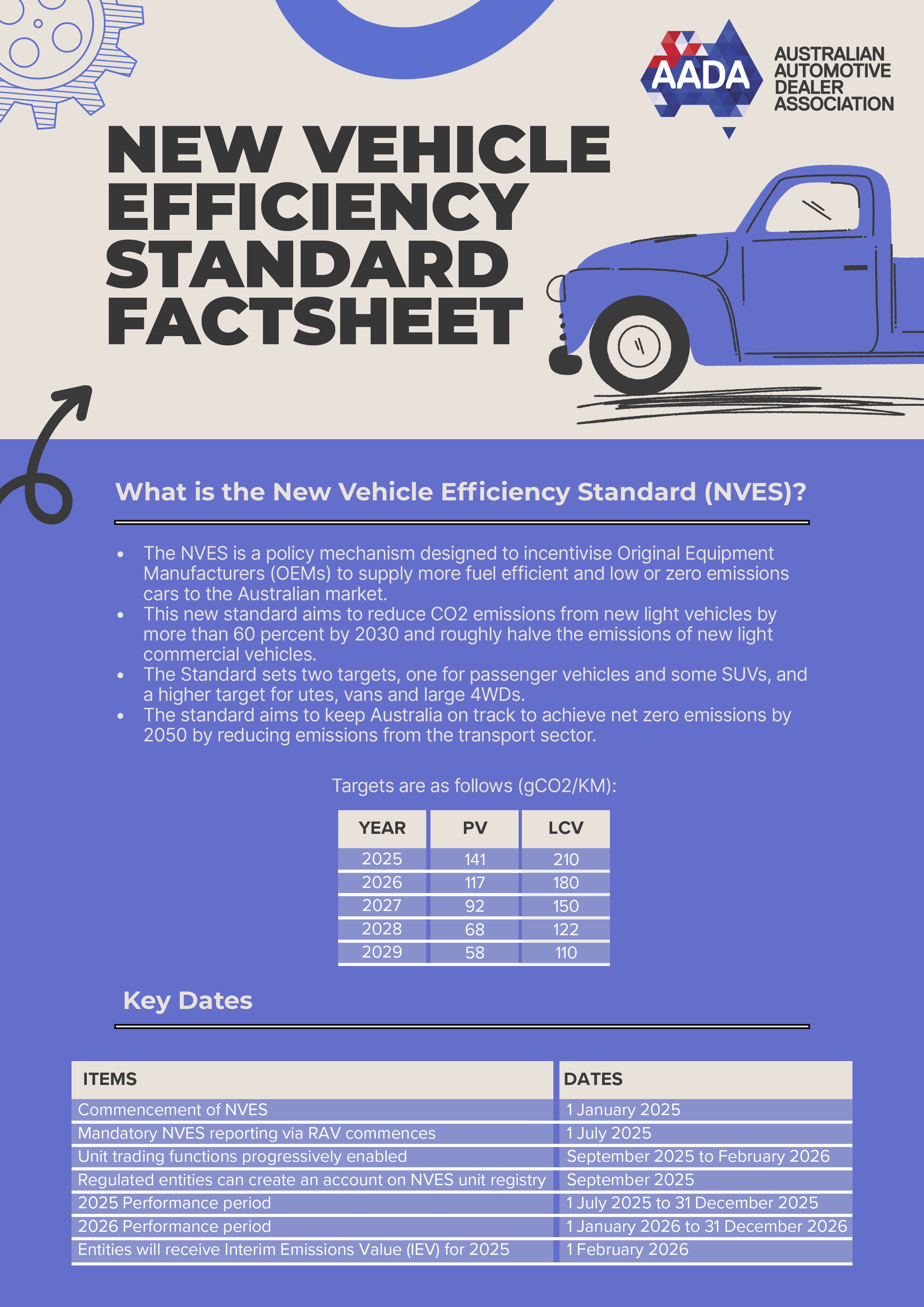
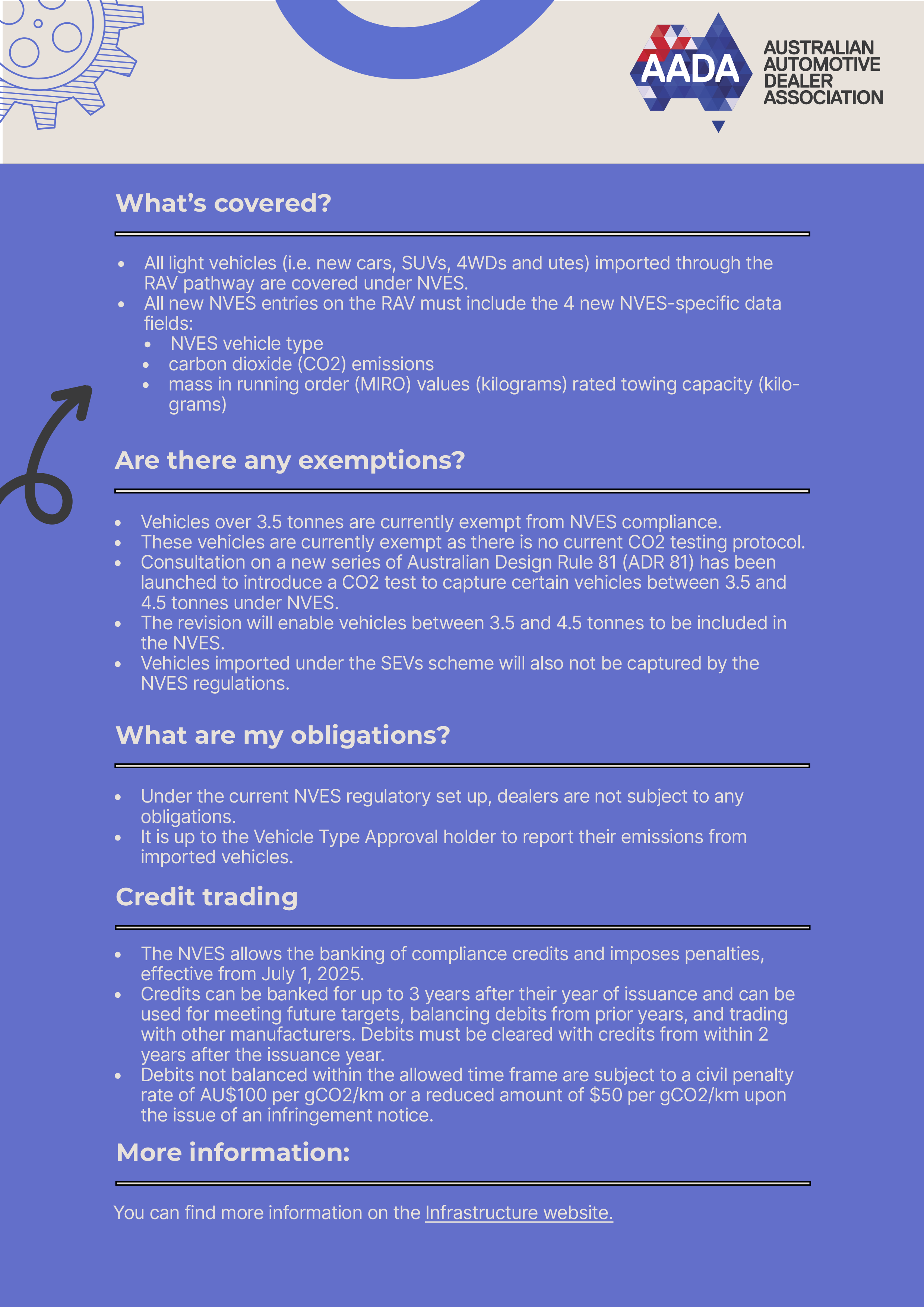

In anticipation of the commencement of the New Vehicle Efficiency Standard, the AADA has produced a fact sheet for members to understand key dates, how the NVES will work and dealer obligations.
The November edition of the Automotive Insight Report (AIR) indicates an ongoing cooling demand for used cars, with sales experiencing a decline of 2.3% to 197,652 compared to last month. In contrast, used car listings continue to grow, rising by 5.4% to 335,148 in November.
This trend is expected to persist as the introduction of more affordable new vehicles encourages buyers to upgrade earlier, increasing the supply of used cars and influencing price sensitivity.
The Northern Territory stands out among the states, with a tight market reflected by a 30.5% increase in sales and a 12.3% decline in listings.
Sales have declined across all fuel categories, with EVs experiencing the largest drop (down 8.3%), followed by PHEVs (down 7.4%). This could be attributed to the growing supply of cheaper new BEV and PHEV vehicles entering the market, expanding used-car inventory and driving up holding costs.
Retained values continue to steadily decline, with almost every vehicle segment across every age category experiencing a drop in value for the month, with the exception of passenger vehicles in 3-4 year old category. On the other hand, retained values of used EVs in the 5-year-old category have dropped to 48.5% (down 4.7% from last month) in November, reflecting the slowing demand for used EVs.
In the passenger segment, Audi RS3 retains value the most at 97.4% in the 2-4 year old category while the Toyota Yaris continues to lead at 95.3% in the 5-7 year-old category. In the SUV category, the Suzuki Jimny retains top spot in both the 2-4 year and 5-7 year old category at 111.3% and 110.1% respectively.
The average time to sell a used EV has decreased to 61.6 days, down from 67.3 days in the previous month. However, this remains considerably higher than earlier in the year when the days to sell ranged between the low to mid-50s. This can be linked to the rising supply of used EVs, as observed across all states but the Northern Territory, where supply is significantly outpacing demand, presenting consumers with more options.
HIGHLIGHTS FROM THE AIR FOR NOVEMBER
Dealers seeking more granular and local data can contact AutoGrab directly for a tailored solution.
If you are a Dealer of a contributing brand and would like access to the monthly report please email Policy and Communications Officer Urmika Deb on udeb@aada.asn.au.
On Tuesday the Government released the Core Skills Occupation List (CSOL), and importantly for the industry, automotive technician occupations of motor mechanic, diesel mechanic and automotive electrician were included in the list. This is a critical inclusion for the industry and acknowledges the pressing skills shortage across the automotive industry.
Skilled automotive technicians are in high demand, and their inclusions as part of the more than 450 eligible occupations, will apply under the Skills in Demand (subclass 482) visa and the Employer Nomination Scheme (subclass 186).
The AADA has continued to advocate that automotive occupations, which are in a critical shortage, must remain a training and employment priority, particularly in the midst of a changing automotive landscape with the increasing uptake of new vehicle technologies. This is essential to the continuing supply of trained automotive technicians and the operation of Dealership businesses to ensure consumers can access timely service and repairs on their vehicles.
Without a comprehensive plan to train new technicians and fill vacancies then vehicle servicing, personal transport and the wider automotive industry, would eventually grind to a halt.
The AADA will continue to engage with Jobs and Skills Australia to ensure the automotive industry has the workforce it needs for the future.
Parliament has recently passed the Anti-Money Laundering and Counter-Terrorism Financing (AML/CTF) Amendment Bill.
In addition to amending the AML/CTF Act, the Bill repeals the Financial Transaction Reports Act 1988 (FTR Act).
The FTR Act mostly affects solicitors and motor vehicle dealers who act as insurers or insurance intermediaries. This means obligations these businesses have under the FTR Act will end when the FTR Act is repealed.
The repeal will take effect 28 days after the AML/CTF Amendment Bill gains Royal Assent.
What this means for Dealers
At the moment, Dealers have obligations to submit transaction reports under the FTR Act which may include significant cash transaction reports (SCTRs) and suspect transaction reports (SUSTRs).
After the FTR Act is repealed, Dealers will not need to submit reports about transactions that occur on or after the repeal date. Dealers will still need to report transactions that occur before the repeal.
AUSTRAC recommends Dealers start preparing for the change now and should start reviewing their processes and standard operating procedures, and prepare their staff for the change.
This change does not affect any obligations that Dealers have under other legislation, such as the AML/CTF Act, and the AADA advises Dealers to seek their own advice regarding ongoing reporting obligations.
The Automotive Insight Report (AIR) for October saw another fall in used car sales, dropping by 3.2% to 202,355 compared to last month. Meanwhile, used car listings have grown by 1% to 317,861, indicating a buyers’ market as used car supply continues to outpace demand.
The average days to sell has increased to the highest point since December last year to 49 days, up from 46.4 days last month.
Across fuel types, petrol and diesel remain the top choice among buyers accounting for over 95% of all sales. However, consumer preferences are gradually shifting toward more fuel-efficient alternatives, driven by an expanding range of options and better affordability. Sales of conventional petrol and diesel vehicles have declined by 4.5% and 2.3%, respectively. In contrast, PHEVs remain the most popular choice, with EVs following closely – both categories experiencing significant sales increases of 27.1% and 22.3%, respectively.
In the states, used car sales declined everywhere except Victoria, which recorded a modest growth of 0.2%.
For the first time, the October AIR report includes a snapshot of Australia’s used EV market. This included a breakdown of EV sales across the states, which showed increases in listings and sales in every state except the Northern Territory. The average time to sell used EVs has increased to 67.3 days, up from a low point of 55 days in August. Turning to top EV makes and models, the MG4 EV was by far and away the best selling used EV in October, recording sales growth of almost 85% on the previous month and selling double the units of its next closest competitor.
Retained values remain on a downward trajectory with every vehicle segment across every age category experiencing a drop in value for the month. Retained values of used EVs in the 1-3 year old category have declined while the older models appear to hold their value better.
Small vehicles in the passenger segment maintain their lead in strongest value retention, with the Kia Picanto replacing the Audi RS3 from last month, at 95.6% in the 2-4 category. The Toyota Yaris remains unbeatable in the 5-7 year old category at 95.4%. In the SUV category, the Suzuki Jimny continues to lead in the 2-4 year category at 113.4% while regaining top position in 5-7 year old category at 114.0%.
HIGHLIGHTS FROM THE AIR FOR OCTOBER
Dealers seeking more granular and local data can contact AutoGrab directly for a tailored solution.
If you are a Dealer of a contributing brand and would like access to the monthly report please email Policy and Communications Officer Urmika Deb on udeb@aada.asn.au.
AADA encourages all women working in the automotive industry to participate in the Women in Automotive Global Industry Study.
The survey will assist in creating a more inclusive and equitable automotive sector with the insights being used to generate Deloitte’s Women in Automotive Report, launching in early 2025.
This initiative will provide data to better understand the unique challenges and opportunities facing women in the industry and try to help create a more inclusive environment for all.
The survey takes just 15 minutes to complete and will explore:
The Automotive Insight Report (AIR) for September shows a modest uptick in used car sales, while used car listings continued to increase continuing a trend of month-on-month increases in listings since May.
Listings of used cars increased by 5.2% to 314,672 while sales increased by 1% to 209,102.
The average days to sell has increased to 46.4, the highest it has been since January. This suggests that sellers are feeling the impact of a growing used vehicle supply, and with retained values dropping, it’s an ideal time for motivated buyers to secure a deal in this market.
Supply has increased in every state except the Northern Territory, however demand for used vehicles is a mixed bag, with some states recording substantial decreases (ACT down 11.2%) and others recording moderate increases (NSW up 3.5%).
Sales of used EVs have surged by 17.3% compared to last month, marking the highest monthly increase observed this year. However, EVs are still the most oversupplied fuel type, a trend further compounded by a 23% increase in EV listings in September.
Retained values continue to fall, with almost every vehicle segment across every age category experiencing a drop in value for the month. With more granular retained values data released this month, it is evident that Utes hold their value best at the two-year mark but are quickly surpassed by passenger vehicles in the 3-7 year age range.
Small vehicles in the passenger segment continue to demonstrate the strongest value retention, with the Audi RS3 claiming the top position at 101.9% in the 2-4 category, breaking Toyota’s longstanding reign. However, the Toyota Yaris maintains the lead at 94.7% in the 5-7 year old category. In the SUV category, the Suzuki Jimny remains dominant in the 2-4 year old category at 113.0%, while the Toyota Land Cruiser has taken the top spot in the 5-7 year-old segment at 88.3%.
HIGHLIGHTS FROM THE AIR FOR SEPTEMBER
Dealers seeking more granular and local data can contact AutoGrab directly for a tailored solution.
If you are a Dealer of a contributing brand and would like access to the monthly report please email Policy and Communications Officer Urmika Deb on udeb@aada.asn.au.
The Federal Government has opened a consultation seeking views on the exposure draft of the Competition and Consumer (Industry Code‑Franchising) Regulations 2024.
The draft regulations remake the Franchising Code of Conduct to implement the Government response to the Independent Review of the Franchising Code of Conduct and also make amendments to update and clarify various provisions.
Earlier this year the Government responded to the Review and agreed with or in principle with all 23 recommendations made by Dr Michael Schaper in his report.
Key changes in the Code for franchised new vehicle dealers are:
The Schaper Review also recommended that the Government look into the feasibility of introducing a licensing regime for the franchising sector. The Government agreed with this recommendation in its response and this week, notified the AADA that in coming weeks, the Taskforce will publish a discussion paper and invite submissions as part of this process.
The AADA has made it clear to the Government that neither the Schaper Review nor the Government response goes far enough to protect franchised Dealers from predatory franchisors. We are continuing to pursue further protections to level the playing field between Dealers and OEMs.
The AADA will be making a comprehensive response to both consultations and if members have any specific areas of concern or comments you would like the AADA to make, please advise the Secretariat by 24 October 2024.
You can view the Exposure Draft, Explanatory Statement and Information paper below.
AADA Dealer members in Victoria, who are also members of the VACC, should be aware that the election period for the 2024 VACC Executive Board is set to commence on October 10 and will close on 15 November 2024.
There are two franchised new car Dealer candidates running in the election, Sid Cetindag and Paul Hopper.
The VACC is among the most powerful automotive advocacy bodies in Australia and it has a very active Dealer Division, VADA, which works tirelessly for Dealer members in the state of Victoria.
AADA would urge all eligible Victorian Dealer members to consider voting in support of the two Dealer candidates standing for Executive Board positions. Please also note that some Dealers are entitled to more than one vote based on their membership arrangements, so you may want to check this for yourself if you think this applies to your organisation.
Dealers should have received voting forms in the mail. If you have not received them and wish to vote, please contact the VACC.
The AADA has sought and obtained guidance for Dealers with regard to the obligations Dealers
and manufacturers have when handling consumer guarantee claims under the Australian
Consumer Law.
The attached guidance also clarifies the indemnity obligations the Dealers have with
manufacturers.
This Bulletin has been prepared with the assistance of HWL Ebsworth Lawyers and is provided
for information purposes only. It is not intended to be legal advice given by AADA or HWL
Ebsworth to be relied upon by dealers. Dealers should obtain independent legal advice if they
have any queries in respect of their rights and obligations under the ACL, including against
manufacturers and distributors.
We would strongly advise all Dealers to read and understand the attached guidance.