
New AADA research finds cheaper running costs have overtaken environmental concerns as the number one reason Australians would consider an electric vehicle, as Chinese brands continue to gain a larger market share.
Australians are increasingly viewing electric vehicles as a way to save money rather than save the planet, according to new research released by the Australian Automotive Dealer Association (AADA).
AADA’s latest national consumer research has found that cheaper running and recharging costs are now the leading reason Australians would consider purchasing an electric vehicle (EV), overtaking environmental benefits from January this year and for the first time since the AADA began tracking consumer sentiment more than four years ago.
AADA CEO James Voortman will present the new research findings to more than 900 dealers and automotive stakeholders at the AADA Convention & Expo in Sydney today.
“This is one of the most significant shifts we have seen since AADA began tracking EV sentiment,” Mr. Voortman said. “For years, Australians considered EVs primarily for their environmental benefits. Today, the biggest attraction is their lower running and recharging costs compared with petrol or diesel vehicles.”
The research found that 45 per cent of prospective EV buyers nominate lower running and charging costs as a reason for considering an EV, making it the most important driver of future EV interest. At the same time, environmental motivations have continued to decline significantly.
“The conflict in Iran and renewed concerns around global energy markets have focused attention on fuel affordability and fuel security,” Mr. Voortman said. “Australians are increasingly viewing EVs through a practical financial lens rather than an environmental one.”
The study found that 55 per cent of Australians agree rising petrol and diesel prices make EVs more attractive, while EV consideration increased to 41 per cent of Australian drivers.
Australia’s automotive market is also undergoing unprecedented change. Australia is expected to have 67 vehicle brands competing in the market in 2026, rising to 75 brands by 2031 as manufacturers compete for a share of the growing EV market.
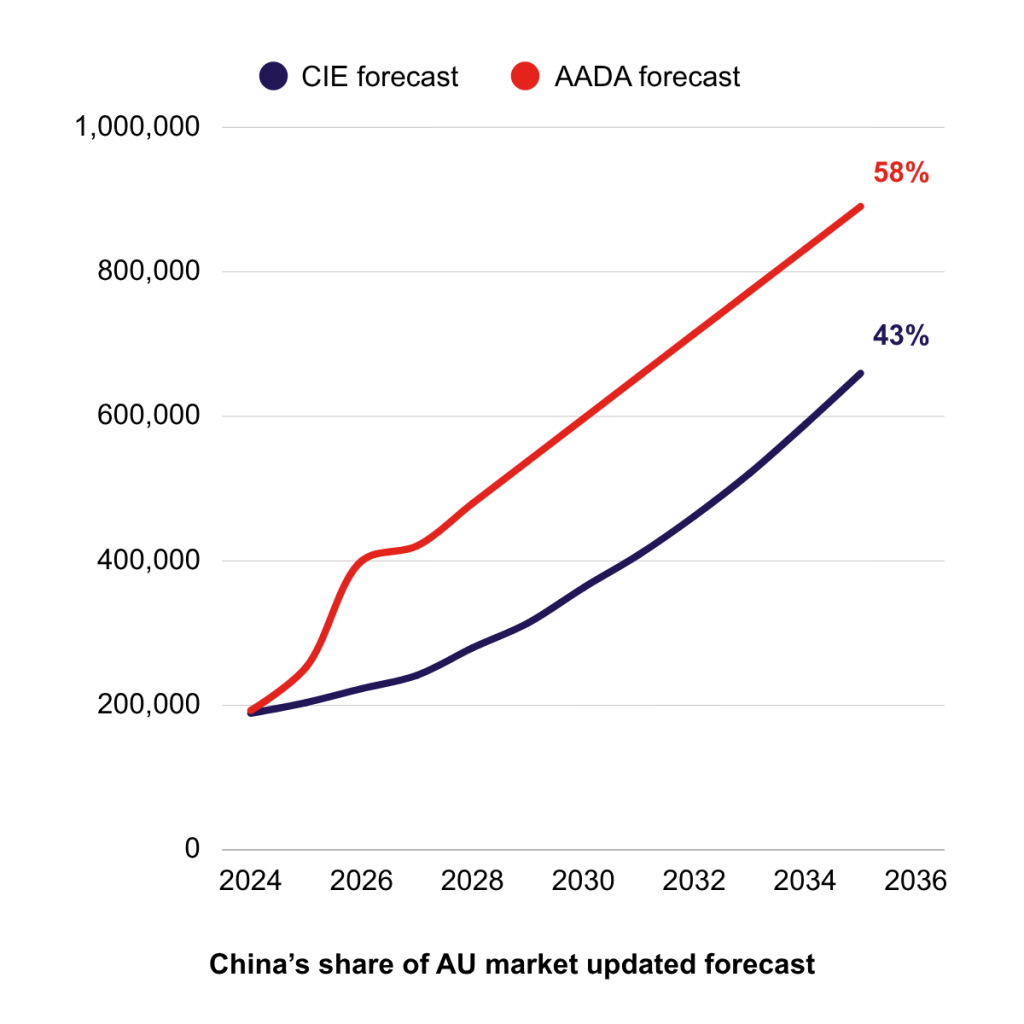
“The June new vehicle sales results show the transition is occurring more quickly than previously forecast, particularly for Chinese manufacturers,” Mr. Voortman said. “Based on recent sales trends, the AADA expects China to account for an even larger share of Australia’s new car market, reaching around 58 per cent by 2035, thereby exceeding previous estimates.”
“The Australian automotive market is undergoing the most significant transformation in its history,” Mr. Voortman said. “Consumer preferences are changing, technology is evolving, and new brands are entering the market at an extraordinary rate. More than 900 industry leaders will gather at the AADA Convention & Expo this week to discuss these trends and what they mean for dealers, manufacturers and consumers.”
“As this transformation accelerates, the Albanese Government must ensure the regulatory framework keeps pace. That means delivering stronger franchising protections for Australian new car dealers and modernising Australian consumer laws to ensure drivers remain protected as new brands enter the market. The pace of change is accelerating, and the policy settings that underpin consumer confidence, dealer investment and long-term market sustainability must evolve just as quickly.”