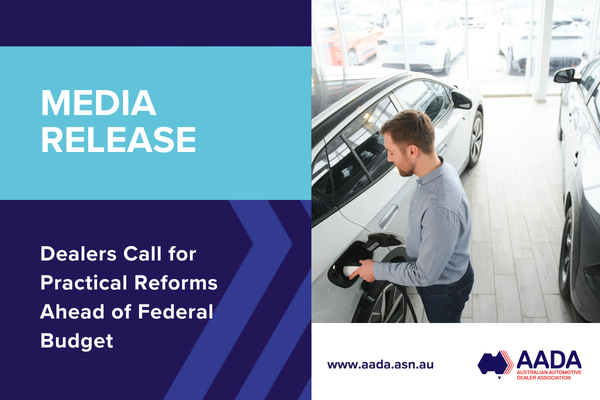
Dealers Call for Practical Reforms Ahead of Federal Budget

The Australian Automotive Dealer Association (AADA) has used its 2026–27 Pre-Budget Submission to call for a series of targeted, low-cost reforms to improve efficiency and fairness, and support the transition to electric vehicles across Australia’s automotive retail sector in challenging economic times.

With more than 3,900 new car dealerships nationwide, the AADA says the upcoming Federal Budget presents a key opportunity to address regulatory bottlenecks and ensure policy settings reflect the realities of the retail automotive industry.

The AADA is calling on the Albanese Government to expedite commitments to reform franchising protections for Australia’s new car dealers. Australia’s franchising framework, with longstanding power imbalances between dealers and multinational manufacturers, is currently not appropriate to respond to the current pace of the transition to electric vehicles. With the introduction of many new brands in the Australian market, this poses many risks to businesses, consumers and the transition to low emission vehicles without proper protections in an open market such as Australia.

“Franchised dealers operate in a system where the balance of power is heavily weighted towards global manufacturers,” an AADA spokesperson said.

“Strengthening protections against unfair trading practices and extending unfair contract terms laws to all franchisees are critical steps to ensuring a fair and sustainable operating environment.”

The submission is also calling for an expansion of the Government’s Dealership and Repairer Initiative for Vehicle Electrification Nationally (DRIVEN) program to better support dealers on the frontline of Australia’s EV transition.

“Expanding this program presents an opportunity to better meet the demands of the surge in low emission vehicle purchases in recent months,” the spokesperson said.

“Dealers are the primary point of contact for consumers, and targeted investment in infrastructure, training and education at the dealership level will be critical to sustaining momentum in EV uptake.”

Another key priority is improving the operation of the Personal Property Securities Register (PPSR), where delays in removing finance encumbrances are creating unnecessary costs and holding up vehicle sales.

“Delays in clearing PPSR registrations are a daily frustration for dealers and consumers alike.”

“Our data shows 71 per cent of dealers using the system experience delays beyond the mandated five-day timeframe, which creates avoidable inefficiencies and slows down transactions.”

“This is a simple fix – ensuring timely removal of registrations and reviewing repeat search fees would deliver immediate productivity gains across the industry.”

“This is about getting the policy settings right and removing friction where it exists. The AADA believes the budget should be backing the businesses that are delivering for Australian consumers every day.”

The New Morrison Ministry

The Prime Minister has made a number of changes to the Ministry that he took to the recent election, but overall the frontbench resembles one of consistency and continuity. While the new Administrative Arrangements Order is out, it is still unclear how the various responsibilities will be split between principal ministers and their assistant minister. The portfolios of most direct influence on areas of AADA interest include the following:

The Deputy Prime Minister Michael McCormack retains the Infrastructure, Transport and Regional Development portfolio. As such he will continue carriage of the implementation of the Road Vehicle Standards Act, although this is likely to be the operational responsibility of Andrew Gee as Assistant Minister to the Deputy Prime Minister.

Karen Andrews remains as Minister for Industry Science and Technology, with the ongoing responsibility to develop a mandatory Automotive Industry Code.

Simon Birmingham, as Minister for Trade, Tourism and Investment will be instrumental in the negotiations surrounding a potential free trade agreement with the European Union. If concluded, this agreement is expected to signal the end of Vehicle Import Tariffs and may also result in the abolishing of the LCT, a revenue measure that is widely seen as a non-tariff barrier to trade.

Michael Sukkar returns to the Ministry as Assistant Treasurer. The AADA has had a very successful relationship with Minister Sukkar in the past, and we look forward to working with him on issues relating to mandatory sharing of Service and Repair information.

Jane Hume has been appointed as the Assistant Minister for Superannuation, Financial Services and Financial Technology. As part of her Financial Services responsibility she is likely to be responsible for the implementation of the recommendations of the Financial Services Royal Commission, including the abolition of the Point of Sale Exemption.

Angus Taylor returns as Minister for Energy, with the added responsibility for emissions reduction. We have worked closely with Minister Taylor in the past and look forward to doing so again throughout this Parliament, particularly on issues relating to vehicle emission and electric vehicles.

Michaelia Cash has been allocated the enlarged portfolio of Employment, Skills, Small and Family Business. We look forward to working with her and her office on the outcomes of the recent parliamentary inquiry into franchising.

The Shadow Ministry led by newly appointed Opposition Leader Anthony Albanese is yet to be revealed. Nevertheless, there are already indications of significant changes to the economic team within the Opposition ranks.

Federal Election Policy Implications

The 2019 Federal Election has passed and in a result none of the national opinion polls predicted, Prime Minister Scott Morrison’s Coalition Government has won a majority victory. The result has implications for franchised new car Dealers on a number of policy fronts. Below is a brief summary on the implications for some of our key policy areas. Rest assured the AADA secretariat is working with our members and Government to achieve the best possible outcome on all of these issues.

On the Automotive Code the AADA has been calling for, there is little change to the way forward. The AADA worked hard to win bi-partisan support for this crucial policy and the current government has already started work in this area through the development of a Regulatory Impact Statement (RIS). We will be working hard to ensure that this work is finalised by the Minister for Industry Innovation and Science, Karen Andrews.

Another area which is largely unaffected by the election result is the inevitable regulation on the sharing of service and repair information. A draft regulation was close to being finalised before the election was called and the AADA expects that this will gain some momentum in this new term of government.

The changes being proposed to the Australian Consumer Law (ACL), and in particular a proposedLemon Law, are less likely to sail through the Consumer Affairs forum of state and territory ministers given the Coalition’s recent wins federally and in New South Wales. Regardless, the possibility of a Lemon Law cannot be ruled out especially as State Government’s may seek to legislate them independently of the Commonwealth.

There is little change to the Tax Regime for new vehicles following the election. There is an argument that the Coalition is more likely to conclude Free Trade Agreements with the EU and the UK, presenting the best opportunity for the removal of the Luxury Car Tax (LCT) and the Passenger Vehicle Import Tariff. The AADA will also be urging the Federal Government to use its influence to reign in State Governments which are implementing state-based LCTs.

In the finance and insurance space, the Coalition victory is undoubtedly better for the industry. While both Labor and the Coalition have said they will adopt the Financial Services Royal Commission’s recommendation to abolish the Point of Sale exemption, the Coalition committed to a thorough process which considers the impact on business whereas Labor said they would make the change immediately.

Finally, there was a clear contrast in policies on vehicle emissions. Labor committed to a CO2 standard of 105g/km and an electric vehicle target of 50 per cent of new car sales by 2030. The Coalition has no plans to introduce a CO2 standard and has said it will release an Electric Vehicle Strategy at some stage in 2020.

Victoria Budget 2019-20

The Victorian Budget brought down on 26 May increases vehicle duty rates for more expensive passenger vehicles. As of 1 July 2019, motor vehicle duty for used vehicles valued above the LCT threshold will be aligned with the rates for new cars. The Budget also introduces two additional duty rate increases for vehicles above $100,000 and above $150,000. The new rates are as follow:

Valued up to $66,331  $8.40 per $200 or part thereof
  Valued over $66,331, up to $100,000  $10.40 per $200 or part thereof
  Valued from $100,001 to $150,000  $14.00 per $200 or part thereof
  Valued from $150,001  $18.00 per $200 or part thereof

Low emission vehicles (below 120 g/km) and those owned by primary producers for the purpose of primary production will be exempt from the LCT rates, and thus will only pay the lowest rate of vehicle duty. This exemption also extends to caravans and motorhomes.

Because of the way the vehicle duty is applied on the value or purchase price, whichever is higher, this increase in vehicle duty is actually a tax on a tax on a tax, as it is applied after the GST, and then the federal LCT are added to the basic cost of the vehicle. This makes the Victorian vehicle duty particularly unfair.

The imposition of these new rates of duty has been met with dismay by the industry as it comes after thirteen months of worsening new car sales. The media has been quick to pick up on the unfairness of the measure, including a front-page article on the Australian Financial Review.

The AADA has sought a meeting with Tim Pallas MLA, the Victorian Treasurer, to discuss the measure and its negative effect on the nearly 1,500 of our members operating in Victoria. We have also sought meetings with the Federal Government, to highlight the impact that this measure could have on the sensitive negotiations surrounding the Free Trade Agreement with the European Union, and the bargaining taking place with respect to both the LCT and the Vehicle Importation Tariffs. We believe that these matters, particularly the potential for other states introducing similar measures in their budgets, should be addressed through COAG.

Not everything in the Victorian Budget was a negative to the industry. For new car Dealers, the exemption to paying vehicle duty has been extended to cover service loan vehicles, as a national first. On a broader canvas, the Government has pledged to increase the monthly payroll threshold for Payroll Tax from $650,000 to $700,000 by 2023. Additionally, the rate of payroll tax has been significantly reduced for regional businesses, from 2.4% to 1.3% by 2022-23. This means that by that year, the rate of payroll tax in the regions will be one quarter of the 4.85% paid by businesses in the metropolitan area. We expect that many of our regional members will be among the 3,500 regional businesses that will benefit from this measure.

Automotive Industry Code – Update

The AADA’s push for an Automotive Industry Code has gathered pace as the Government used Mid-Year Economic and Fiscal Outlook (MYEFO) to announce funding for the purpose of developing an Automotive Industry Code of Conduct. As part of this work the Department of Industry, Innovation and Science has prepared a Regulation Impact Statement (RIS) to consider how best to address new car Dealers’ concerns with their franchising relationships with car manufacturers. The AADA has already held a consultation session with the Department and will be attending an industry workshop on the RIS in the coming weeks. We will also be finalising our submission by 13 February.

We now have commitments from the Government and the Opposition as well as support from the Small Business and Family Enterprise Ombudsman, the Franchising Council of Australia and most industry bodies in the Automotive sector. Furthermore, AADA is hopeful that the parliamentary inquiry into franchising will also support an Automotive code when it is released next month. While there is much work to be done, we have made significant progress over the past 12 months.